Civility Quote by Slavoj Žižek
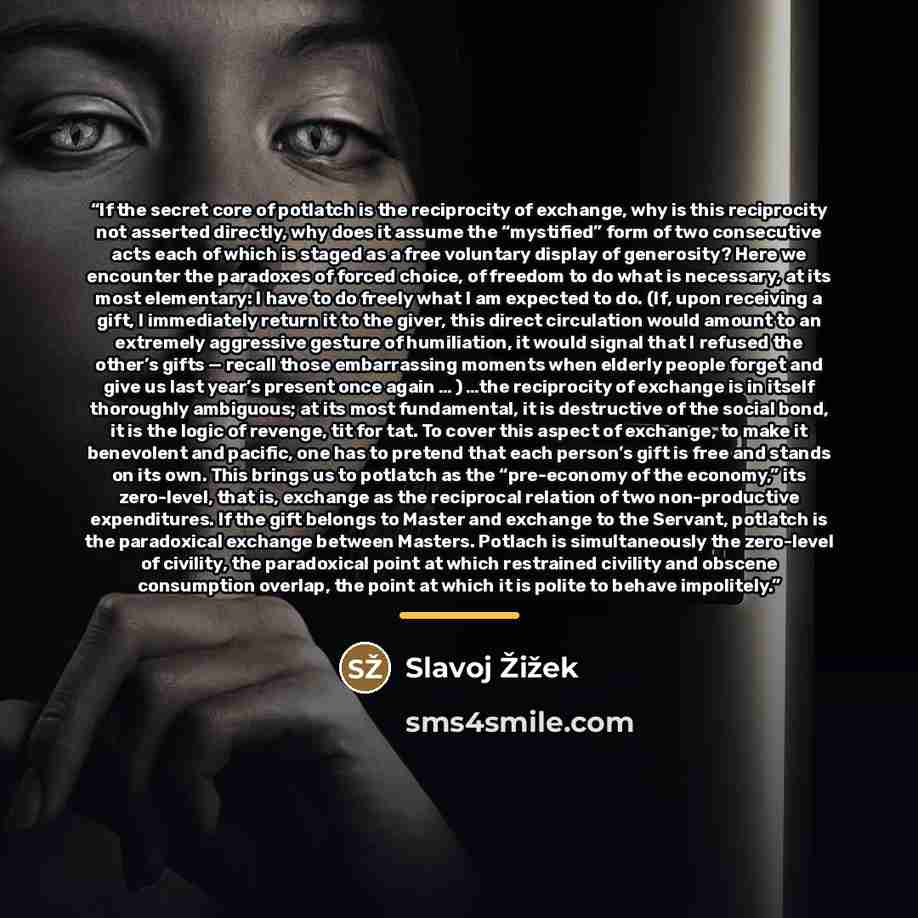
““If the secret core of potlatch is the reciprocity of exchange, why is this reciprocity not asserted directly, why does it assume the “mystified” form of two consecutive acts each of which is staged as a free voluntary display of generosity? Here we encounter the paradoxes of forced choice, of freedom to do what is necessary, at its most elementary: I have to do freely what I am expected to do. (If, upon receiving a gift, I immediately return it to the giver, this direct circulation would amount to an extremely aggressive gesture of humiliation, it would signal that I refused the other’s gifts — recall those embarrassing moments when elderly people forget and give us last year’s present once again … ) …the reciprocity of exchange is in itself thoroughly ambiguous; at its most fundamental, it is destructive of the social bond, it is the logic of revenge, tit for tat. To cover this aspect of exchange, to make it benevolent and pacific, one has to pretend that each person’s gift is free and stands on its own. This brings us to potlatch as the “pre-economy of the economy,” its zero-level, that is, exchange as the reciprocal relation of two non-productive expenditures. If the gift belongs to Master and exchange to the Servant, potlatch is the paradoxical exchange between Masters. Potlach is simultaneously the zero-level of civility, the paradoxical point at which restrained civility and obscene consumption overlap, the point at which it is polite to behave impolitely.””
About This Quote
Source Book: The Paradox of Gift Exchange, 2018
Potlatch disguises forced reciprocity as voluntary generosity, masking underlying power dynamics and social tension.
In simple terms: Gift exchange hides power struggles behind free giving.
Key Takeaway
Recognize hidden motives in reciprocal exchanges.
Themes
anthropology
economics
power
ritual
Mood
critical
analytical
Type
philosophical
inspirational
When to use this quote
- corporate negotiations
- family traditions
- cultural festivals
- political diplomacy
Key Concepts
reciprocity theory
social exchange
symbolic interaction
Questions to Reflect On
- What motives drive your own gift-giving?
- Can generosity be truly free?
A Different Perspective
The model may oversimplify complex motivations; not all exchanges are manipulative.