Arabic language Quote by Shaykh Muhammad Zakariyya Kandhlawi
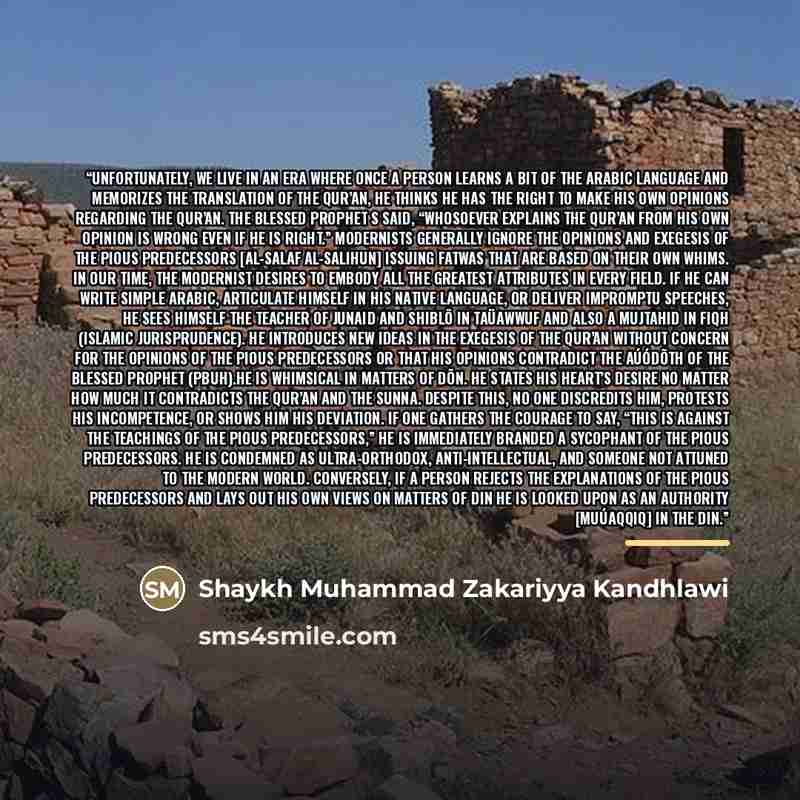
““Unfortunately, we live in an era where once a person learns a bit of the Arabic language and memorizes the translation of the Qur’an, he thinks he has the right to make his own opinions regarding the Qur’an. The Blessed Prophet s said, “Whosoever explains the Qur’an from his own opinion is wrong even if he is right.” Modernists generally ignore the opinions and exegesis of the pious predecessors [al-salaf al-salihun] issuing fatwas that are based on their own whims. In our time, the modernist desires to embody all the greatest attributes in every field. If he can write simple Arabic, articulate himself in his native language, or deliver impromptu speeches, he sees himself the teacher of Junaid and Shiblõ in Taüawwuf and also a mujtahid in fiqh (Islamic jurisprudence). He introduces new ideas in the exegesis of the Qur’an without concern for the opinions of the pious predecessors or that his opinions contradict the aúódõth of the Blessed Prophet (PBUH).He is whimsical in matters of Dõn. He states his heart’s desire no matter how much it contradicts the Qur’an and the Sunna. Despite this, no one discredits him, protests his incompetence, or shows him his deviation. If one gathers the courage to say, “This is against the teachings of the pious predecessors,” he is immediately branded a sycophant of the pious predecessors. He is condemned as ultra-orthodox, anti-intellectual, and someone not attuned to the modern world. Conversely, if a person rejects the explanations of the pious predecessors and lays out his own views on matters of Din he is looked upon as an authority [muúaqqiq] in the Din.””
About This Quote
Superficial religious learning leads to self‑appointed authority, ignoring traditional scholarship.
In simple terms: Shallow learning creates false authority.
Key Takeaway
Prioritize deep, traditional study.
Themes
religion
authority
tradition
interpretation
knowledge
Mood
serious
reflective
Type
Arabic language:1
Koran:1
Modern world:0
Native language:0
Qur Opinion:0
Qur Thinks:0
Contradicts Qur:0
Explains Qur:0
Qur Concern:0
When to use this quote
- religious education
- community leadership
- interfaith dialogue
Key Concepts
Islamic jurisprudence
scholarly humility
critical thinking
Questions to Reflect On
- How to balance tradition and modern insight?
- What safeguards prevent misinterpretation?
A Different Perspective
Modernism may bring innovation.