American identity Quote by Roxanne Dunbar-Ortiz
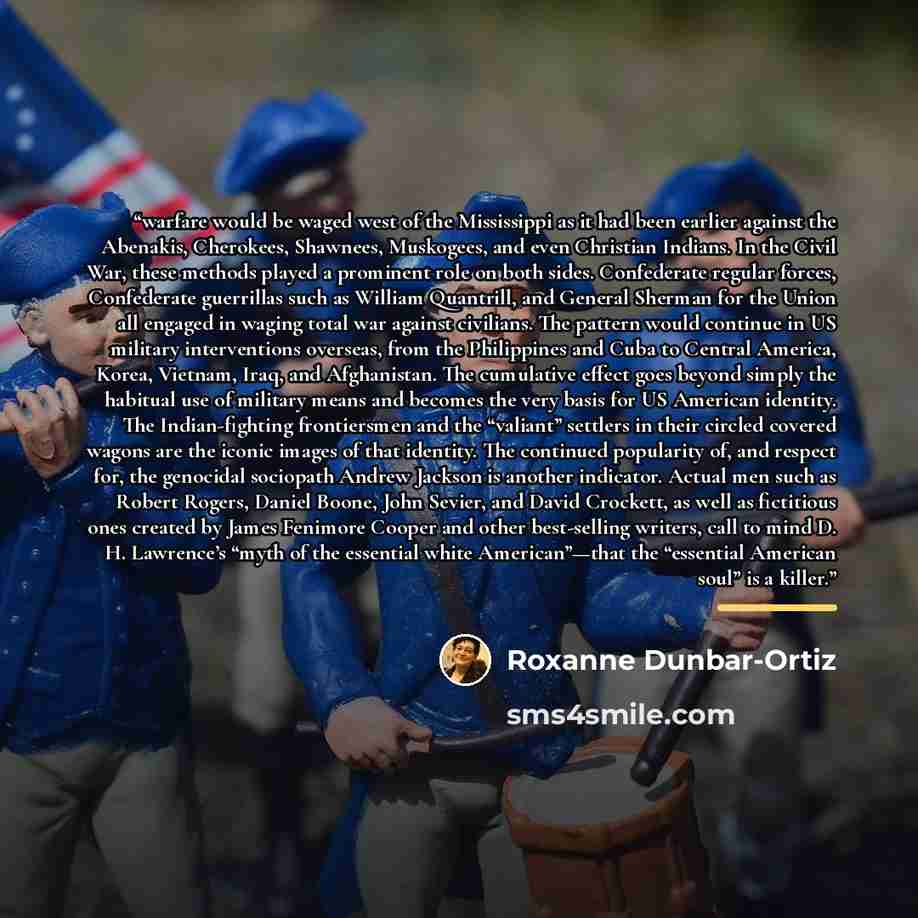
““warfare would be waged west of the Mississippi as it had been earlier against the Abenakis, Cherokees, Shawnees, Muskogees, and even Christian Indians. In the Civil War, these methods played a prominent role on both sides. Confederate regular forces, Confederate guerrillas such as William Quantrill, and General Sherman for the Union all engaged in waging total war against civilians. The pattern would continue in US military interventions overseas, from the Philippines and Cuba to Central America, Korea, Vietnam, Iraq, and Afghanistan. The cumulative effect goes beyond simply the habitual use of military means and becomes the very basis for US American identity. The Indian-fighting frontiersmen and the “valiant” settlers in their circled covered wagons are the iconic images of that identity. The continued popularity of, and respect for, the genocidal sociopath Andrew Jackson is another indicator. Actual men such as Robert Rogers, Daniel Boone, John Sevier, and David Crockett, as well as fictitious ones created by James Fenimore Cooper and other best-selling writers, call to mind D. H. Lawrence’s “myth of the essential white American”—that the “essential American soul” is a killer.””
About This Quote
Source Book: An Indigenous Peoples’ History of the United States, 2014
U.S. military actions have historically targeted civilians, shaping a national identity rooted in violence and conquest.
In simple terms: American identity built on violent expansion.
Key Takeaway
Question the violent foundations of national identity.
Themes
history
colonialism
military
identity
Mood
critical
somber
Type
historical
political
When to use this quote
- education curricula
- policy debates
- public memorials
- media analysis
Key Concepts
imperialism
genocide
mythmaking
Questions to Reflect On
- How does this perspective change your view of American history?
- What steps can address these violent legacies?
A Different Perspective
Complex histories may be oversimplified; narratives can be contested.


![“How will the family unit be destroyed? ...[T]he demand alone will throw the whole ideology of the family into question, so that women can begin establishing a community of work with each other and we can fight collectively. Women will feel freer to leave their husbands and become economically…” quote by Roxanne Dunbar-Ortiz](https://sms4smile.com/quotes/img-quotes/046/roxanne-dunbar-ortiz-24305_community_how-will-the-family-unit-be-destroyed-t_1560275.jpg)

![“It [9/11 tragedy] has affected us on so many levels: economically, morally, spiritually, ethically. It's been all over the place. A new American identity emerged - we now live in a very different America. This is the power of the definitive event.” quote by Porochista Khakpour](https://sms4smile.com/quotes/img-quotes/3b7/porochista-khakpour-20047_affected_it-9-11-tragedy-has-affected-us-on-so-ma_821622.jpg)