Books Quote by Ronald Carter
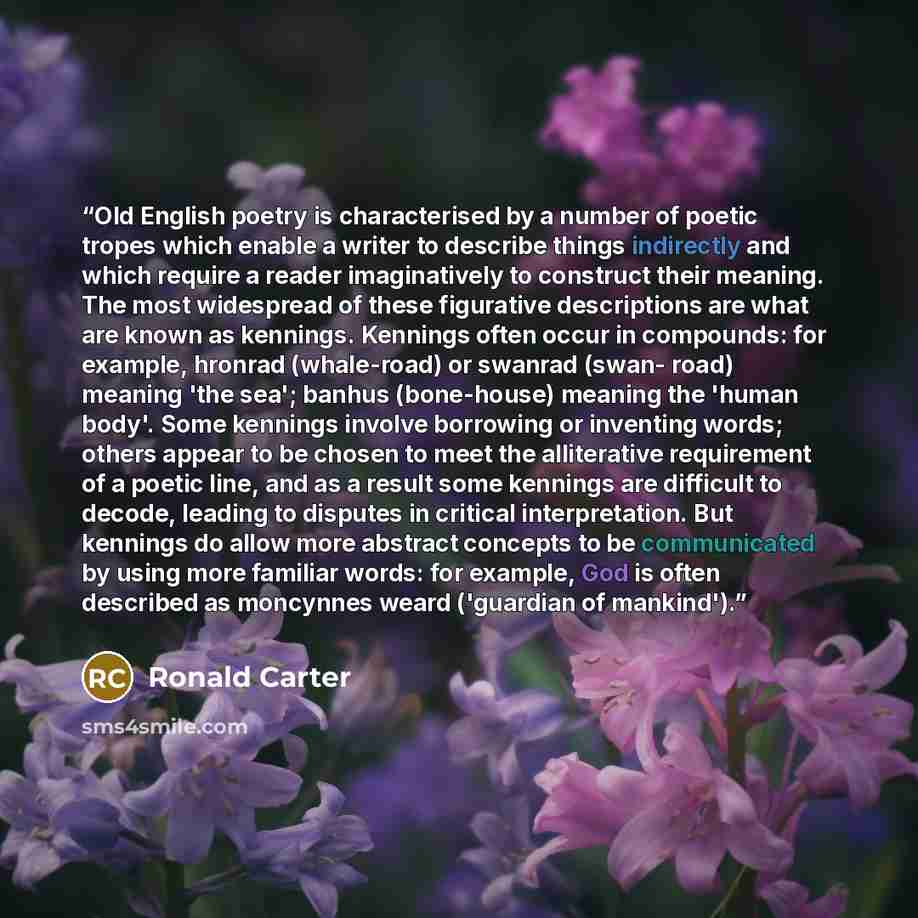
““Old English poetry is characterised by a number of poetic tropes which enable a writer to describe things indirectly and which require a reader imaginatively to construct their meaning. The most widespread of these figurative descriptions are what are known as kennings. Kennings often occur in compounds: for example, hronrad (whale-road) or swanrad (swan- road) meaning 'the sea'; banhus (bone-house) meaning the 'human body'. Some kennings involve borrowing or inventing words; others appear to be chosen to meet the alliterative requirement of a poetic line, and as a result some kennings are difficult to decode, leading to disputes in critical interpretation. But kennings do allow more abstract concepts to be communicated by using more familiar words: for example, God is often described as moncynnes weard ('guardian of mankind').””
About This Quote
Source Book: A History of Old English Literature, Ronald Carter, 1991
Kennings are metaphorical compounds that let poets describe concepts indirectly, requiring readers to infer meaning creatively.
In simple terms: Kennings use familiar words to hint at other ideas.
Key Takeaway
Interpret figurative language carefully.
Themes
poetry
language
metaphor
interpretation
alliteration
Mood
thoughtful
analytical
Type
literary
educational
When to use this quote
- literary analysis
- translation
- creative writing
- teaching ancient literature
Key Concepts
kenning
compound metaphor
semantic inference
Questions to Reflect On
- How do kennings shape our understanding of Old English culture?
- What challenges arise when translating kennings?
A Different Perspective
Kennings can be obscure, leading to misinterpretation.

![“[Poetry] is a field where England can take on all challengers.” quote by Patrick Leigh Fermor](https://sms4smile.com/quotes/img-quotes/09e/patrick-leigh-fermor-42052_english-poetry_poetry-is-a-field-where-england-can-take_1895074.jpg)