Books Quote by Robert Spencer
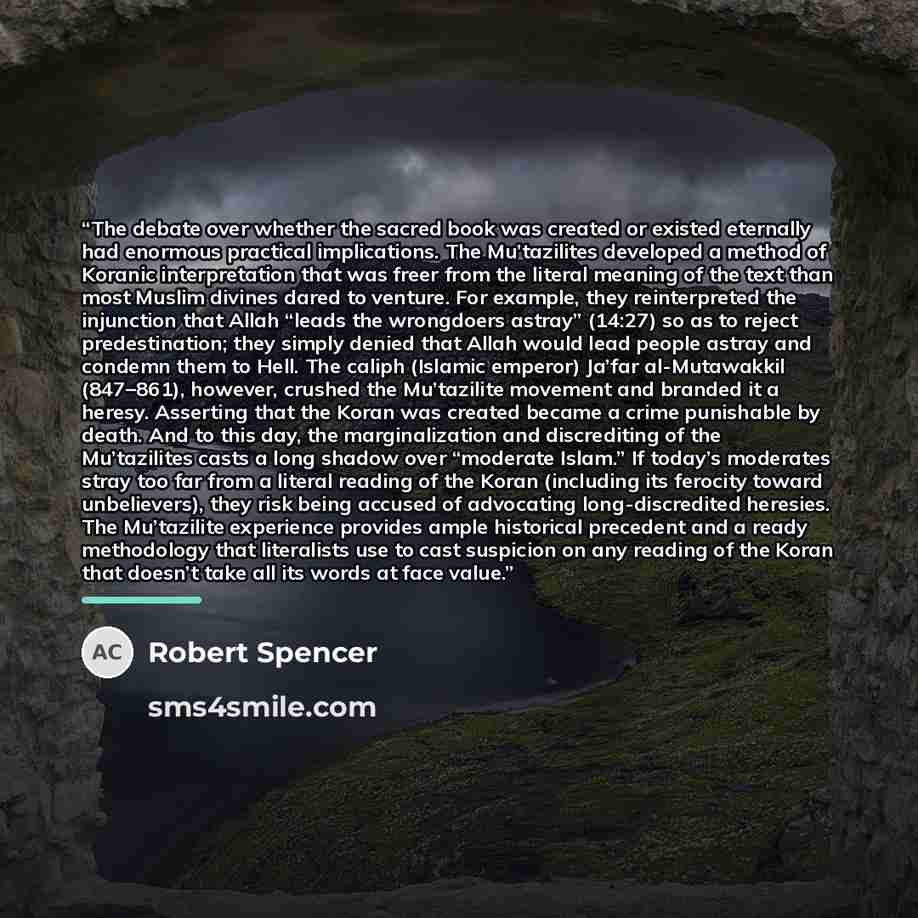
““The debate over whether the sacred book was created or existed eternally had enormous practical implications. The Mu’tazilites developed a method of Koranic interpretation that was freer from the literal meaning of the text than most Muslim divines dared to venture. For example, they reinterpreted the injunction that Allah “leads the wrongdoers astray” (14:27) so as to reject predestination; they simply denied that Allah would lead people astray and condemn them to Hell. The caliph (Islamic emperor) Ja’far al-Mutawakkil (847–861), however, crushed the Mu’tazilite movement and branded it a heresy. Asserting that the Koran was created became a crime punishable by death. And to this day, the marginalization and discrediting of the Mu’tazilites casts a long shadow over “moderate Islam.” If today’s moderates stray too far from a literal reading of the Koran (including its ferocity toward unbelievers), they risk being accused of advocating long-discredited heresies. The Mu’tazilite experience provides ample historical precedent and a ready methodology that literalists use to cast suspicion on any reading of the Koran that doesn’t take all its words at face value.””
About This Quote
Source Book: The Rise of Islamic Fundamentalism by Robert Spencer, 2003
The debate over the Qur'an’s origin shaped interpretive freedom; Mu’tazilites advocated a rational, non‑literal reading, but were suppressed, leaving a legacy that still limits moderate approaches.
In simple terms: Historical clash over Qur’an’s origin limits interpretive freedom.
Key Takeaway
Recognize how doctrinal control restricts theological openness.
Themes
theology
interpretation
history
politics
freedom of thought
Mood
reflective
critical
inquisitive
Type
analytical
historical
theological
When to use this quote
- academic study
- interfaith dialogue
- policy making
- educational curricula
Key Concepts
rationalism
hermeneutics
orthodoxy
censorship
Questions to Reflect On
- How does historical suppression affect today’s religious discourse?
- What mechanisms can protect interpretive freedom?
A Different Perspective
Literalist dominance can stifle intellectual diversity and marginalize moderate voices.

![“[People who have left the ISIS] say that there comes a moment when the inconsistencies and apparent hypocrisies of their sheikh lets them down, and they begin rereading scripture and find ways that vouch for a nonliteralist reading of the Koran.” quote by Rukmini Maria Callimachi](https://sms4smile.com/quotes/img-quotes/38e/rukmini-maria-callimachi-34961_down-and_people-who-have-left-the-isis-say-that-t_271551.jpg)