Islam Quote by Robert Spencer
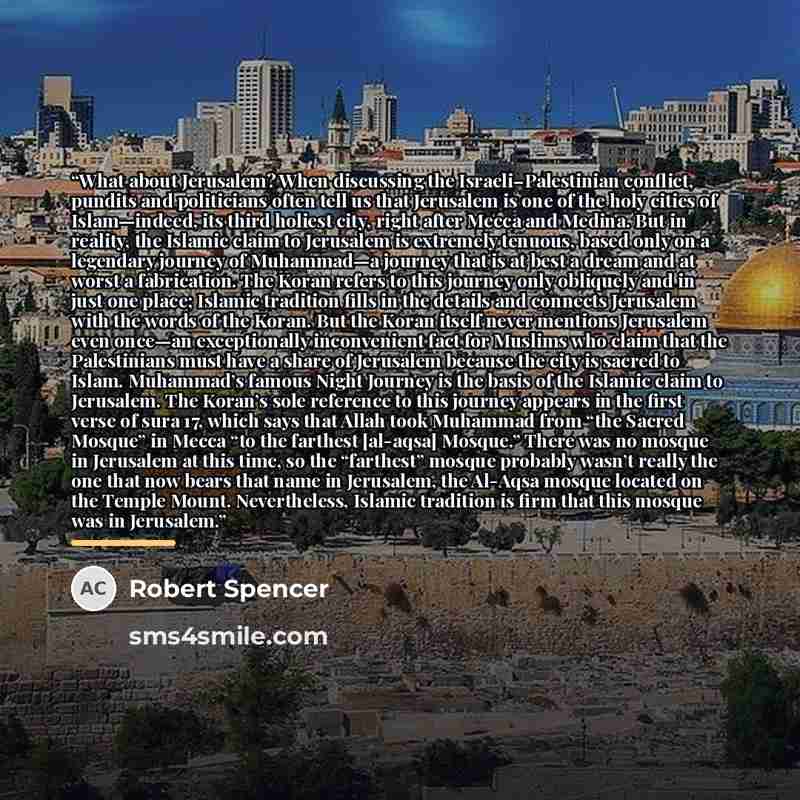
““What about Jerusalem? When discussing the Israeli–Palestinian conflict, pundits and politicians often tell us that Jerusalem is one of the holy cities of Islam—indeed, its third holiest city, right after Mecca and Medina. But in reality, the Islamic claim to Jerusalem is extremely tenuous, based only on a legendary journey of Muhammad—a journey that is at best a dream and at worst a fabrication. The Koran refers to this journey only obliquely and in just one place; Islamic tradition fills in the details and connects Jerusalem with the words of the Koran. But the Koran itself never mentions Jerusalem even once—an exceptionally inconvenient fact for Muslims who claim that the Palestinians must have a share of Jerusalem because the city is sacred to Islam. Muhammad’s famous Night Journey is the basis of the Islamic claim to Jerusalem. The Koran’s sole reference to this journey appears in the first verse of sura 17, which says that Allah took Muhammad from “the Sacred Mosque” in Mecca “to the farthest [al-aqsa] Mosque.” There was no mosque in Jerusalem at this time, so the “farthest” mosque probably wasn’t really the one that now bears that name in Jerusalem, the Al-Aqsa mosque located on the Temple Mount. Nevertheless, Islamic tradition is firm that this mosque was in Jerusalem.””
About This Quote
Source Essay: The Myth of the Islamic Claim to Jerusalem, Robert Spencer, 2010
The argument claims that Islam's holy status for Jerusalem lacks direct Qur'anic support and relies on later tradition, questioning its legitimacy.
In simple terms: Islamic claim to Jerusalem is weak without Qur'anic evidence.
Key Takeaway
Scrutinize religious claims with primary sources.
Themes
religion
history
politics
truth
myth
Mood
analytical
skeptical
inquisitive
Type
expository
critical
analytical
When to use this quote
- academic debate
- policy making
- interfaith dialogue
- media reporting
- education
Key Concepts
Qur'anic analysis
historical criticism
theology
Questions to Reflect On
- How do we balance respect for faith with critical historical inquiry?
- What role should primary texts play in modern geopolitical claims?
A Different Perspective
Religious traditions often fill gaps left by scripture, complicating factual assessments.

![“René of Anjou [(1409-80)] painted a picture of his mistress's corpse as he found it eaten by worms on having it [her tomb] openedon his return from a pilgrimage to Jerusalem. This [is] another instance of the strange mixture of religion and gallantry in those ages.” quote by Horace Walpole](https://sms4smile.com/quotes/img-quotes/aba/horace-walpole-3357_age_ren-of-anjou-1409-80-painted-a-picture-o_33917.jpg)

![“Ben Carson also denounced [Donald] Trump's ban all Muslims proposal saying we do not and would not advocate being selective on one's religion.” quote by Rachel Maddow](https://sms4smile.com/quotes/img-quotes/0d7/rachel-maddow-1240_bans_ben-carson-also-denounced-donald-trump-s_674.jpg)
![“[Islam] Leaves no room of human legislation in an Islamic state, because herein all legislative functions vest in God and the only function left for Muslims lies in their observance of the God-made law.” quote by Abul A'la Maududi](https://sms4smile.com/quotes/img-quotes/704/abul-a-la-maududi-51903_function_islam-leaves-no-room-of-human-legislatio_886.jpg)
![“[T]he people who are close to Allah worry so much about wasting time that they call themselves to account for every breath they spend - how many of us wonder about how we spend our day, let alone each breath?” quote by Ethar El- Katatney](https://sms4smile.com/quotes/img-quotes/a43/ethar-el-katatney-236694_allah_t-he-people-who-are-close-to-allah-worry_3003.jpg)