Books Quote by Richard Dawkins
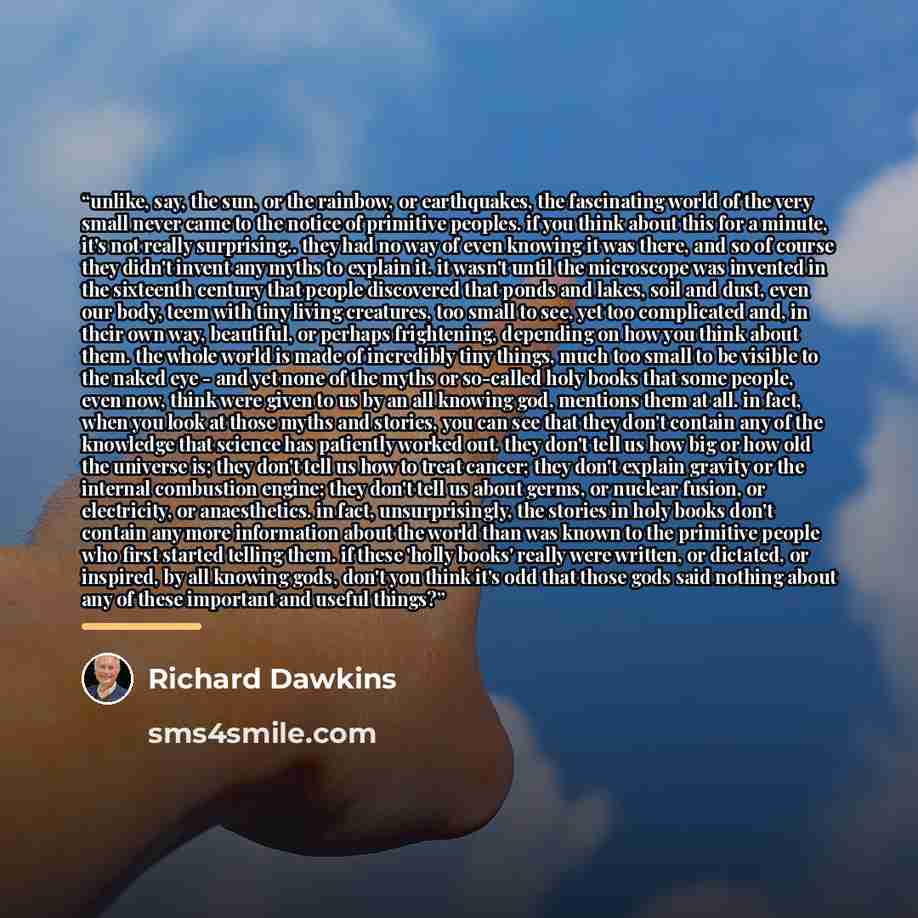
““unlike, say, the sun, or the rainbow, or earthquakes, the fascinating world of the very small never came to the notice of primitive peoples. if you think about this for a minute, it's not really surprising.. they had no way of even knowing it was there, and so of course they didn't invent any myths to explain it. it wasn't until the microscope was invented in the sixteenth century that people discovered that ponds and lakes, soil and dust, even our body, teem with tiny living creatures, too small to see, yet too complicated and, in their own way, beautiful, or perhaps frightening, depending on how you think about them. the whole world is made of incredibly tiny things, much too small to be visible to the naked eye - and yet none of the myths or so-called holy books that some people, even now, think were given to us by an all knowing god, mentions them at all. in fact, when you look at those myths and stories, you can see that they don't contain any of the knowledge that science has patiently worked out. they don't tell us how big or how old the universe is; they don't tell us how to treat cancer; they don't explain gravity or the internal combustion engine; they don't tell us about germs, or nuclear fusion, or electricity, or anaesthetics. in fact, unsurprisingly, the stories in holy books don't contain any more information about the world than was known to the primitive people who first started telling them. if these 'holly books' really were written, or dictated, or inspired, by all knowing gods, don't you think it's odd that those gods said nothing about any of these important and useful things?””
About This Quote
Source Book: The God Delusion by Richard Dawkins, 2006
The quote argues that religious texts lack scientific knowledge about the microscopic world and modern discoveries, highlighting a gap between myth and empirical understanding.
In simple terms: Religious texts don’t mention tiny living things or modern science.
Key Takeaway
Recognize the limits of myth and seek scientific explanations.
Themes
science
myth
knowledge
religion
progress
Mood
critical
inquisitive
skeptical
Type
philosophical
analytical
controversial
When to use this quote
- education
- public discourse
- science communication
- religious debate
- personal belief
Key Concepts
empiricism
skepticism
cosmology
biology
technology
Questions to Reflect On
- How do we reconcile ancient beliefs with modern science?
- What responsibilities do societies have to update myths with new knowledge?
A Different Perspective
Religious narratives often reflect the knowledge of their time, not current science.
![“When those myths were created, when the Bible was written, man didn't know what an atom or a germ was, or where the sun went at night, or why the women got pregnant. [Laughs.] They needed stories to answer the questions.” quote by Bill Maher](https://sms4smile.com/quotes/img-quotes/5cd/bill-maher-211_answers_when-those-myths-were-created-when-the-b_2477028.jpg)
![“[When asked about his thoughts on gods] I think it's like a movie that was way too popular. It's a story that's been told too many times and just doesn't mean anything. Man lived on the planet — [placing his fingers an inch apart], this is 5000 years of semi-recorded history. And God and the…” quote by Eddie Vedder](https://sms4smile.com/quotes/img-quotes/533/eddie-vedder-2057_atheism_when-asked-about-his-thoughts-on-gods-i_3019910.jpg)