Israel Quote by Phyllis Goldstein
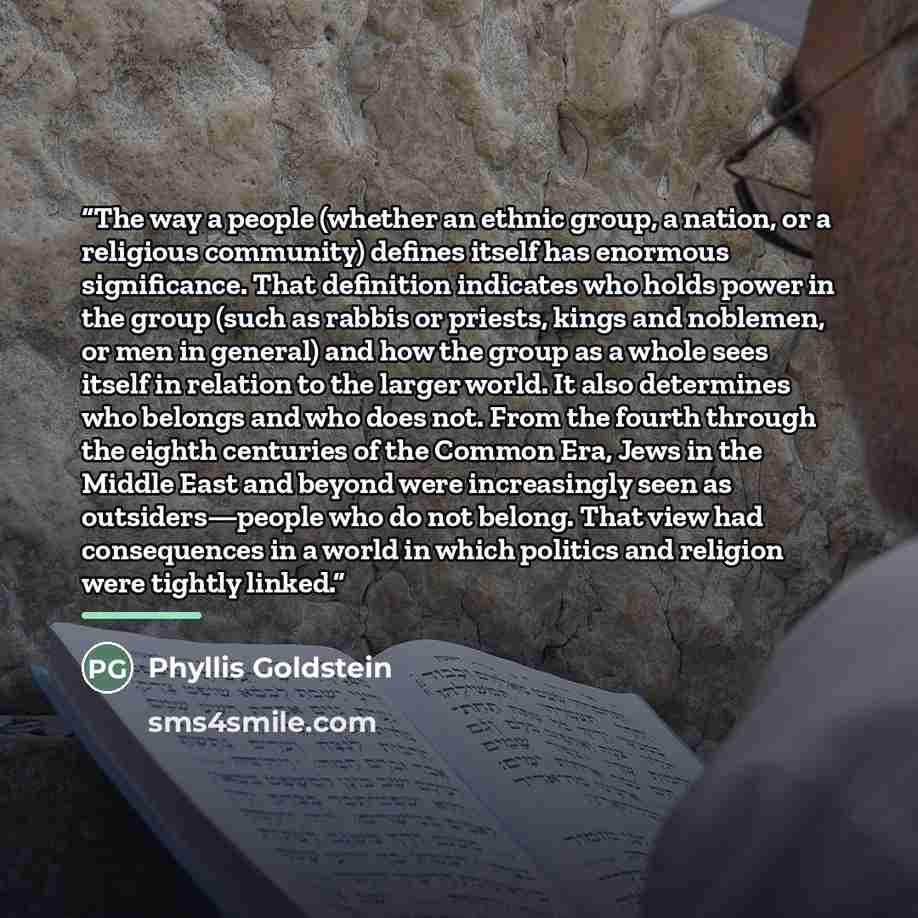
““The way a people (whether an ethnic group, a nation, or a religious community) defines itself has enormous significance. That definition indicates who holds power in the group (such as rabbis or priests, kings and noblemen, or men in general) and how the group as a whole sees itself in relation to the larger world. It also determines who belongs and who does not. From the fourth through the eighth centuries of the Common Era, Jews in the Middle East and beyond were increasingly seen as outsiders—people who do not belong. That view had consequences in a world in which politics and religion were tightly linked.””
About This Quote
Group identity shapes power structures and inclusion, historically marginalizing Jews in the early medieval world.
In simple terms: How a group defines itself determines power and belonging.
Key Takeaway
Consider how identity politics affect inclusion.
Themes
identity
power
exclusion
Mood
analytical
historical
Type
academic
critical
When to use this quote
- political discourse
- community building
- education
- policy making
Key Concepts
social construct
group dynamics
historical marginalization
Questions to Reflect On
- How do modern groups negotiate identity?
- What can break cycles of exclusion?
A Different Perspective
Identity can be fluid, not fixed.
![“[Islam] Leaves no room of human legislation in an Islamic state, because herein all legislative functions vest in God and the only function left for Muslims lies in their observance of the God-made law.” quote by Abul A'la Maududi](https://sms4smile.com/quotes/img-quotes/704/abul-a-la-maududi-51903_function_islam-leaves-no-room-of-human-legislatio_886.jpg)