Air pollution Quote by Philip Hamburger
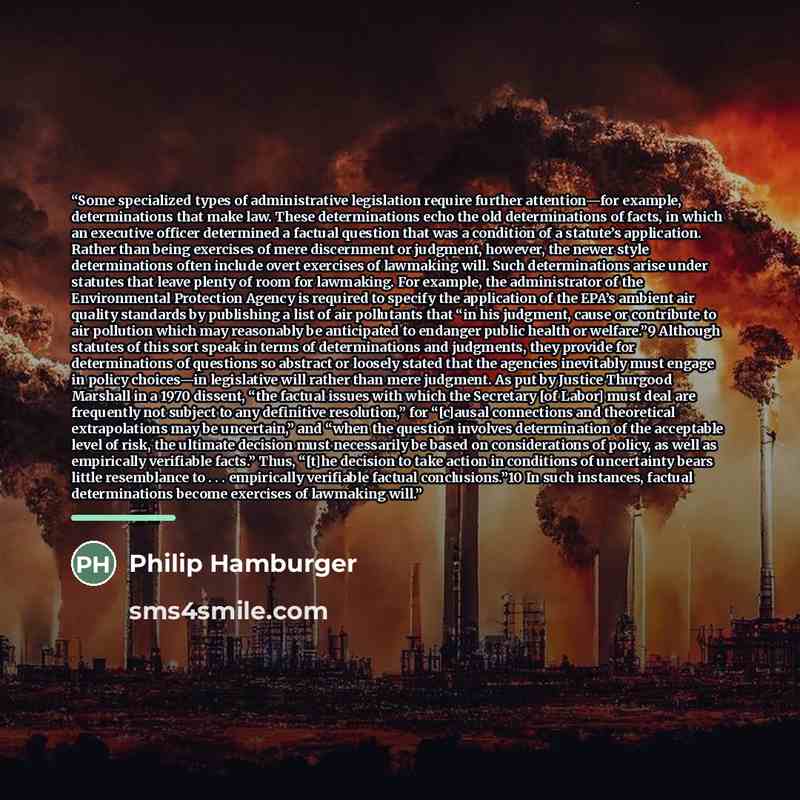
““Some specialized types of administrative legislation require further attention—for example, determinations that make law. These determinations echo the old determinations of facts, in which an executive officer determined a factual question that was a condition of a statute’s application. Rather than being exercises of mere discernment or judgment, however, the newer style determinations often include overt exercises of lawmaking will. Such determinations arise under statutes that leave plenty of room for lawmaking. For example, the administrator of the Environmental Protection Agency is required to specify the application of the EPA’s ambient air quality standards by publishing a list of air pollutants that “in his judgment, cause or contribute to air pollution which may reasonably be anticipated to endanger public health or welfare.”9 Although statutes of this sort speak in terms of determinations and judgments, they provide for determinations of questions so abstract or loosely stated that the agencies inevitably must engage in policy choices—in legislative will rather than mere judgment. As put by Justice Thurgood Marshall in a 1970 dissent, “the factual issues with which the Secretary [of Labor] must deal are frequently not subject to any definitive resolution,” for “[c]ausal connections and theoretical extrapolations may be uncertain,” and “when the question involves determination of the acceptable level of risk, the ultimate decision must necessarily be based on considerations of policy, as well as empirically verifiable facts.” Thus, “[t]he decision to take action in conditions of uncertainty bears little resemblance to . . . empirically verifiable factual conclusions.”10 In such instances, factual determinations become exercises of lawmaking will.””
About This Quote
Source Article: Administrative Law and the Rise of Agency Lawmaking, 2020
Agency determinations often blend factual judgment with policy choices, effectively creating law within statutory gaps.
In simple terms: Agencies sometimes make law when statutes are vague.
Key Takeaway
Recognize when policy decisions replace pure fact-finding.
Themes
law
policy
agency power
statutory interpretation
Mood
critical
analytical
Type
legal
theoretical
When to use this quote
- environmental regulation
- labor policy
- public health guidelines
- agency rulemaking
Key Concepts
administrative law
legislative intent
risk assessment
Questions to Reflect On
- How should courts balance agency expertise with democratic legitimacy?
- When does policy become lawmaking?
A Different Perspective
Agency discretion can blur accountability and democratic oversight.