Law Quote by Philip Hamburger
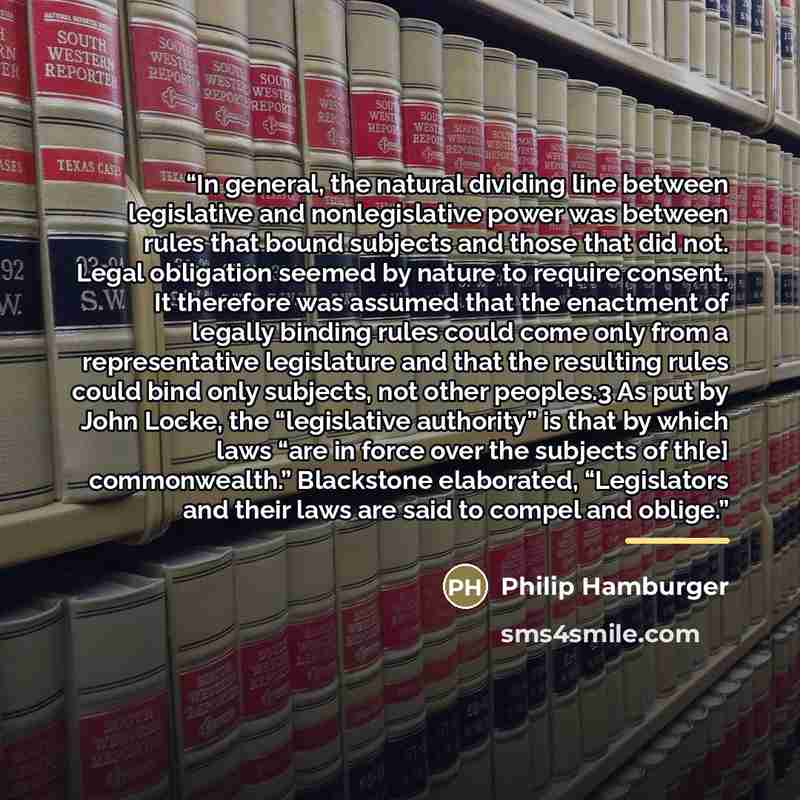
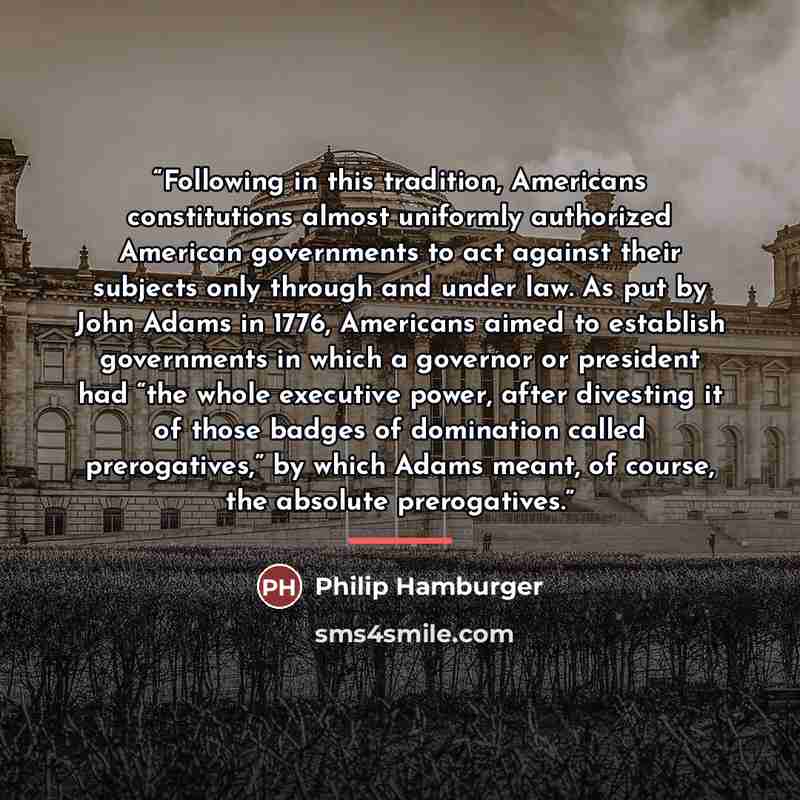
““In general, the natural dividing line between legislative and nonlegislative power was between rules that bound subjects and those that did not. Legal obligation seemed by nature to require consent. It therefore was assumed that the enactment of legally binding rules could come only from a representative legislature and that the resulting rules could bind only subjects, not other peoples.3 As put by John Locke, the “legislative authority” is that by which laws “are in force over the subjects of th[e] commonwealth.” Blackstone elaborated, “Legislators and their laws are said to compel and oblige.””
About This Quote
Source Book: Legal Theory and the Constitution, 2012
Legislative power traditionally creates binding rules for subjects, not for others, based on consent and representation.
In simple terms: Law makes rules that bind people, not other groups.
Key Takeaway
Recognize limits of legislative authority.
Themes
law
authority
consent
Mood
analytical
critical
Type
academic
philosophical
When to use this quote
- parliamentary decisions
- international treaties
- corporate governance
Key Concepts
political theory
jurisprudence
Questions to Reflect On
- How do modern institutions challenge this view?
- Can non‑legislative bodies create binding rules?
A Different Perspective
Modern governance often blurs subject‑subject boundaries.








![“That country [Carthage] was rapidly sinking into the state of barbarism from whence it had been raised by the Phoenician colonies and Roman laws; and every step of intestine discord was marked by some deplorable victory of savage man over civilized society.” quote by Edward Gibbon](https://sms4smile.com/quotes/img-quotes/70c/edward-gibbon-710_barbarism_that-country-carthage-was-rapidly-sinkin_393.jpg)
![“[Islam] Leaves no room of human legislation in an Islamic state, because herein all legislative functions vest in God and the only function left for Muslims lies in their observance of the God-made law.” quote by Abul A'la Maududi](https://sms4smile.com/quotes/img-quotes/704/abul-a-la-maududi-51903_function_islam-leaves-no-room-of-human-legislatio_886.jpg)



![“Next came the Patent laws. These began in England in 1624; and, in this country, with the adoption of our constitution. Before then [these?], any man might instantly use what another had invented; so that the inventor had no special advantage from his own invention. The patent system changed this…” quote by Abraham Lincoln](https://sms4smile.com/quotes/img-quotes/449/abraham-lincoln-88_adoption_next-came-the-patent-laws-these-began-in_1828.jpg)