Politics Quote by Philip Hamburger
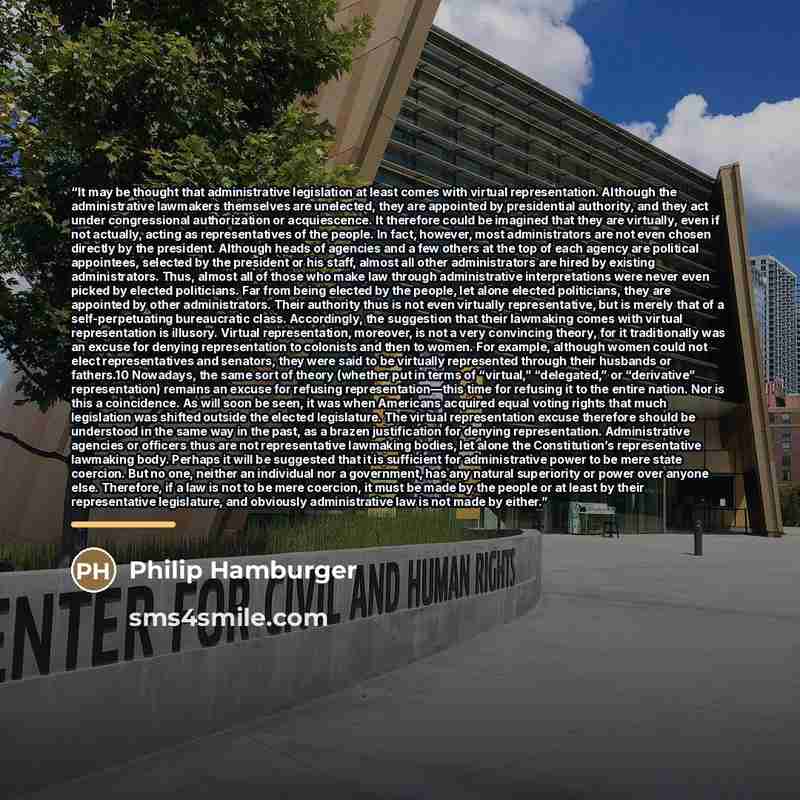
““It may be thought that administrative legislation at least comes with virtual representation. Although the administrative lawmakers themselves are unelected, they are appointed by presidential authority, and they act under congressional authorization or acquiescence. It therefore could be imagined that they are virtually, even if not actually, acting as representatives of the people. In fact, however, most administrators are not even chosen directly by the president. Although heads of agencies and a few others at the top of each agency are political appointees, selected by the president or his staff, almost all other administrators are hired by existing administrators. Thus, almost all of those who make law through administrative interpretations were never even picked by elected politicians. Far from being elected by the people, let alone elected politicians, they are appointed by other administrators. Their authority thus is not even virtually representative, but is merely that of a self-perpetuating bureaucratic class. Accordingly, the suggestion that their lawmaking comes with virtual representation is illusory. Virtual representation, moreover, is not a very convincing theory, for it traditionally was an excuse for denying representation to colonists and then to women. For example, although women could not elect representatives and senators, they were said to be virtually represented through their husbands or fathers.10 Nowadays, the same sort of theory (whether put in terms of “virtual,” “delegated,” or “derivative” representation) remains an excuse for refusing representation—this time for refusing it to the entire nation. Nor is this a coincidence. As will soon be seen, it was when Americans acquired equal voting rights that much legislation was shifted outside the elected legislature. The virtual representation excuse therefore should be understood in the same way in the past, as a brazen justification for denying representation. Administrative agencies or officers thus are not representative lawmaking bodies, let alone the Constitution’s representative lawmaking body. Perhaps it will be suggested that it is sufficient for administrative power to be mere state coercion. But no one, neither an individual nor a government, has any natural superiority or power over anyone else. Therefore, if a law is not to be mere coercion, it must be made by the people or at least by their representative legislature, and obviously administrative law is not made by either.””
About This Quote
Administrative agencies, largely appointed and self‑perpetuating, lack true democratic representation, making “virtual representation” a flawed justification.
In simple terms: Bureaucrats aren’t truly elected, so representation is illusory.
Key Takeaway
Advocate for more accountable governance.
Themes
government
bureaucracy
representation
democracy
legislation
Mood
critical
concerned
Type
analytical
political
When to use this quote
- policy reform
- public advocacy
- citizen oversight
Key Concepts
political theory
constitutional law
Questions to Reflect On
- What reforms could increase transparency?
- How can citizens influence bureaucratic decisions?
A Different Perspective
Changing agencies is complex and may face resistance.





![“Aren't we supposed to believe that if you are an elected official, if you serve in Congress, you are representing all the people of your district not just the people who voted for you, not [just] the people who you agree with?” quote by David Duke](https://sms4smile.com/quotes/img-quotes/3f3/david-duke-8534_agree_aren-t-we-supposed-to-believe-that-if-yo_1159300.jpg)

![“[E]very act of a delegated authority, contrary to the tenor of the commission under which it is exercised, is void. No legislative act, therefore, contrary to the Constitution, can be valid. To deny this, would be to affirm, that the deputy is greater than his principal; that the servant is above…” quote by Alexander Hamilton](https://sms4smile.com/quotes/img-quotes/156/alexander-hamilton-619_acting_e-very-act-of-a-delegated-authority-cont_1212377.jpg)