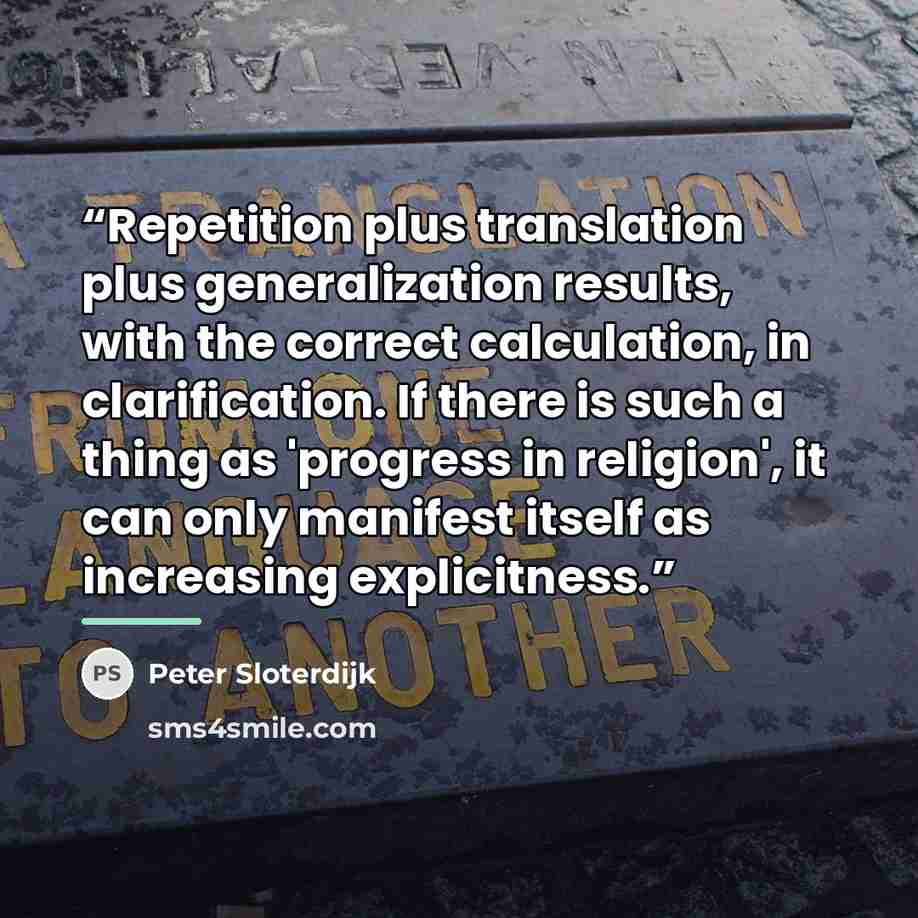
Explicitness Quote by Peter Sloterdijk
““The novelty of the new, as noted earlier, stems from the unfolding of the known into larger, brighter, more richly contoured surfaces. Consequently, it can never be innovative in an absolute sense; in part, it is always the continuation of the cognitively existent by other means. Here, novelty and greater explicitness amount to the same thing. We can therefore say that the higher the degree of explicitness, the deeper the possible, indeed inevitable disconcertment caused by the newly acquired knowledge. I have previously accepted as a conventional fact that this table is made of cherrywood; I acknowledge with the tolerance of the educated that the cherrywood consists of atoms, even though these oft-cited atoms, these epistemological contemporaries of the twentieth century, possess no greater reality for me than unicorn powder or Saturnian influences. That these cherrywood atoms dissolve into a mist of sub-atomic almost-nothings upon further explication - this is something that I, as an end consumer of physical Enlightenment, must accept, even if it goes decisively against my assumptions about the substantiality of substance. The final explanation illustrates most emphatically how the later knowledge tends to be the more disconcerting.””
About This Quote
Source Book: Spheres of Influence, 2015
Explores how increased explicitness in knowledge leads to deeper discomfort, questioning material reality.
In simple terms: More detail can be unsettling.
Key Takeaway
Accept that deeper knowledge may disturb comfort.
Themes
knowledge
explicitness
discomfort
philosophy
epistemology
Mood
thoughtful
introspective
serious
Type
philosophical
inspirational
When to use this quote
- academic study
- personal reflection
- scientific research
- creative thinking
Key Concepts
cognitive limits
material illusion
semantic expansion
Questions to Reflect On
- How does explicit knowledge affect our sense of reality?
- Can we balance curiosity with emotional stability?
A Different Perspective
May cause paralysis or anxiety when confronting unsettling truths.