Aesthetic beauty Quote by Peter Singer
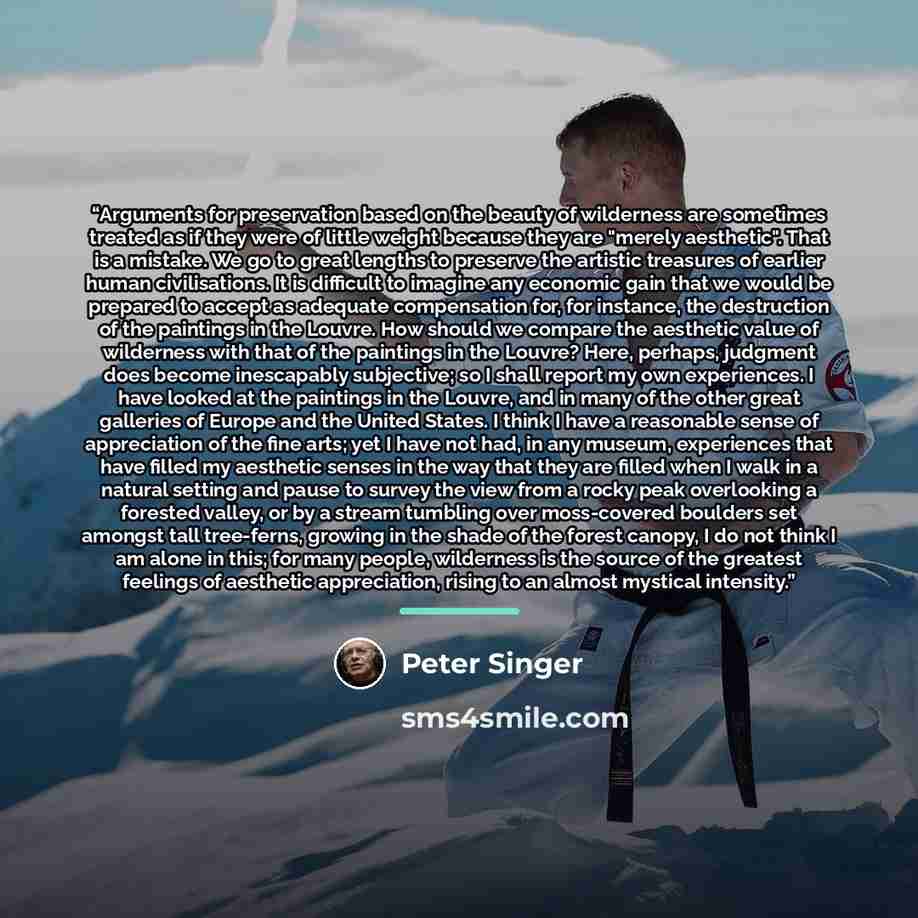
““Arguments for preservation based on the beauty of wilderness are sometimes treated as if they were of little weight because they are "merely aesthetic". That is a mistake. We go to great lengths to preserve the artistic treasures of earlier human civilisations. It is difficult to imagine any economic gain that we would be prepared to accept as adequate compensation for, for instance, the destruction of the paintings in the Louvre. How should we compare the aesthetic value of wilderness with that of the paintings in the Louvre? Here, perhaps, judgment does become inescapably subjective; so I shall report my own experiences. I have looked at the paintings in the Louvre, and in many of the other great galleries of Europe and the United States. I think I have a reasonable sense of appreciation of the fine arts; yet I have not had, in any museum, experiences that have filled my aesthetic senses in the way that they are filled when I walk in a natural setting and pause to survey the view from a rocky peak overlooking a forested valley, or by a stream tumbling over moss-covered boulders set amongst tall tree-ferns, growing in the shade of the forest canopy, I do not think I am alone in this; for many people, wilderness is the source of the greatest feelings of aesthetic appreciation, rising to an almost mystical intensity.””
About This Quote
Source Essay: “The Aesthetic Value of Wilderness,” 2002
Wilderness holds profound aesthetic value comparable to great art, yet its worth is often dismissed as merely subjective, challenging us to recognize its deep, almost mystical impact.
In simple terms: Nature’s beauty is as valuable as museum art.
Key Takeaway
Protect wilderness as a vital source of aesthetic and spiritual enrichment.
Themes
environment
aesthetics
philosophy
conservation
Mood
inspirational
reflective
thought‑provoking
Type
essay
philosophical
When to use this quote
- policy making
- environmental education
- personal nature experiences
Key Concepts
subjective value
environmental ethics
beauty perception
Questions to Reflect On
- How do you experience nature’s beauty?
- Can aesthetic appreciation motivate conservation action?
A Different Perspective
Subjectivity can make protection arguments harder to persuade.



![“Nineteen thousand children [are] dying every day. Does it really matter that we're not walking past them in the street? Does it really matter that they're far away? I don't think it does make a morally relevant difference.” quote by Peter Singer](https://sms4smile.com/quotes/img-quotes/cc1/peter-singer-1001_children_nineteen-thousand-children-are-dying-eve_33961.jpg)

![“The depressing majority of comics seem to be about violence of one sort or another, [...] And I just don’t enjoy violence. I can see that narratively it is often a powerful spike in a story, but I certainly don’t want to dwell on it. I don’t want it in my real life, I don’t find violence…” quote by Dave McKean](https://sms4smile.com/quotes/img-quotes/548/dave-mckean-15219_psychology_the-depressing-majority-of-comics-seem-t_933308.jpg)