Art Quote by Oscar Wilde
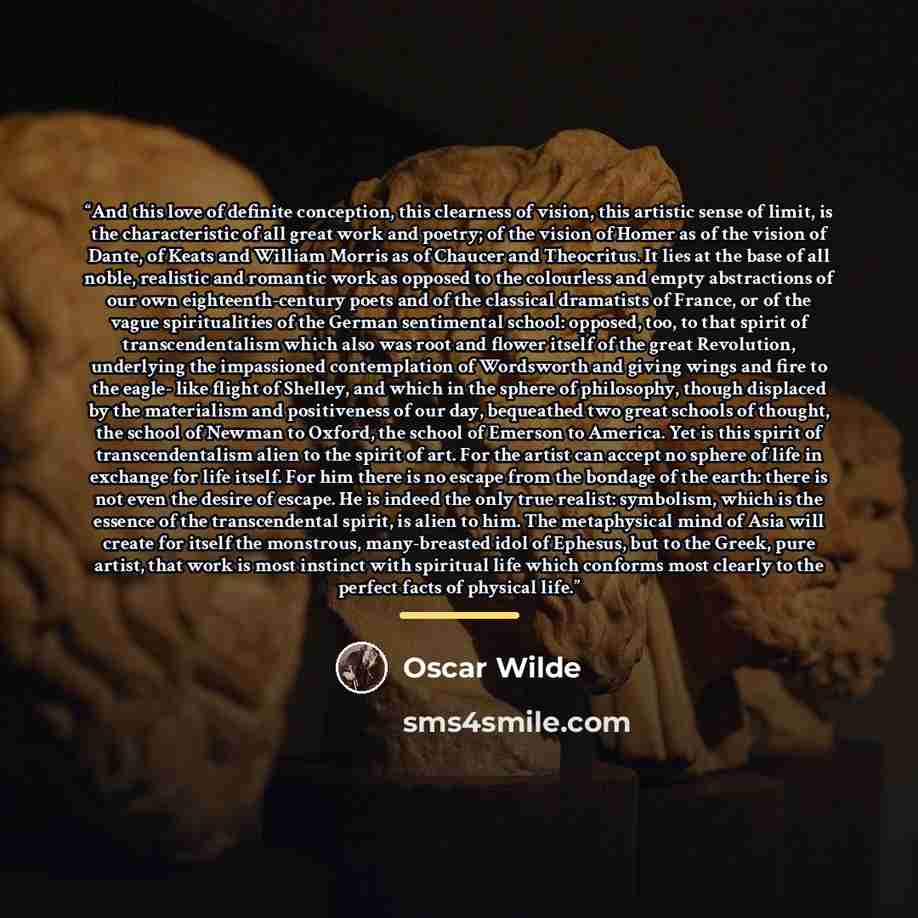
““And this love of definite conception, this clearness of vision, this artistic sense of limit, is the characteristic of all great work and poetry; of the vision of Homer as of the vision of Dante, of Keats and William Morris as of Chaucer and Theocritus. It lies at the base of all noble, realistic and romantic work as opposed to the colourless and empty abstractions of our own eighteenth-century poets and of the classical dramatists of France, or of the vague spiritualities of the German sentimental school: opposed, too, to that spirit of transcendentalism which also was root and flower itself of the great Revolution, underlying the impassioned contemplation of Wordsworth and giving wings and fire to the eagle- like flight of Shelley, and which in the sphere of philosophy, though displaced by the materialism and positiveness of our day, bequeathed two great schools of thought, the school of Newman to Oxford, the school of Emerson to America. Yet is this spirit of transcendentalism alien to the spirit of art. For the artist can accept no sphere of life in exchange for life itself. For him there is no escape from the bondage of the earth: there is not even the desire of escape. He is indeed the only true realist: symbolism, which is the essence of the transcendental spirit, is alien to him. The metaphysical mind of Asia will create for itself the monstrous, many-breasted idol of Ephesus, but to the Greek, pure artist, that work is most instinct with spiritual life which conforms most clearly to the perfect facts of physical life.””
About This Quote
Source Essay: The Decay of Lying, 1891
Great art demands clear vision and defined limits, contrasting with vague, abstract trends of later periods.
In simple terms: Art needs clear limits, not vague abstraction.
Key Takeaway
Embrace precise, realistic vision in creation.
Themes
art
clarity
realism
tradition
transcendentalism
Mood
reflective
critical
Type
analytical
philosophical
When to use this quote
- painting
- poetry
- literature
- academic analysis
Key Concepts
symbolism
materialism
philosophy
literary criticism
Questions to Reflect On
- How can artists balance clarity with innovation?
- What defines “great work” in changing eras?
A Different Perspective
May limit creative freedom and exclude experimental forms.

![“[O]ne has to have endured a few decades before wanting, let alone needing, to embark on the project of recovering lost life. And I think it may be possible to review 'the chronicles of wasted time.' William Morris wrote in The Dream of John Ball that men fight for things and then lose the battle…” quote by Christopher Hitchens](https://sms4smile.com/quotes/img-quotes/53d/christopher-hitchens-117_age_o-ne-has-to-have-endured-a-few-decades-b_1102939.jpg)