Art Quote by Oscar Wilde
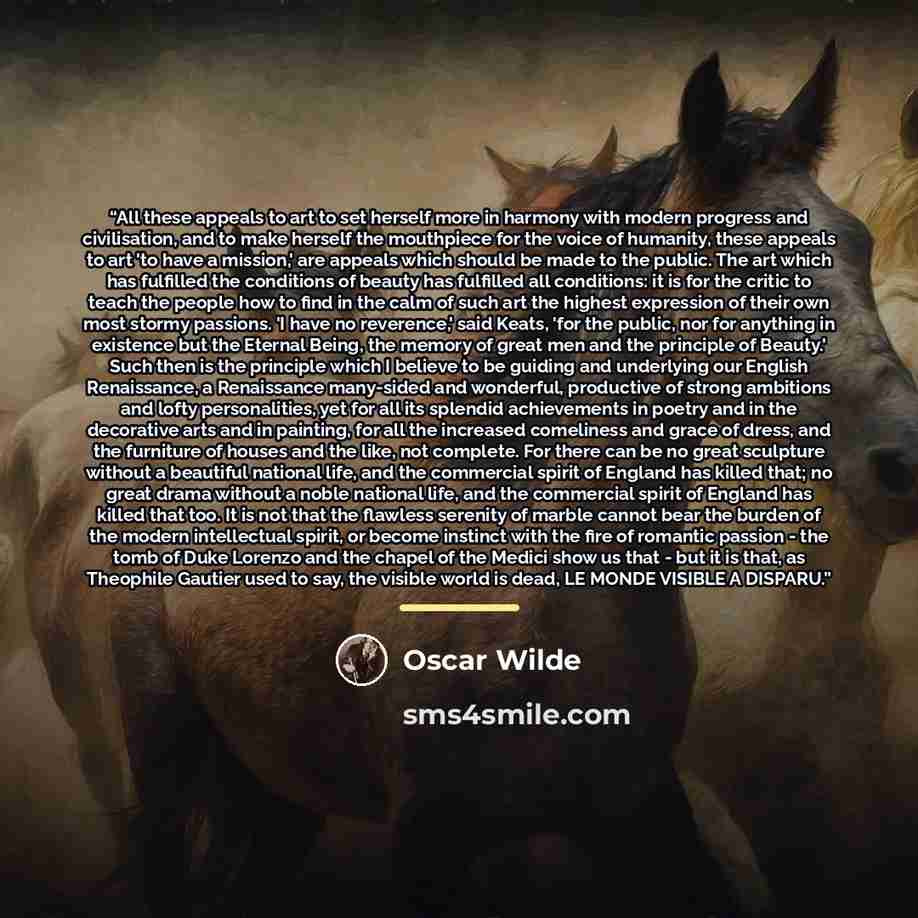
““All these appeals to art to set herself more in harmony with modern progress and civilisation, and to make herself the mouthpiece for the voice of humanity, these appeals to art 'to have a mission,' are appeals which should be made to the public. The art which has fulfilled the conditions of beauty has fulfilled all conditions: it is for the critic to teach the people how to find in the calm of such art the highest expression of their own most stormy passions. 'I have no reverence,' said Keats, 'for the public, nor for anything in existence but the Eternal Being, the memory of great men and the principle of Beauty.' Such then is the principle which I believe to be guiding and underlying our English Renaissance, a Renaissance many-sided and wonderful, productive of strong ambitions and lofty personalities, yet for all its splendid achievements in poetry and in the decorative arts and in painting, for all the increased comeliness and grace of dress, and the furniture of houses and the like, not complete. For there can be no great sculpture without a beautiful national life, and the commercial spirit of England has killed that; no great drama without a noble national life, and the commercial spirit of England has killed that too. It is not that the flawless serenity of marble cannot bear the burden of the modern intellectual spirit, or become instinct with the fire of romantic passion - the tomb of Duke Lorenzo and the chapel of the Medici show us that - but it is that, as Theophile Gautier used to say, the visible world is dead, LE MONDE VISIBLE A DISPARU.””
About This Quote
Source Essay: The Decay of Lying, 1891
The passage argues that true art must serve the public, embody beauty, and reflect a vibrant national spirit, warning that commercialism kills artistic greatness.
In simple terms: Art should be public, beautiful, and reflect national life; commerce harms it.
Key Takeaway
Support art that inspires and reflects society.
Themes
art
beauty
national identity
commercialism
culture
Mood
reflective
critical
Type
philosophical
literary
When to use this quote
- museum curation
- public art projects
- cultural policy
- educational curricula
Key Concepts
aesthetic theory
public engagement
cultural criticism
historical context
Questions to Reflect On
- Can commercial art coexist with high aesthetic standards?
- How does public taste shape artistic value?
A Different Perspective
The critique may ignore the value of commercial art and its role in accessibility.
![“There is evidence that the honoree [Leonard Cohen] might be privy to the secret of the universe, which, in case you're wondering, is simply this: everything is connected. Everything. Many, if not most, of the links are difficult to determine. The instrument, the apparatus, the focused ray that can…” quote by Tom Robbins](https://sms4smile.com/quotes/img-quotes/a32/tom-robbins-169_buddhism_there-is-evidence-that-the-honoree-leona_2831671.jpg)


![“Lady Dellwyn ... for the first time began to entertain some suspicions that she had a heart to bestow. Not that she was actuated by that romantic passion which creates indifference to every other object and makes all happiness to consist in pleasing the beloved person, [but] only overstraining…” quote by Anonymous](https://sms4smile.com/quotes/img-quotes/a04/anonymous-1_first-time_lady-dellwyn-for-the-first-time-began-to_596617.jpg)