Miracles Quote by Nassim Nicholas Taleb
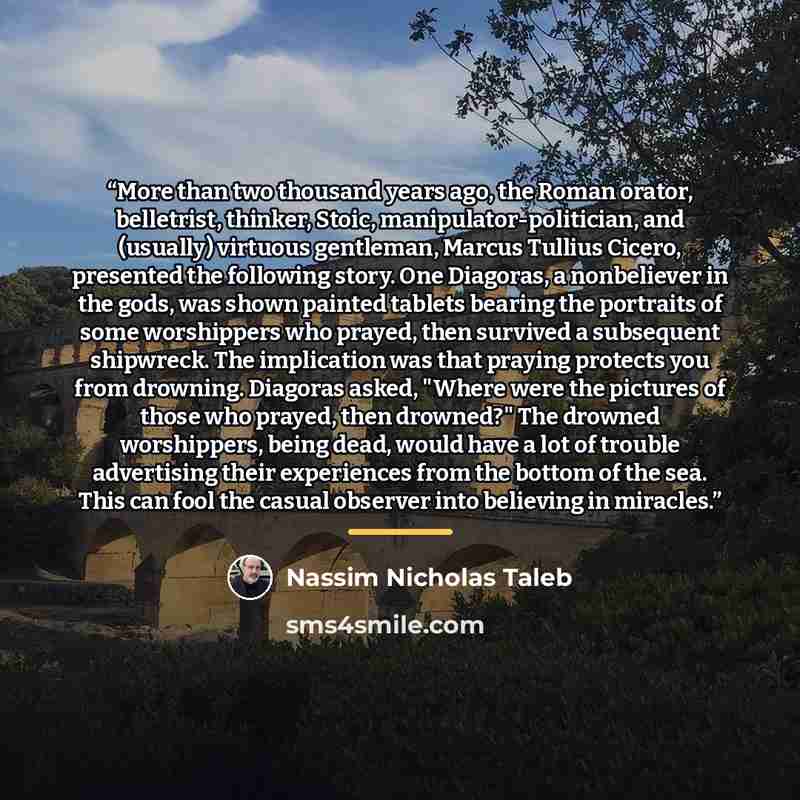
““More than two thousand years ago, the Roman orator, belletrist, thinker, Stoic, manipulator-politician, and (usually) virtuous gentleman, Marcus Tullius Cicero, presented the following story. One Diagoras, a nonbeliever in the gods, was shown painted tablets bearing the portraits of some worshippers who prayed, then survived a subsequent shipwreck. The implication was that praying protects you from drowning. Diagoras asked, "Where were the pictures of those who prayed, then drowned?" The drowned worshippers, being dead, would have a lot of trouble advertising their experiences from the bottom of the sea. This can fool the casual observer into believing in miracles.””
About This Quote
Source Book: The Black Swan by Nassim Nicholas Taleb, 2007
The anecdote illustrates how selective evidence can create false beliefs about cause and effect, especially regarding miracles.
In simple terms: People see only successes, not failures, and assume a link.
Key Takeaway
Beware of survivorship bias.
Themes
critical thinking
statistics
belief formation
Mood
skeptical
inquisitive
Type
analytical
philosophical
When to use this quote
- risk assessment
- policy making
- personal belief evaluation
Key Concepts
survivorship bias
causality
probability
Questions to Reflect On
- How do you verify claims that rely on anecdotal evidence?
- What evidence would disprove a widely held belief?
A Different Perspective
It ignores that many non‑prayers also survive, and that correlation isn’t causation.