Appearing Quote by N.T. Wright
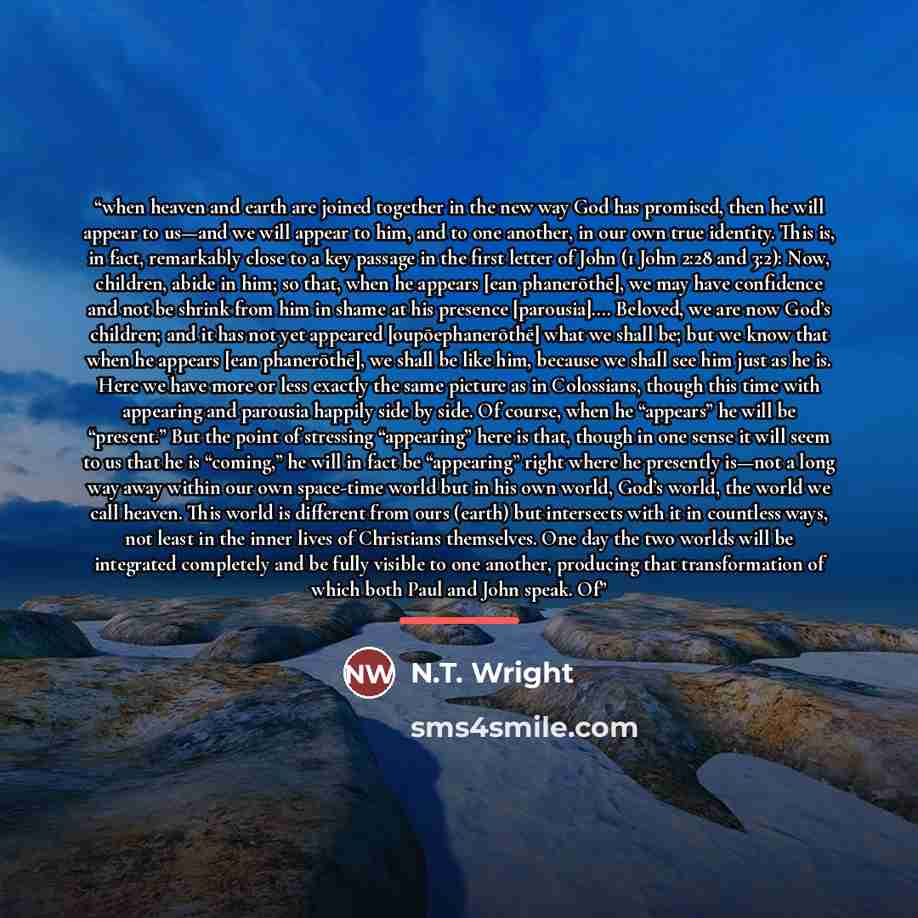
““when heaven and earth are joined together in the new way God has promised, then he will appear to us—and we will appear to him, and to one another, in our own true identity. This is, in fact, remarkably close to a key passage in the first letter of John (1 John 2:28 and 3:2): Now, children, abide in him; so that, when he appears [ean phanerōthē], we may have confidence and not be shrink from him in shame at his presence [parousia]…. Beloved, we are now God’s children; and it has not yet appeared [oupōephanerōthē] what we shall be; but we know that when he appears [ean phanerōthē], we shall be like him, because we shall see him just as he is. Here we have more or less exactly the same picture as in Colossians, though this time with appearing and parousia happily side by side. Of course, when he “appears” he will be “present.” But the point of stressing “appearing” here is that, though in one sense it will seem to us that he is “coming,” he will in fact be “appearing” right where he presently is—not a long way away within our own space-time world but in his own world, God’s world, the world we call heaven. This world is different from ours (earth) but intersects with it in countless ways, not least in the inner lives of Christians themselves. One day the two worlds will be integrated completely and be fully visible to one another, producing that transformation of which both Paul and John speak. Of””
About This Quote
Source Book: Surprised by Hope by N.T. Wright, 2008
The quote describes a future where heaven and earth merge, revealing true identities and allowing believers to see God directly, fulfilling biblical prophecy.
In simple terms: Heaven and earth will unite, showing us our true selves and God.
Key Takeaway
Seek unity of spiritual and material realms.
Themes
spirituality
eschatology
identity
transformation
theology
Mood
hopeful
reverent
Type
theological
inspirational
When to use this quote
- personal worship
- theological study
- interfaith dialogue
- artistic expression
- community building
Key Concepts
Christology
eschatology
participation
Questions to Reflect On
- How does this vision affect daily faith practice?
- What does “true identity” mean for believers?
A Different Perspective
Interpretations of “appearance” vary; some view it metaphorically, not literally.



![“And so in the heart of such a believer is a sort of paradise. That is the paradise that Ibn Taymiyyah, may Allah have mercy on his soul, spoke of when he said: 'Truly, there is a Heaven in this world, [and] whoever does not enter it, will not enter the Heaven of the next world.' And in that…” quote by Yasmin Mogahed](https://sms4smile.com/quotes/img-quotes/fd6/yasmin-mogahed-1335_believer_and-so-in-the-heart-of-such-a-believer-i_1629697.jpg)
![“The cross [is] the ultimate statement of God's involvement in the world on this side of heaven.” quote by Tullian Tchividjian](https://sms4smile.com/quotes/img-quotes/bf3/tullian-tchividjian-1105_crosses_the-cross-is-the-ultimate-statement-of-g_1117197.jpg)