Death Quote by Miriam Robbins Dexter
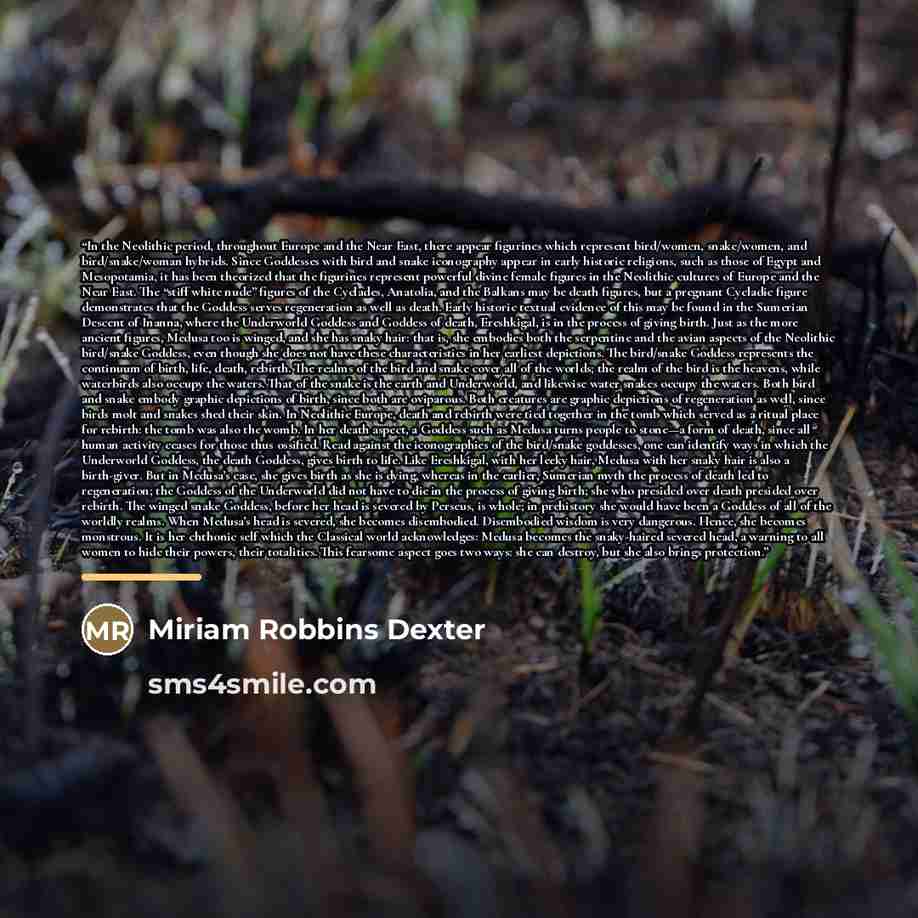
““In the Neolithic period, throughout Europe and the Near East, there appear figurines which represent bird/women, snake/women, and bird/snake/woman hybrids. Since Goddesses with bird and snake iconography appear in early historic religions, such as those of Egypt and Mesopotamia, it has been theorized that the figurines represent powerful divine female figures in the Neolithic cultures of Europe and the Near East. The “stiff white nude” figures of the Cyclades, Anatolia, and the Balkans may be death figures, but a pregnant Cycladic figure demonstrates that the Goddess serves regeneration as well as death. Early historic textual evidence of this may be found in the Sumerian Descent of Inanna, where the Underworld Goddess and Goddess of death, Ereshkigal, is in the process of giving birth. Just as the more ancient figures, Medusa too is winged, and she has snaky hair: that is, she embodies both the serpentine and the avian aspects of the Neolithic bird/snake Goddess, even though she does not have these characteristics in her earliest depictions. The bird/snake Goddess represents the continuum of birth, life, death, rebirth. The realms of the bird and snake cover all of the worlds; the realm of the bird is the heavens, while waterbirds also occupy the waters. That of the snake is the earth and Underworld, and likewise water snakes occupy the waters. Both bird and snake embody graphic depictions of birth, since both are oviparous. Both creatures are graphic depictions of regeneration as well, since birds molt and snakes shed their skin. In Neolithic Europe, death and rebirth were tied together in the tomb which served as a ritual place for rebirth: the tomb was also the womb. In her death aspect, a Goddess such as Medusa turns people to stone—a form of death, since all human activity ceases for those thus ossified. Read against the iconographies of the bird/snake goddesses, one can identify ways in which the Underworld Goddess, the death Goddess, gives birth to life. Like Ereshkigal, with her leeky hair, Medusa with her snaky hair is also a birth-giver. But in Medusa’s case, she gives birth as she is dying, whereas in the earlier, Sumerian myth the process of death led to regeneration; the Goddess of the Underworld did not have to die in the process of giving birth; she who presided over death presided over rebirth. The winged snake Goddess, before her head is severed by Perseus, is whole; in prehistory she would have been a Goddess of all of the worldly realms. When Medusa’s head is severed, she becomes disembodied. Disembodied wisdom is very dangerous. Hence, she becomes monstrous. It is her chthonic self which the Classical world acknowledges: Medusa becomes the snaky-haired severed head, a warning to all women to hide their powers, their totalities. This fearsome aspect goes two ways: she can destroy, but she also brings protection.””
About This Quote
Ancient bird‑snake hybrid goddesses symbolize a cycle of birth, death, and rebirth, linking sky, earth, and water realms.
In simple terms: These figures represent life‑death‑rebirth cycles.
Key Takeaway
Recognize the unity of opposing forces.
Themes
mythology
gender
rebirth
Mood
inquisitive
reflective
Type
mythological
philosophical
When to use this quote
- art analysis
- academic research
- personal meditation
- creative writing
- spiritual practice
Key Concepts
symbolism
duality
ancient religions
Questions to Reflect On
- What personal transformations mirror this cycle?
- How do you integrate opposing aspects of yourself?
A Different Perspective
Interpretations vary; modern lenses may misread ancient meanings.