Books Quote by Milan Kundera
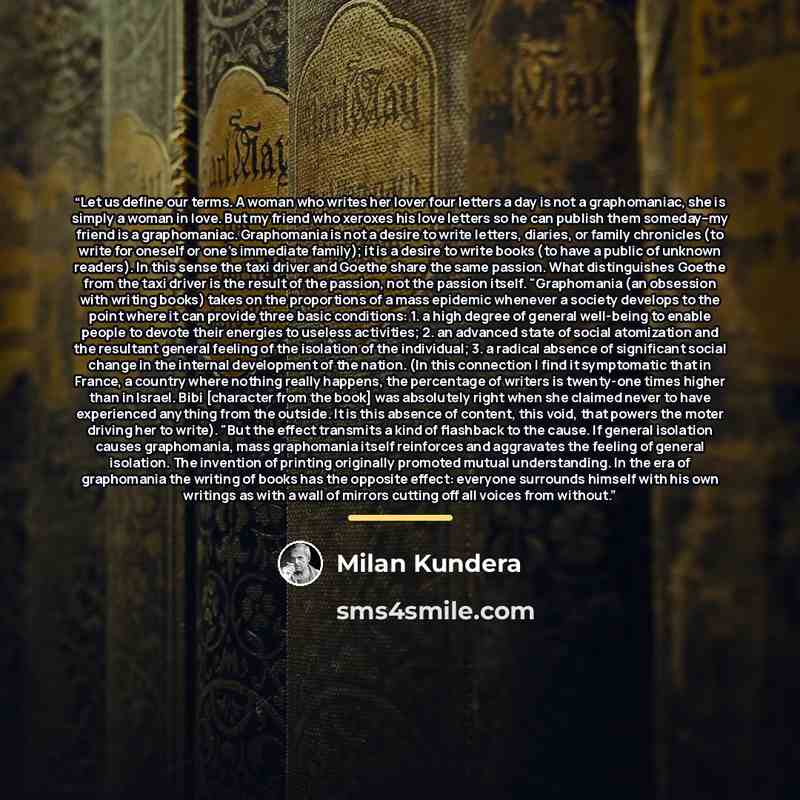
““Let us define our terms. A woman who writes her lover four letters a day is not a graphomaniac, she is simply a woman in love. But my friend who xeroxes his love letters so he can publish them someday--my friend is a graphomaniac. Graphomania is not a desire to write letters, diaries, or family chronicles (to write for oneself or one's immediate family); it is a desire to write books (to have a public of unknown readers). In this sense the taxi driver and Goethe share the same passion. What distinguishes Goethe from the taxi driver is the result of the passion, not the passion itself. "Graphomania (an obsession with writing books) takes on the proportions of a mass epidemic whenever a society develops to the point where it can provide three basic conditions: 1. a high degree of general well-being to enable people to devote their energies to useless activities; 2. an advanced state of social atomization and the resultant general feeling of the isolation of the individual; 3. a radical absence of significant social change in the internal development of the nation. (In this connection I find it symptomatic that in France, a country where nothing really happens, the percentage of writers is twenty-one times higher than in Israel. Bibi [character from the book] was absolutely right when she claimed never to have experienced anything from the outside. It is this absence of content, this void, that powers the moter driving her to write). "But the effect transmits a kind of flashback to the cause. If general isolation causes graphomania, mass graphomania itself reinforces and aggravates the feeling of general isolation. The invention of printing originally promoted mutual understanding. In the era of graphomania the writing of books has the opposite effect: everyone surrounds himself with his own writings as with a wall of mirrors cutting off all voices from without.””
About This Quote
Source Novel: The Unbearable Lightness of Being, Milan Kundera, 1984
The passage critiques how societal comfort, isolation, and stagnation foster an epidemic of self‑absorbed writing that deepens loneliness rather than fostering connection.
In simple terms: Comfortable societies can breed self‑obsessed writing that isolates people.
Key Takeaway
Beware of writing that builds walls instead of bridges.
Themes
isolation
culture
writing
societal critique
literature
mass media
Mood
reflective
critical
introspective
Type
analytical
philosophical
literary criticism
When to use this quote
- academic analysis
- creative writing workshops
- media literacy programs
- urban community projects
- personal journaling
Key Concepts
graphomania
social atomization
media saturation
public discourse
intellectual echo chambers
Questions to Reflect On
- How does your own writing affect your sense of connection?
- Can literature ever truly bridge isolated minds?
A Different Perspective
The argument may overgeneralize; not all prolific writers are socially detached, and some writing can inspire solidarity.