Six months Quote by Michelle Alexander
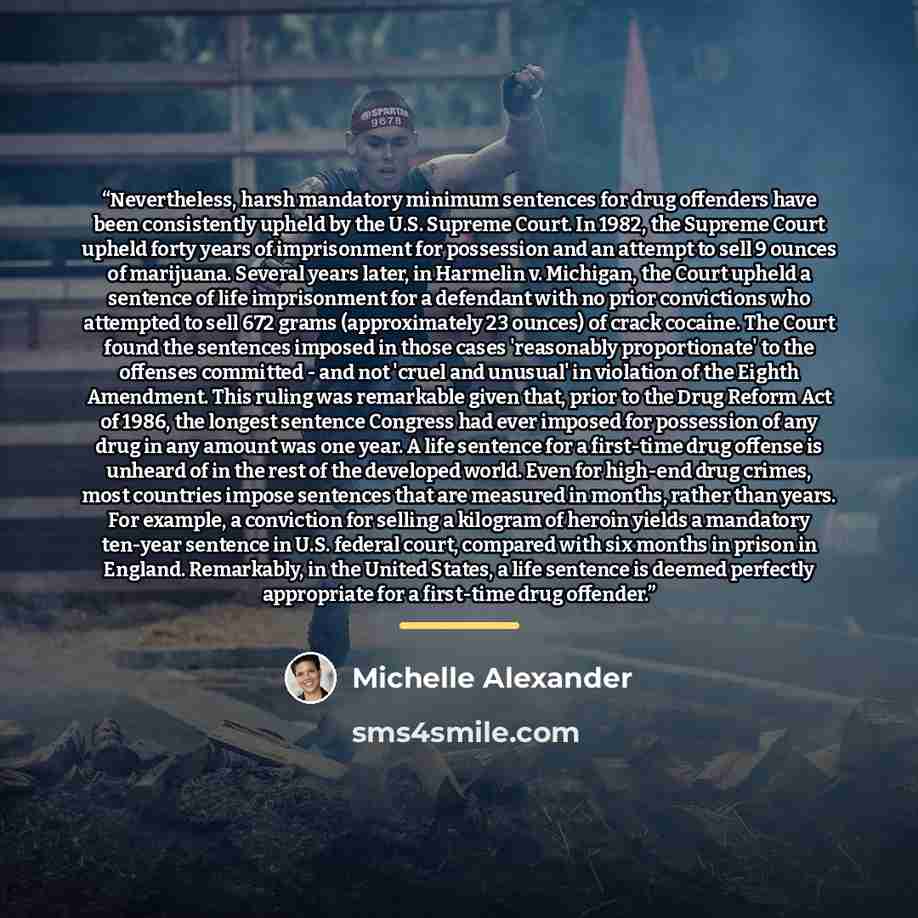
““Nevertheless, harsh mandatory minimum sentences for drug offenders have been consistently upheld by the U.S. Supreme Court. In 1982, the Supreme Court upheld forty years of imprisonment for possession and an attempt to sell 9 ounces of marijuana. Several years later, in Harmelin v. Michigan, the Court upheld a sentence of life imprisonment for a defendant with no prior convictions who attempted to sell 672 grams (approximately 23 ounces) of crack cocaine. The Court found the sentences imposed in those cases 'reasonably proportionate' to the offenses committed - and not 'cruel and unusual' in violation of the Eighth Amendment. This ruling was remarkable given that, prior to the Drug Reform Act of 1986, the longest sentence Congress had ever imposed for possession of any drug in any amount was one year. A life sentence for a first-time drug offense is unheard of in the rest of the developed world. Even for high-end drug crimes, most countries impose sentences that are measured in months, rather than years. For example, a conviction for selling a kilogram of heroin yields a mandatory ten-year sentence in U.S. federal court, compared with six months in prison in England. Remarkably, in the United States, a life sentence is deemed perfectly appropriate for a first-time drug offender.””
About This Quote
Source Book: The New Jim Crow, 2010
U.S. courts have imposed disproportionately harsh, life‑long sentences for first‑time drug offenses, reflecting a punitive system unlike most nations.
In simple terms: Harsh drug sentences are unusually severe in the U.S.
Key Takeaway
Advocate for sentencing reform.
Themes
justice
law
punishment
inequality
Mood
critical
urgent
Type
analytical
call‑to‑action
When to use this quote
- policy advocacy
- legal defense
- community education
Key Concepts
criminal justice reform
human rights
Questions to Reflect On
- How can societies balance deterrence and fairness?
- What alternatives exist to incarceration?
A Different Perspective
Reforms face political resistance and entrenched interests.













![“[T]he slave went free; stood a brief moment in the sun; then moved back again toward slavery. —W.E.B Du Bois, Black Reconstruction in America For” quote by Michelle Alexander](https://sms4smile.com/quotes/img-quotes/fdb/michelle-alexander-750_slavery_t-he-slave-went-free-stood-a-brief-momen_96485.jpg)








![“I learned more in those six months [ in the White House] than in the prior six years. I don't think that anybody who has had the privilege to serve the country at that level should walk out and behave like a crybaby. And I plan to continue to serve the country in other capacities.” quote by Van Jones](https://sms4smile.com/quotes/img-quotes/3dc/van-jones-984_behave_i-learned-more-in-those-six-months-in-th_27061.jpg)