American politics Quote by Michael Wolff
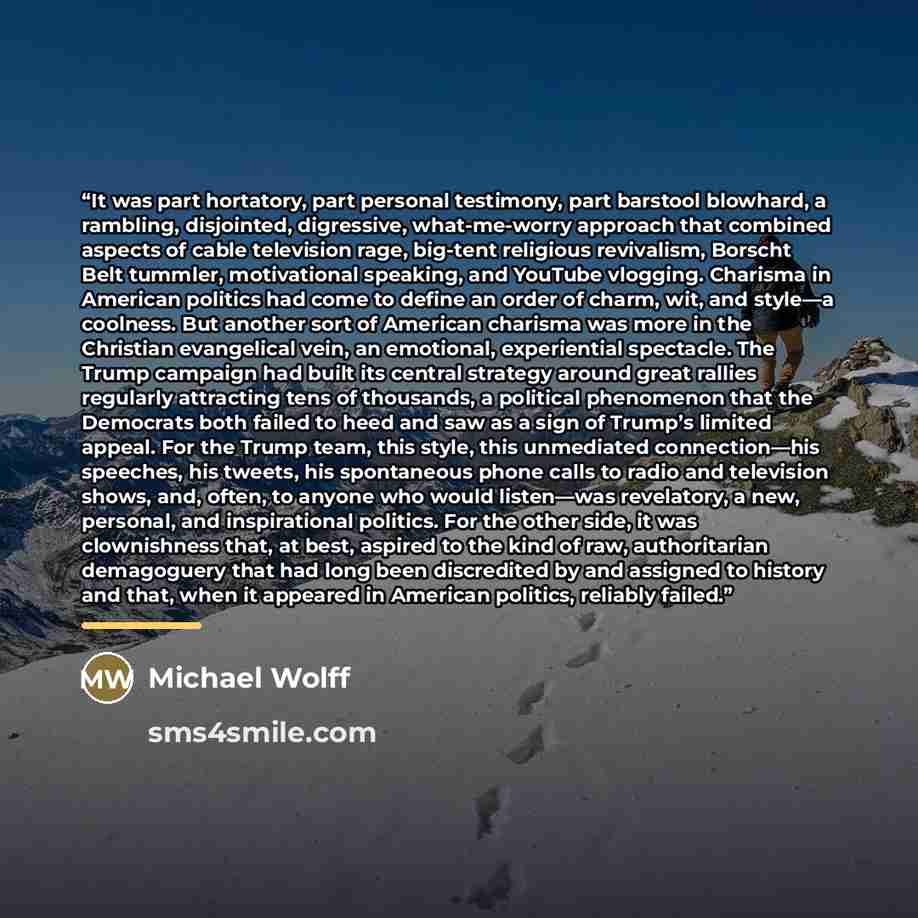
““It was part hortatory, part personal testimony, part barstool blowhard, a rambling, disjointed, digressive, what-me-worry approach that combined aspects of cable television rage, big-tent religious revivalism, Borscht Belt tummler, motivational speaking, and YouTube vlogging. Charisma in American politics had come to define an order of charm, wit, and style—a coolness. But another sort of American charisma was more in the Christian evangelical vein, an emotional, experiential spectacle. The Trump campaign had built its central strategy around great rallies regularly attracting tens of thousands, a political phenomenon that the Democrats both failed to heed and saw as a sign of Trump’s limited appeal. For the Trump team, this style, this unmediated connection—his speeches, his tweets, his spontaneous phone calls to radio and television shows, and, often, to anyone who would listen—was revelatory, a new, personal, and inspirational politics. For the other side, it was clownishness that, at best, aspired to the kind of raw, authoritarian demagoguery that had long been discredited by and assigned to history and that, when it appeared in American politics, reliably failed.””
About This Quote
Source Book: “Fire and Fury: Inside the Trump White House” by Michael Wolff, 2018
The passage contrasts two styles of American political charisma: the polished, media‑savvy charisma of Trump versus the emotive, evangelical charisma of his supporters, highlighting how both are seen as either inspiring or clownish.
In simple terms: Two types of political charisma are described and judged differently.
Key Takeaway
Recognize how charisma can mask underlying motives.
Themes
politics
charisma
media
populism
religion
Mood
critical
analytical
skeptical
Type
observational
critical
analytical
When to use this quote
- campaign rallies
- social media outreach
- political speeches
- public perception
- media analysis
Key Concepts
media influence
populist rhetoric
personal branding
Questions to Reflect On
- How does charisma affect voter perception?
- What are the risks of equating style with substance?
A Different Perspective
The description may overgeneralize or simplify complex political dynamics.