Blink of an eye Quote by Michael Crichton

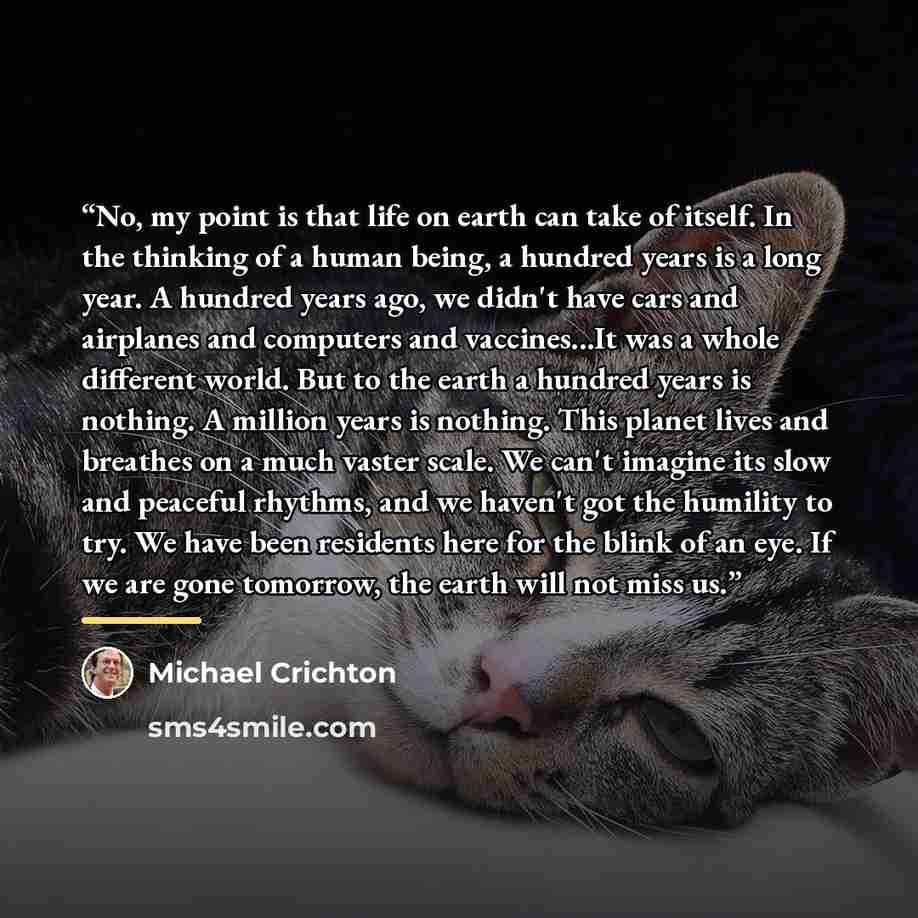
““You think man can destroy the planet? What intoxicating vanity. Let me tell you about our planet. Earth is four-and-a-half-billion-years-old. There's been life on it for nearly that long, 3.8 billion years. Bacteria first; later the first multicellular life, then the first complex creatures in the sea, on the land. Then finally the great sweeping ages of animals, the amphibians, the dinosaurs, at last the mammals, each one enduring millions on millions of years, great dynasties of creatures rising, flourishing, dying away -- all this against a background of continuous and violent upheaval. Mountain ranges thrust up, eroded away, cometary impacts, volcano eruptions, oceans rising and falling, whole continents moving, an endless, constant, violent change, colliding, buckling to make mountains over millions of years. Earth has survived everything in its time. It will certainly survive us. If all the nuclear weapons in the world went off at once and all the plants, all the animals died and the earth was sizzling hot for a hundred thousand years, life would survive, somewhere: under the soil, frozen in Arctic ice. Sooner or later, when the planet was no longer inhospitable, life would spread again. The evolutionary process would begin again. It might take a few billion years for life to regain its present variety. Of course, it would be very different from what it is now, but the earth would survive our folly, only we would not. If the ozone layer gets thinner, ultraviolet radiation sears the earth, so what? Ultraviolet radiation is good for life. It's powerful energy. It promotes mutation, change. Many forms of life will thrive with more UV radiation. Many others will die out. Do you think this is the first time that's happened? Think about oxygen. Necessary for life now, but oxygen is actually a metabolic poison, a corrosive glass, like fluorine. When oxygen was first produced as a waste product by certain plant cells some three billion years ago, it created a crisis for all other life on earth. Those plants were polluting the environment, exhaling a lethal gas. Earth eventually had an atmosphere incompatible with life. Nevertheless, life on earth took care of itself. In the thinking of the human being a hundred years is a long time. A hundred years ago we didn't have cars, airplanes, computers or vaccines. It was a whole different world, but to the earth, a hundred years is nothing. A million years is nothing. This planet lives and breathes on a much vaster scale. We can't imagine its slow and powerful rhythms, and we haven't got the humility to try. We've been residents here for the blink of an eye. If we're gone tomorrow, the earth will not miss us.””
About This Quote
Source Interview: Michael Crichton on environmental resilience, 1990s
The quote emphasizes Earth's long history of surviving massive catastrophes and suggests that while the planet endures, humanity may not survive our own destructive actions.
In simple terms: Earth out survive humanity; life persists through extreme change.
Key Takeaway
Recognize humanity's impact and act responsibly.
Themes
environmental stewardship
human fragility
geological time
evolutionary resilience
Mood
concerned
reflective
urgent
Type
philosophical
warning
inspirational
When to use this quote
- climate policy debates
- nuclear disarmament
- education on deep time
- personal lifestyle choices
- corporate environmental responsibility
Key Concepts
planetary science
anthropocene
existential risk
Questions to Reflect On
- How can we balance technological progress with planetary health?
- What responsibilities arise from knowing Earth's resilience?
A Different Perspective
The quote may downplay the unique role of human civilization in shaping future ecosystems.