Being Quote by Martin Heidegger
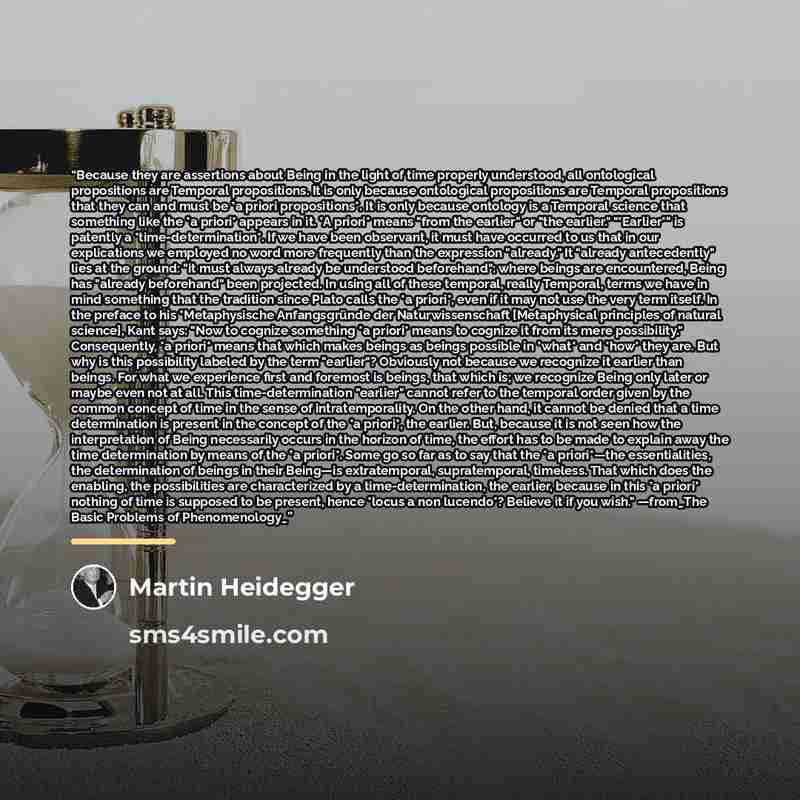
““Because they are assertions about Being in the light of time properly understood, all ontological propositions are Temporal propositions. It is only because ontological propositions are Temporal propositions that they can and must be *a priori propositions*. It is only because ontology is a Temporal science that something like the *a priori* appears in it. *A priori* means "from the earlier" or "the earlier." "*Earlier*" is patently a *time-determination*. If we have been observant, it must have occurred to us that in our explications we employed no word more frequently than the expression "already." It "already antecedently" lies at the ground: "it must always already be understood beforehand": where beings are encountered, Being has "already beforehand" been projected. In using all of these temporal, really Temporal, terms we have in mind something that the tradition since Plato calls the *a priori*, even if it may not use the very term itself. In the preface to his *Metaphysische Anfangsgründe der Naturwissenschaft [Metaphysical principles of natural science], Kant says: "Now to cognize something *a priori* means to cognize it from its mere possibility." Consequently, *a priori* means that which makes beings as beings possible in *what* and *how* they are. But why is this possibility labeled by the term "earlier"? Obviously not because we recognize it earlier than beings. For what we experience first and foremost is beings, that which is; we recognize Being only later or maybe even not at all. This time-determination "earlier" cannot refer to the temporal order given by the common concept of time in the sense of intratemporality. On the other hand, it cannot be denied that a time determination is present in the concept of the *a priori*, the earlier. But, because it is not seen how the interpretation of Being necessarily occurs in the horizon of time, the effort has to be made to explain away the time determination by means of the *a priori*. Some go so far as to say that the *a priori*―the essentialities, the determination of beings in their Being―is extratemporal, supratemporal, timeless. That which does the enabling, the possibilities are characterized by a time-determination, the earlier, because in this *a priori* nothing of time is supposed to be present, hence *locus a non lucendo*? Believe it if you wish." ―from_The Basic Problems of Phenomenology_””
About This Quote
Source Book: Being and Time, Martin Heidegger, 1927
Ontological statements are inherently temporal, making them a priori because they presuppose time's role in understanding being.
In simple terms: Being statements rely on time, so they are known before experience.
Key Takeaway
Recognize time’s role in philosophical foundations.
Themes
ontologyology
time
a priori
philosophy
Mood
reflective
analytical
Type
philosophical
theoretical
When to use this quote
- Academic lecture
- philosophical writing
- teaching
- research
- debate
Key Concepts
Temporal logic
existential analysis
Kantian influence
Questions to Reflect On
- How does time shape our basic concepts?
- Can a priori knowledge exist without temporal reference?
A Different Perspective
Some argue a priori knowledge can be non‑temporal, challenging this view.