Anger Quote by Martha Nussbaum
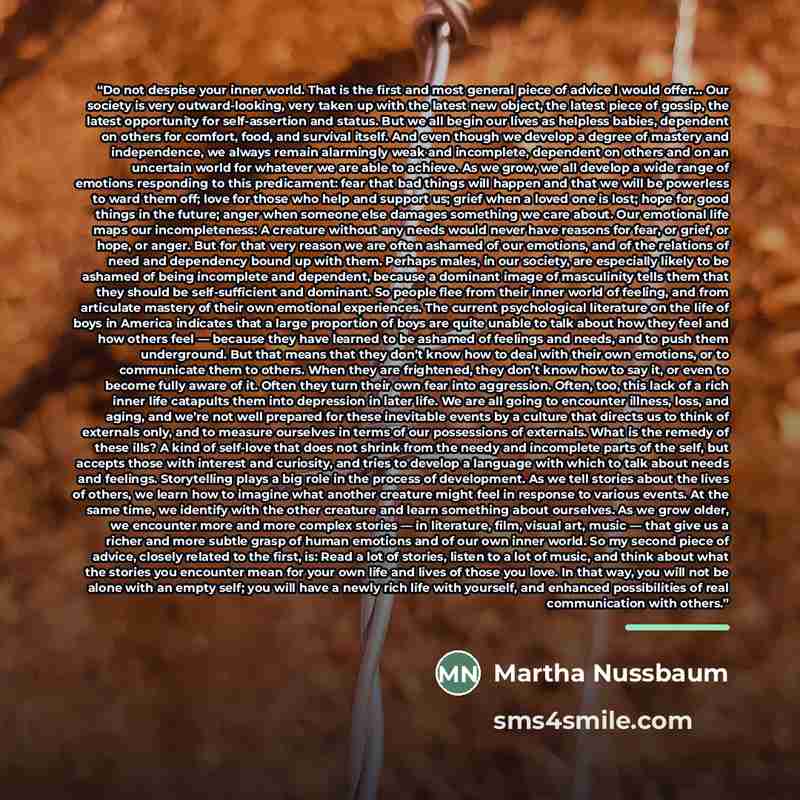
““Do not despise your inner world. That is the first and most general piece of advice I would offer… Our society is very outward-looking, very taken up with the latest new object, the latest piece of gossip, the latest opportunity for self-assertion and status. But we all begin our lives as helpless babies, dependent on others for comfort, food, and survival itself. And even though we develop a degree of mastery and independence, we always remain alarmingly weak and incomplete, dependent on others and on an uncertain world for whatever we are able to achieve. As we grow, we all develop a wide range of emotions responding to this predicament: fear that bad things will happen and that we will be powerless to ward them off; love for those who help and support us; grief when a loved one is lost; hope for good things in the future; anger when someone else damages something we care about. Our emotional life maps our incompleteness: A creature without any needs would never have reasons for fear, or grief, or hope, or anger. But for that very reason we are often ashamed of our emotions, and of the relations of need and dependency bound up with them. Perhaps males, in our society, are especially likely to be ashamed of being incomplete and dependent, because a dominant image of masculinity tells them that they should be self-sufficient and dominant. So people flee from their inner world of feeling, and from articulate mastery of their own emotional experiences. The current psychological literature on the life of boys in America indicates that a large proportion of boys are quite unable to talk about how they feel and how others feel — because they have learned to be ashamed of feelings and needs, and to push them underground. But that means that they don’t know how to deal with their own emotions, or to communicate them to others. When they are frightened, they don’t know how to say it, or even to become fully aware of it. Often they turn their own fear into aggression. Often, too, this lack of a rich inner life catapults them into depression in later life. We are all going to encounter illness, loss, and aging, and we’re not well prepared for these inevitable events by a culture that directs us to think of externals only, and to measure ourselves in terms of our possessions of externals. What is the remedy of these ills? A kind of self-love that does not shrink from the needy and incomplete parts of the self, but accepts those with interest and curiosity, and tries to develop a language with which to talk about needs and feelings. Storytelling plays a big role in the process of development. As we tell stories about the lives of others, we learn how to imagine what another creature might feel in response to various events. At the same time, we identify with the other creature and learn something about ourselves. As we grow older, we encounter more and more complex stories — in literature, film, visual art, music — that give us a richer and more subtle grasp of human emotions and of our own inner world. So my second piece of advice, closely related to the first, is: Read a lot of stories, listen to a lot of music, and think about what the stories you encounter mean for your own life and lives of those you love. In that way, you will not be alone with an empty self; you will have a newly rich life with yourself, and enhanced possibilities of real communication with others.””
About This Quote
Source Book: The Fragility of Goodness, Martha Nussbaum, 2001
We are inherently dependent and emotionally incomplete, yet society pressures us to deny this, leading to shame and maladaptive coping.
In simple terms: Humans need others and feel emotions, but cultural expectations hide this truth.
Key Takeaway
Accept dependence and explore emotions openly.
Themes
dependence
emotion
masculinity
societal pressure
psychology
Mood
reflective
empathetic
Type
philosophical
inspirational
When to use this quote
- parenting
- therapy
- education
- personal growth
- relationship building
Key Concepts
human needs
emotional intelligence
masculine identity
social conditioning
Questions to Reflect On
- How can we create safe spaces for men to discuss feelings?
- What practices help integrate emotional awareness into daily life?
A Different Perspective
Men may resist emotional openness due to entrenched masculine ideals, limiting emotional health.
![“[W]hat is ordinarily felt as the wayward, unpredictable, dangerous, and even hostile world - including one's capricious emotions and inner feelings - is actually one's own being and doing. The very sense that this is not so is, in turn, part of its being so,” quote by Alan W. Watts](https://sms4smile.com/quotes/img-quotes/541/alan-w-watts-9497_inner-feelings_w-hat-is-ordinarily-felt-as-the-wayward_3005743.jpg)


![“Not in order to justify, but simply in order to explain my lack of consistency, I say: Look at my present life and then at my former life, and you will see that I do attempt to carry them out. It is true that I have not fulfilled one thousandth part of them [Christian precepts], and I am ashamed…” quote by Leo Tolstoy](https://sms4smile.com/quotes/img-quotes/4c6/leo-tolstoy-55_accountability_not-in-order-to-justify-but-simply-in-or_623047.jpg)