Extinct Quote by Mark Carwardine
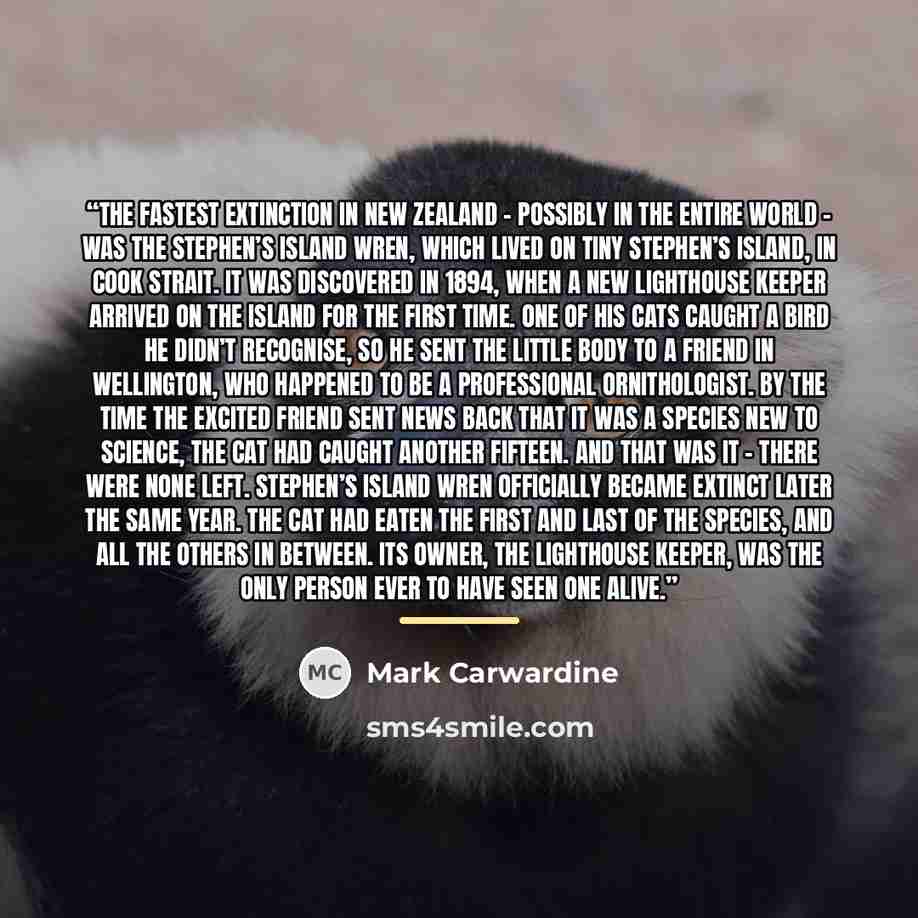
““The fastest extinction in New Zealand – possibly in the entire world – was the Stephen’s Island wren, which lived on tiny Stephen’s Island, in Cook Strait. It was discovered in 1894, when a new lighthouse keeper arrived on the island for the first time. One of his cats caught a bird he didn’t recognise, so he sent the little body to a friend in Wellington, who happened to be a professional ornithologist. By the time the excited friend sent news back that it was a species new to science, the cat had caught another fifteen. And that was it – there were none left. Stephen’s Island wren officially became extinct later the same year. The cat had eaten the first and last of the species, and all the others in between. Its owner, the lighthouse keeper, was the only person ever to have seen one alive.””
About This Quote
Source Article: “The Fastest Extinction” by Mark Carwardine, BBC Wildlife Magazine, 2020
A species can disappear instantly when human actions, even accidental ones, eradicate its last individuals.
In simple terms: Human impact can cause immediate extinction.
Key Takeaway
Protect vulnerable species before they vanish.
Themes
conservation
extinction
human impact
Mood
sad
urgent
reflective
Type
warning
educational
contemplative
When to use this quote
- wildlife monitoring
- biosecurity
- education
- policy making
Key Concepts
ecology
species vulnerability
anthropogenic loss
Questions to Reflect On
- How can we better detect and protect unknown species?
- What responsibilities do we have for accidental harms?
A Different Perspective
Extinction may be irreversible, and unknown species could be lost unnoticed.


![“In ten years [i.e., 1980] all important animal life in the sea will be extinct. Large areas of coastline will have to be evacuated because of the stench of dead fish.” quote by Paul R. Ehrlich](https://sms4smile.com/quotes/img-quotes/552/paul-r-ehrlich-13046_animal_in-ten-years-i-e-1980-all-important-anim_180543.jpg)