Asking questions Quote by Marilyn French
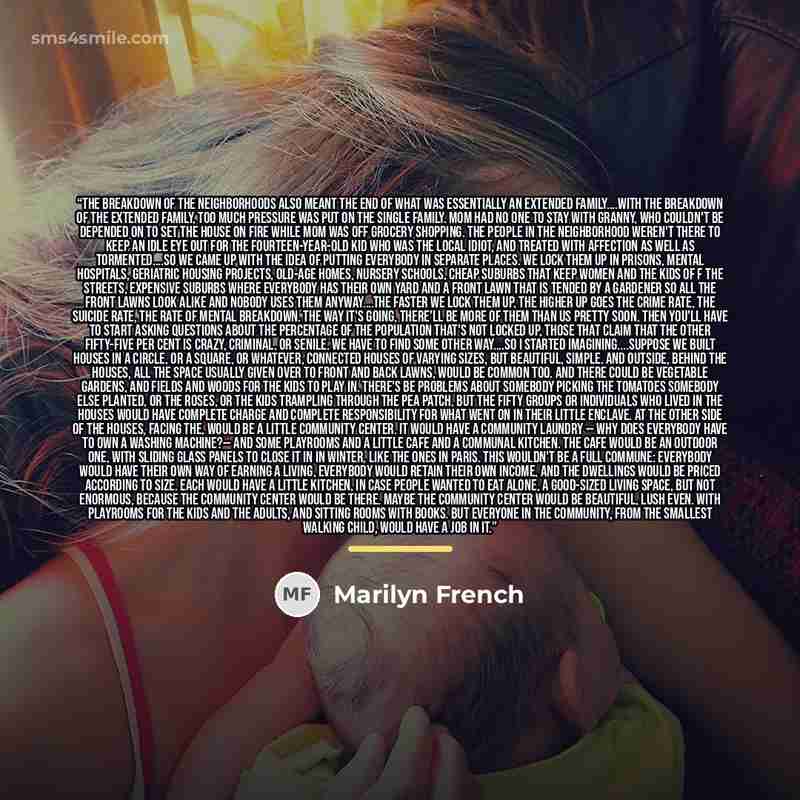
““The breakdown of the neighborhoods also meant the end of what was essentially an extended family…With the breakdown of the extended family, too much pressure was put on the single family. Mom had no one to stay with Granny, who couldn't be depended on to set the house on fire while Mom was off grocery shopping. The people in the neighborhood weren't there to keep an idle eye out for the fourteen-year-old kid who was the local idiot, and treated with affection as well as tormented…So we came up with the idea of putting everybody in separate places. We lock them up in prisons, mental hospitals, geriatric housing projects, old-age homes, nursery schools, cheap suburbs that keep women and the kids of f the streets, expensive suburbs where everybody has their own yard and a front lawn that is tended by a gardener so all the front lawns look alike and nobody uses them anyway…the faster we lock them up, the higher up goes the crime rate, the suicide rate, the rate of mental breakdown. The way it's going, there'll be more of them than us pretty soon. Then you'll have to start asking questions about the percentage of the population that's not locked up, those that claim that the other fifty-five per cent is crazy, criminal, or senile. WE have to find some other way…So I started imagining…Suppose we built houses in a circle, or a square, or whatever, connected houses of varying sizes, but beautiful, simple. And outside, behind the houses, all the space usually given over to front and back lawns, would be common too. And there could be vegetable gardens, and fields and woods for the kids to play in. There's be problems about somebody picking the tomatoes somebody else planted, or the roses, or the kids trampling through the pea patch, but the fifty groups or individuals who lived in the houses would have complete charge and complete responsibility for what went on in their little enclave. At the other side of the houses, facing the, would be a little community center. It would have a community laundry -- why does everybody have to own a washing machine?-- and some playrooms and a little cafe and a communal kitchen. The cafe would be an outdoor one, with sliding glass panels to close it in in winter, like the ones in Paris. This wouldn't be a full commune: everybody would have their own way of earning a living, everybody would retain their own income, and the dwellings would be priced according to size. Each would have a little kitchen, in case people wanted to eat alone, a good-sized living space, but not enormous, because the community center would be there. Maybe the community center would be beautiful, lush even. With playrooms for the kids and the adults, and sitting rooms with books. But everyone in the community, from the smallest walking child, would have a job in it.””
About This Quote
The passage critiques modern social isolation, arguing that dismantling communal bonds forces individuals into institutional confinement, which exacerbates social and mental health crises.
In simple terms: Isolation fuels systemic breakdown.
Key Takeaway
Rebuild shared spaces to restore community resilience.
Themes
social isolation
urban design
community responsibility
mental health
institutionalization
collective well‑being
Mood
reflective
concerned
hopeful
Type
social critique
visionary proposal
When to use this quote
- urban planning meetings
- neighborhood watch programs
- co‑housing initiatives
- community garden projects
Key Concepts
neighborhood cohesion
shared resources
environmental design
social support networks
Practical Applications
- Design mixed‑use housing with communal areas
- Create policies that incentivize shared public spaces
Questions to Reflect On
- How might shared spaces be balanced with personal privacy?
- What policies could prevent the over‑institutionalization of vulnerable populations?
A Different Perspective
Some argue that individual autonomy and privacy are compromised in tightly knit communal settings, potentially leading to conformity pressures.