Curiosity Quote by Margaret Atwood
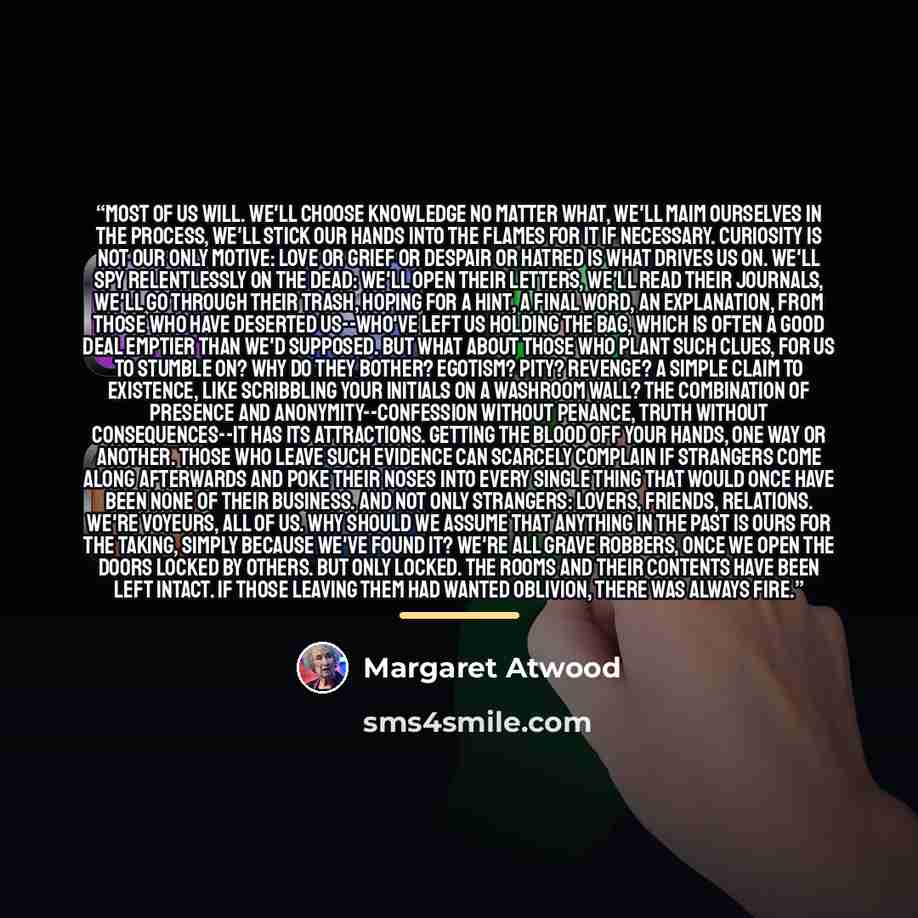
““Most of us will. We'll choose knowledge no matter what, we'll maim ourselves in the process, we'll stick our hands into the flames for it if necessary. Curiosity is not our only motive: love or grief or despair or hatred is what drives us on. We'll spy relentlessly on the dead: we'll open their letters, we'll read their journals, we'll go through their trash, hoping for a hint, a final word, an explanation, from those who have deserted us--who've left us holding the bag, which is often a good deal emptier than we'd supposed. But what about those who plant such clues, for us to stumble on? Why do they bother? Egotism? Pity? Revenge? A simple claim to existence, like scribbling your initials on a washroom wall? The combination of presence and anonymity--confession without penance, truth without consequences--it has its attractions. Getting the blood off your hands, one way or another. Those who leave such evidence can scarcely complain if strangers come along afterwards and poke their noses into every single thing that would once have been none of their business. And not only strangers: lovers, friends, relations. We're voyeurs, all of us. Why should we assume that anything in the past is ours for the taking, simply because we've found it? We're all grave robbers, once we open the doors locked by others. But only locked. The rooms and their contents have been left intact. If those leaving them had wanted oblivion, there was always fire.””
About This Quote
The passage explores humanity's relentless drive to seek knowledge and meaning through the remnants of others, driven by complex emotions beyond curiosity, and questions the moral implications of invading privacy and extracting meaning from the dead.
In simple terms: Human curiosity mixed with deeper emotions fuels invasive inquiry into the past.
Key Takeaway
We are compelled to uncover hidden truths, even at ethical costs.
Themes
curiosity
mortality
ethics
memory
voyeurism
motivation
Mood
intrigue
melancholy
caution
Type
philosophical
reflective
critical
When to use this quote
- researching a deceased author's unpublished letters
- investigating a family's hidden past
- examining a friend's discarded diary
- exploring a lover's secret messages
Key Concepts
knowledge pursuit
emotional drivers
privacy invasion
historical reconstruction
Practical Applications
- archival research
- forensic psychology
Questions to Reflect On
- What responsibilities do we have to the dead when we uncover their secrets?
- How do our personal motives shape the way we interpret historical artifacts?
A Different Perspective
Some argue that respecting the dead's privacy is paramount, suggesting that the quest for knowledge should not override consent.