Books Quote by M. Scott Peck
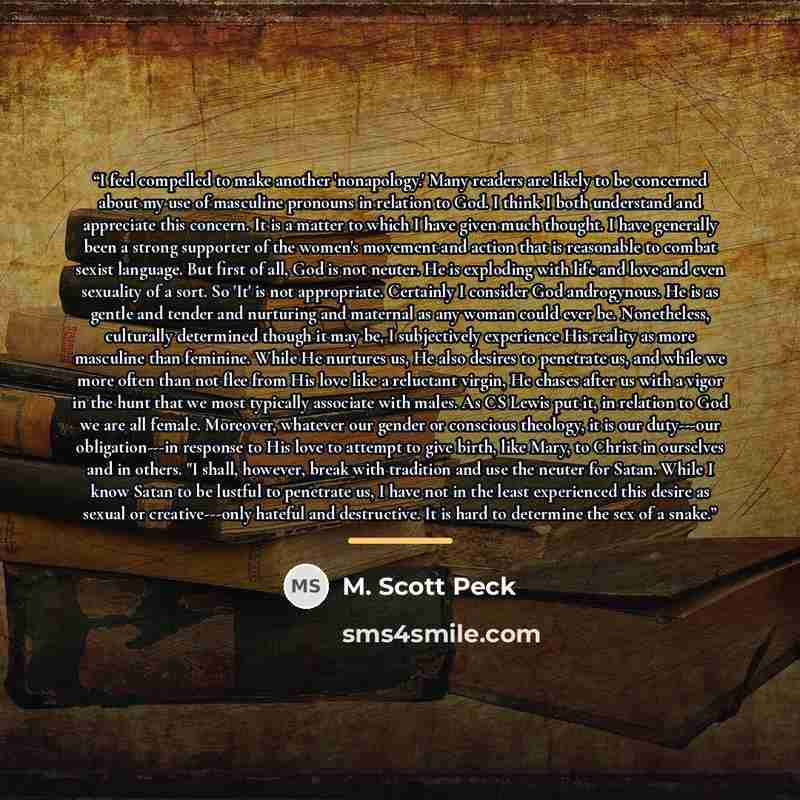
““I feel compelled to make another 'nonapology.' Many readers are likely to be concerned about my use of masculine pronouns in relation to God. I think I both understand and appreciate this concern. It is a matter to which I have given much thought. I have generally been a strong supporter of the women's movement and action that is reasonable to combat sexist language. But first of all, God is not neuter. He is exploding with life and love and even sexuality of a sort. So 'It' is not appropriate. Certainly I consider God androgynous. He is as gentle and tender and nurturing and maternal as any woman could ever be. Nonetheless, culturally determined though it may be, I subjectively experience His reality as more masculine than feminine. While He nurtures us, He also desires to penetrate us, and while we more often than not flee from His love like a reluctant virgin, He chases after us with a vigor in the hunt that we most typically associate with males. As CS Lewis put it, in relation to God we are all female. Moreover, whatever our gender or conscious theology, it is our duty---our obligation---in response to His love to attempt to give birth, like Mary, to Christ in ourselves and in others. "I shall, however, break with tradition and use the neuter for Satan. While I know Satan to be lustful to penetrate us, I have not in the least experienced this desire as sexual or creative---only hateful and destructive. It is hard to determine the sex of a snake.””
About This Quote
The author argues that God is best described with masculine imagery due to cultural perceptions, while Satan is genderless, acknowledging the difficulty of assigning gender to divine or demonic entities.
In simple terms: God is seen as masculine; Satan as genderless; gender language is complex.
Key Takeaway
Consider how gendered language shapes spiritual views.
Themes
theology
gender
language
Mood
contemplative
critical
Type
theological
philosophical
When to use this quote
- religious discourse
- personal belief
- gender studies
- interfaith dialogue
Key Concepts
Divine anthropology
masculine/feminine archetypes
Questions to Reflect On
- Do gendered metaphors help or hinder spiritual understanding?
- How might a non‑binary view of divinity change worship?
A Different Perspective
The argument may impose binary gender norms on a concept many view as beyond gender.

![“Whom can you consider as God? It is he who has become completely independent in this world and he does not have anyone above [superior] him, he is God. When one cannot even see his dependency, how can he realize his own independence?” quote by Dada Bhagwan](https://sms4smile.com/quotes/img-quotes/9ab/dada-bhagwan-31_god_whom-can-you-consider-as-god-it-is-he-wh_1870184.jpg)