Two months Quote by Lynne Olson
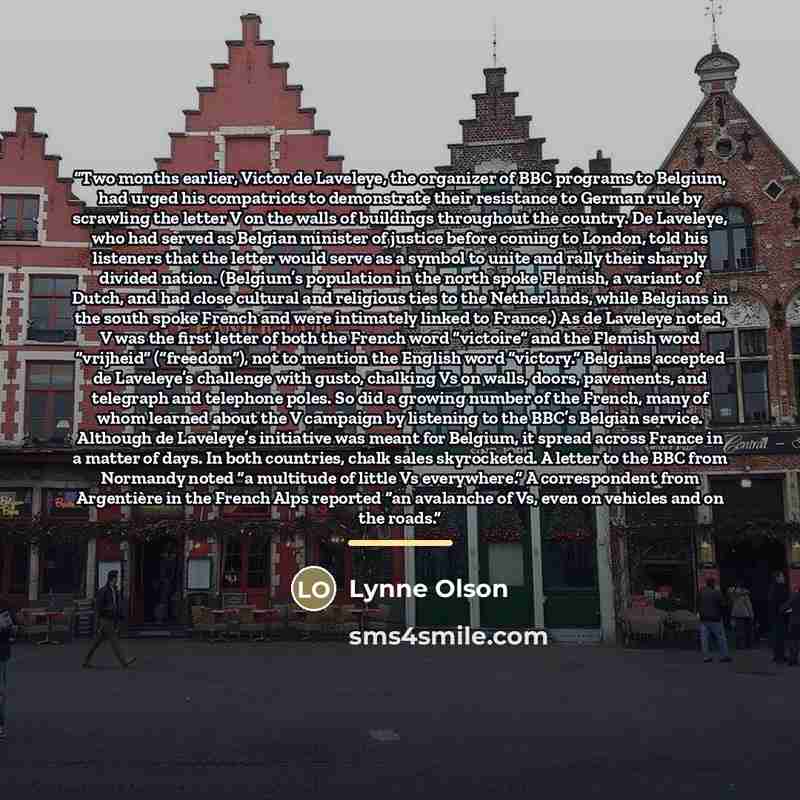
““Two months earlier, Victor de Laveleye, the organizer of BBC programs to Belgium, had urged his compatriots to demonstrate their resistance to German rule by scrawling the letter V on the walls of buildings throughout the country. De Laveleye, who had served as Belgian minister of justice before coming to London, told his listeners that the letter would serve as a symbol to unite and rally their sharply divided nation. (Belgium’s population in the north spoke Flemish, a variant of Dutch, and had close cultural and religious ties to the Netherlands, while Belgians in the south spoke French and were intimately linked to France.) As de Laveleye noted, V was the first letter of both the French word “victoire” and the Flemish word “vrijheid” (“freedom”), not to mention the English word “victory.” Belgians accepted de Laveleye’s challenge with gusto, chalking Vs on walls, doors, pavements, and telegraph and telephone poles. So did a growing number of the French, many of whom learned about the V campaign by listening to the BBC’s Belgian service. Although de Laveleye’s initiative was meant for Belgium, it spread across France in a matter of days. In both countries, chalk sales skyrocketed. A letter to the BBC from Normandy noted “a multitude of little Vs everywhere.” A correspondent from Argentière in the French Alps reported “an avalanche of Vs, even on vehicles and on the roads.””
About This Quote
Source Historical: BBC Broadcast, Belgium, 1940s, WWII resistance campaign
A simple symbol, the letter V, unified a divided nation against occupation, spreading resistance and hope.
In simple terms: V symbolized victory and freedom, rallying people.
Key Takeaway
Use symbols to unite for a cause.
Themes
resistance
unity
symbolism
Mood
inspirational
reflective
Type
historical
political
When to use this quote
- occupied Europe
- national solidarity
- grassroots campaigns
- propaganda efforts
Key Concepts
history
social movements
Questions to Reflect On
- How can a symbol stay inclusive?
- What modern symbols unite people today?
A Different Perspective
Symbols can be misinterpreted or co‑opted by opposing groups.




![“In Europe, Murrow observed to his wife, people were dying and "a thousand years of civilization [were] being smashed" while America remained on the sidelines. How could one possibly be objective or neutral about that?” quote by Lynne Olson](https://sms4smile.com/quotes/img-quotes/4da/lynne-olson-34648_edward-r-murrow_in-europe-murrow-observed-to-his-wife-pe_639932.jpg)

![“I wrote an article about the marine landing [in Haiti] right away, but barely mentioned the oil, because my article would come out two months later and I assumed by then, "of course, everybody knows." Nobody knew. There was a news report in the Wall Street Journal, in the petroleum journals, and…” quote by Noam Chomsky](https://sms4smile.com/quotes/img-quotes/dc5/noam-chomsky-42_articles_i-wrote-an-article-about-the-marine-land_13341.jpg)