Next step Quote by Lee Smolin
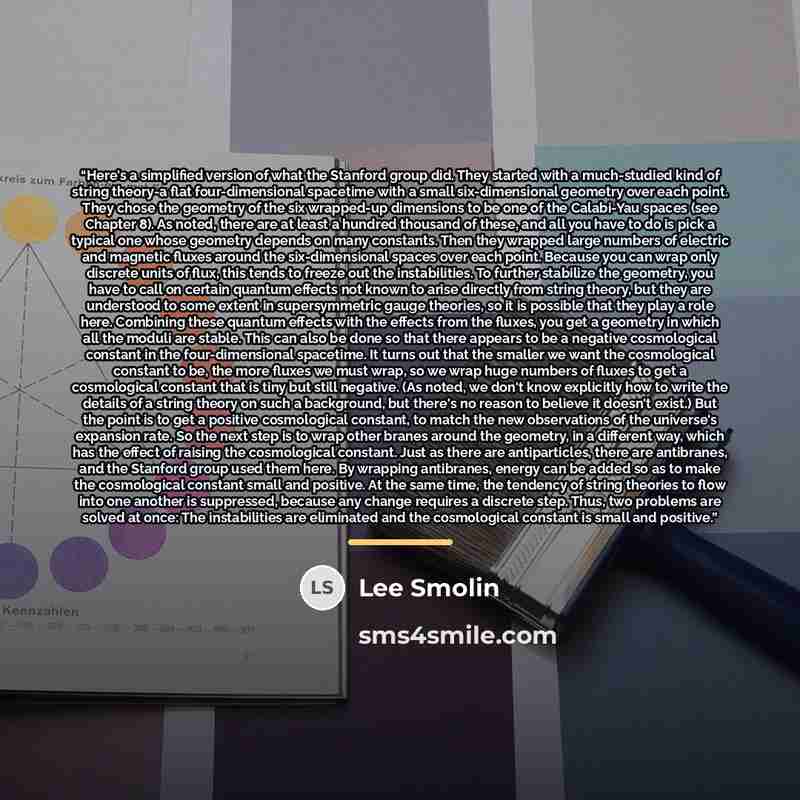
““Here's a simplified version of what the Stanford group did. They started with a much-studied kind of string theory-a flat four-dimensional spacetime with a small six-dimensional geometry over each point. They chose the geometry of the six wrapped-up dimensions to be one of the Calabi-Yau spaces (see Chapter 8). As noted, there are at least a hundred thousand of these, and all you have to do is pick a typical one whose geometry depends on many constants. Then they wrapped large numbers of electric and magnetic fluxes around the six-dimensional spaces over each point. Because you can wrap only discrete units of flux, this tends to freeze out the instabilities. To further stabilize the geometry, you have to call on certain quantum effects not known to arise directly from string theory, but they are understood to some extent in supersymmetric gauge theories, so it is possible that they play a role here. Combining these quantum effects with the effects from the fluxes, you get a geometry in which all the moduli are stable. This can also be done so that there appears to be a negative cosmological constant in the four-dimensional spacetime. It turns out that the smaller we want the cosmological constant to be, the more fluxes we must wrap, so we wrap huge numbers of fluxes to get a cosmological constant that is tiny but still negative. (As noted, we don't know explicitly how to write the details of a string theory on such a background, but there's no reason to believe it doesn't exist.) But the point is to get a positive cosmological constant, to match the new observations of the universe's expansion rate. So the next step is to wrap other branes around the geometry, in a different way, which has the effect of raising the cosmological constant. Just as there are antiparticles, there are antibranes, and the Stanford group used them here. By wrapping antibranes, energy can be added so as to make the cosmological constant small and positive. At the same time, the tendency of string theories to flow into one another is suppressed, because any change requires a discrete step. Thus, two problems are solved at once: The instabilities are eliminated and the cosmological constant is small and positive.””
About This Quote
Source Lecture: String Theory and the Landscape, Stanford University, 2005
The passage describes how physicists use flux compactifications and antibranes to stabilize extra dimensions and adjust the cosmological constant, aiming for a small positive value matching observations.
In simple terms: Physicists manipulate extra dimensions with fluxes and branes to achieve a tiny positive cosmological constant.
Key Takeaway
Use fluxes and antibranes to tune vacuum energy.
Themes
theoretical physics
cosmology
string theory
moduli stabilization
anthropic principle
Mood
analytical
speculative
Type
scientific
technical
When to use this quote
- research seminars
- graduate coursework
- theoretical model building
- cosmological constant problem
- anthropic reasoning
Key Concepts
flux compactification
Calabi‑Yau manifolds
antibranes
quantum effects
vacuum energy
Questions to Reflect On
- What experimental signatures could test these constructions?
- How robust are the conclusions under different compactification choices?
A Different Perspective
The approach relies on many assumptions and untested quantum effects, making predictions uncertain.