Lower class Quote by Kaiten Nukariya
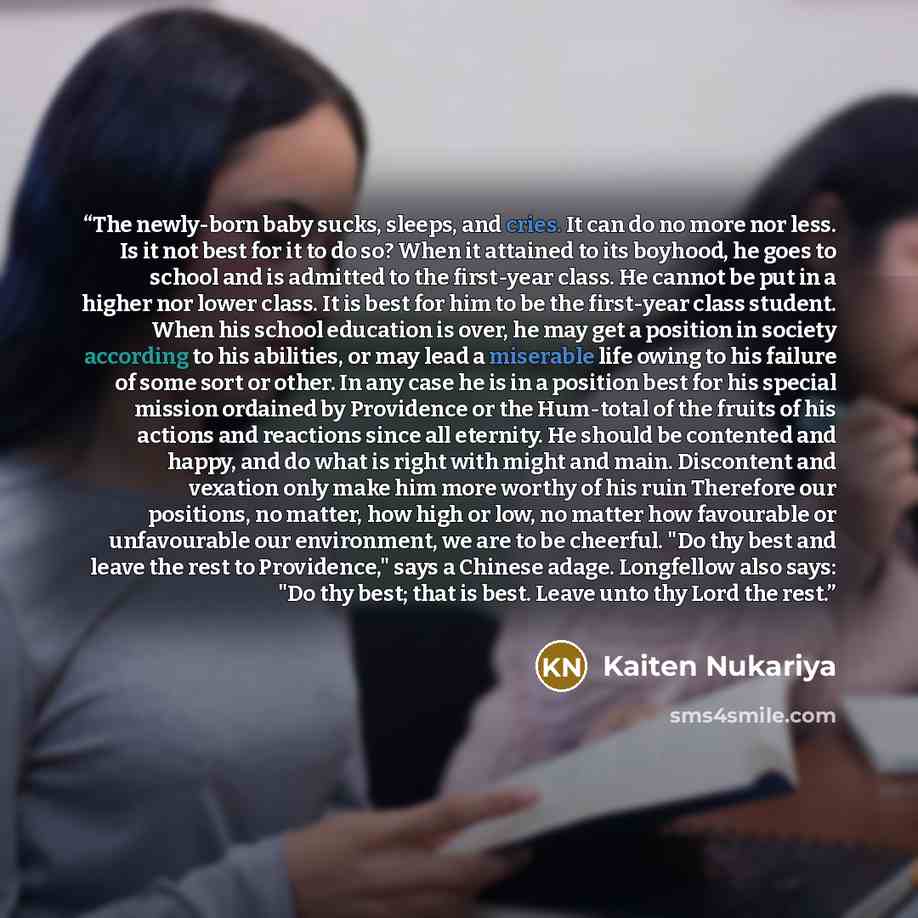
““The newly-born baby sucks, sleeps, and cries. It can do no more nor less. Is it not best for it to do so? When it attained to its boyhood, he goes to school and is admitted to the first-year class. He cannot be put in a higher nor lower class. It is best for him to be the first-year class student. When his school education is over, he may get a position in society according to his abilities, or may lead a miserable life owing to his failure of some sort or other. In any case he is in a position best for his special mission ordained by Providence or the Hum-total of the fruits of his actions and reactions since all eternity. He should be contented and happy, and do what is right with might and main. Discontent and vexation only make him more worthy of his ruin Therefore our positions, no matter, how high or low, no matter how favourable or unfavourable our environment, we are to be cheerful. "Do thy best and leave the rest to Providence," says a Chinese adage. Longfellow also says: "Do thy best; that is best. Leave unto thy Lord the rest.””
About This Quote
Source Book: Unknown Chinese philosophical text, possibly a collection of proverbs
The passage urges acceptance of one's life stage and duties, trusting that each role fits a divine plan, and to focus on doing one's best while leaving outcomes to higher forces.
In simple terms: Accept your role, do your best, trust fate.
Key Takeaway
Do your best, stay cheerful.
Themes
acceptance
trust
contentment
Mood
reflective
calm
Type
philosophical
inspirational
When to use this quote
- career choices
- personal setbacks
- social expectations
- spiritual practice
Key Concepts
Providence
destiny
duty
Questions to Reflect On
- How can you balance effort with acceptance?
- What does “cheerful” mean in adversity?
A Different Perspective
Overemphasis on fate may discourage proactive change.



![“His [the President's] earnest desire is, that you may perpetuated and preserved as a nation; and this he believes can only be doneand secured by your consent to remove to a country beyond the Mississippi… Where you are, it is not possible you can live contented and happy.” quote by Andrew Jackson](https://sms4smile.com/quotes/img-quotes/d65/andrew-jackson-2317_believe_his-the-president-s-earnest-desire-is-th_581736.jpg)





![“Rin-zai also says: "Spirit is formless, but it penetrates through the world in the ten directions."[FN#149] The Sixth Patriarch expresses the same idea more explicitly: "What creates the phenomena is Mind; what transcends all the phenomena is Buddha."[FN#150]” quote by Kaiten Nukariya](https://sms4smile.com/quotes/img-quotes/d4e/kaiten-nukariya-793_spirit-formless_rin-zai-also-says-spirit-is-formless-but_13012.jpg)
![“it is the overcoming of egoism, the destroying of mean desires, the uplifting of the moral ideal, and the disclosing of inborn wisdom. [FN#12]” quote by Kaiten Nukariya](https://sms4smile.com/quotes/img-quotes/3ae/kaiten-nukariya-793_egoism_it-is-the-overcoming-of-egoism-the-destr_46308.jpg)
![“The fourth stage is called the Rank of Co-operative Merit,[FN#273] in which the student 'co-operates' with other persons in order to complete his merit. Now, he is not compared with a general who conquers his foe, but with the prime-minister who co-operates with other officials to the benefit of…” quote by Kaiten Nukariya](https://sms4smile.com/quotes/img-quotes/4a6/kaiten-nukariya-793_quote_the-fourth-stage-is-called-the-rank-of-c_48041.jpg)