“Enlightened Consciousness 16. Buddha Dwelling in the Individual Mind Enlightened Consciousness is not an Intellectual Insight” — Kaiten Nukariya Copy Share Image
“I simply worship Buddha. I ask Buddha for nothing. I ask Dharma for nothing. I ask Samgha for nothing.” — Kaiten Nukariya Copy Share Image
“Enlightenment is beyond Description and Analysis 2. Enlightenment Implies an Insight into the Nature of Self” — Kaiten Nukariya Copy Share Image
“it became one of the characteristics of Zen monks that they would never approach rulers and statesmen for the sake of worldly… — Kaiten Nukariya Copy Share Image
“The Rin-zai teachers mostly make use of the doctrine of unreality of all things, as taught in Prajnya-paramita-sutras.” — Kaiten Nukariya Copy Share Image
“Therefore, to get Enlightened we have to believe that all beings are Buddha-natured—that is, absolutely good-natured in the sense that transcends the… — Kaiten Nukariya Copy Share Image
“the Buddha, aged seventy-two, thought it was high time to preach his long-cherished doctrine that all sentient beings can attain to Supreme… — Kaiten Nukariya Copy Share Image
“12. The Great Person and Small Person. For these reasons Zen proposes to call man Buddha-natured or Good-natured in a sense transcendental… — Kaiten Nukariya Copy Share Image
“Enlightened consciousness is often called Buddha-nature, as it is the real nature of Universal Spirit. Zen teachers compare it with a precious… — Kaiten Nukariya Copy Share Image
“Enlightened Consciousness, or Buddha-nature, as we have seen in the previous chapter, is the mind of mind and the consciousness of consciousness,… — Kaiten Nukariya Copy Share Image
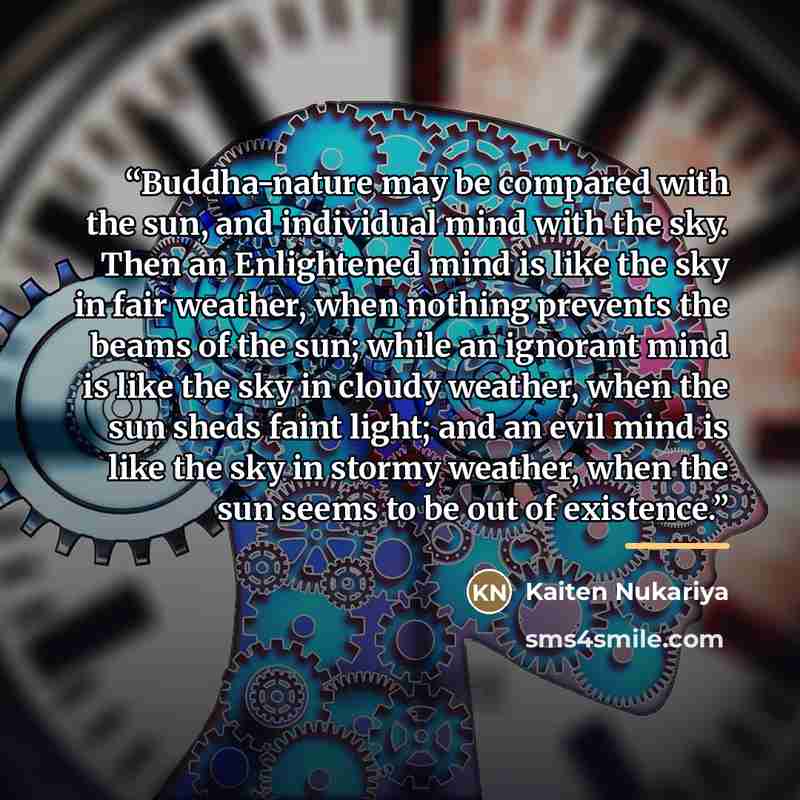
“Buddha-nature may be compared with the sun, and individual mind with the sky. Then an Enlightened mind is like the sky in… — Kaiten Nukariya Copy Share Image
“Ye who seek for purity and peace, go to Nature. She will give you more than ye ask. Ye who long for… — Kaiten Nukariya Copy Share Image
“Having set ourselves free from the misconception of Self, next we must awaken our innermost wisdom, pure and divine, called the Mind… — Kaiten Nukariya Copy Share Image
“Enlightened Consciousness once awakened within us serves as a guiding principle, and leads us to hope, bliss, and life; consequently, it is… — Kaiten Nukariya Copy Share Image
“4. Mahayana Doctrine of the Nihilists. This doctrine disproves (both) the Mahayana and the Hinayana doctrines above mentioned that adhere to Dharma-laksana,… — Kaiten Nukariya Copy Share Image
“According to the theory of Buddha-nature, the fact that the good become bad or the bad become good, does not imply in… — Kaiten Nukariya Copy Share Image
“Again, ancient Zenists did not claim that there was any mysterious element in their spiritual attainment, as Do-gen says[FN#259] unequivocally respecting his… — Kaiten Nukariya Copy Share Image
“Once Tathagata, having observed every sort of sentient beings all over the universe, said as follows: 'Wonderful, how wonderful! That these various… — Kaiten Nukariya Copy Share Image
“To get Enlightened, therefore, we have to correct, first of all, our notions concerning Self. Individual body and mind are not the… — Kaiten Nukariya Copy Share Image
“8. Man is not Good-natured nor Bad-natured, but Buddha-natured. We have had already occasion to observe that Zen teaches Buddha-nature, which all… — Kaiten Nukariya Copy Share Image
“Its mental discipline, however, is by far more fruitful, and keeps one's mind in equipoise, making one neither passionate nor dispassionate, neither… — Kaiten Nukariya Copy Share Image
“Enlightened Consciousness is not an Intellectual Insight. Enlightened Consciousness is not a bare intellectual insight, for it is full of beautiful emotions.… — Kaiten Nukariya Copy Share Image
“1. The Doctrine for Men and Devas. The Buddha, to meet temporarily the spiritual needs of the uninitiated, preached a doctrine concerning… — Kaiten Nukariya Copy Share Image
“8. The Application of the Law of Causation to Morals. Although it may be needless to state here the law of causation… — Kaiten Nukariya Copy Share Image
“Therefore the Buddha for a temporary purpose made these (uninitiated) observe the Five Precepts similar to the Five Virtues[FN#327] of the outside… — Kaiten Nukariya Copy Share Image
“If there is a person of the highest grade of understanding, he may first of all learn the most profound, next the… — Kaiten Nukariya Copy Share Image
“Enlightenment, first of all, implies an insight into the nature of Self. It is an emancipation of mind from illusion concerning Self.… — Kaiten Nukariya Copy Share Image
“1. The Doctrine for Men and Devas. The Buddha, to meet temporarily the spiritual needs of the uninitiated, preached a doctrine concerning… — Kaiten Nukariya Copy Share Image
“Let me say (a few words) about this doctrine by way of criticism. So many Kalpas we spent never meeting with this… — Kaiten Nukariya Copy Share Image
“14. Zen and Nirvana. The beatitude of Zen is Nirvana, not in the Hinayanistic sense of the term, but in the sense… — Kaiten Nukariya Copy Share Image
“The nihilistic doctrine is stated not only in the various Prajnya-sutras (the books having Prajnya-paramita in their titles), but also in almost… — Kaiten Nukariya Copy Share Image
“The Buddhist precepts are different from the Confucian teachings in the form of expression, but they agree in their warning against the… — Kaiten Nukariya Copy Share Image
“This is why the higher the peak of enlightenment the people climb, the more widely the vista of moral possibilities open before… — Kaiten Nukariya Copy Share Image
“Buddha is Mind itself. Mind itself is Dharma. Buddha is identical with Dharma. So is Samgha.” — Kaiten Nukariya Copy Share Image
“Zen teachers expound with strong conviction. Enlightened Consciousness is, according to Zen, the centre of spiritual life. It is the mind of… — Kaiten Nukariya Copy Share Image
“Arhat, the Killer of thieves (i.e., passions), means one who conquered his passions. It means, secondly, one who is exempted from birth,… — Kaiten Nukariya Copy Share Image
“the Mahayanist's aim of life is to bring out man's inborn light of Buddha-nature to illumine the world, to realize the universal… — Kaiten Nukariya Copy Share Image
“the new theory of matter has entirely over thrown the old conception of the unchanging atoms, and they are now regarded to be composed… — Kaiten Nukariya Copy Share Image
“5. Nature is the Mother of All Things. Furthermore, man has come into existence out of Nature. He is her child. She provided him… — Kaiten Nukariya Copy Share Image
“Rin-zai also says: "Spirit is formless, but it penetrates through the world in the ten directions."[FN#149] The Sixth Patriarch expresses the same idea more… — Kaiten Nukariya Copy Share Image
“(O-yo-mei) won a splendid victory over the rebel army which threatened the throne of the Ming dynasty. During that warfare Wang was giving a… — Kaiten Nukariya Copy Share Image
“in the use of the terms 'good' and 'bad.' Now let us examine how does good differ from bad. A good action ever promotes… — Kaiten Nukariya Copy Share Image
“Although all sentient beings are endowed with this Enlightened Consciousness, they are not aware of its existence, excepting men who can discover it by… — Kaiten Nukariya Copy Share Image
“There are a good many people always buoyant in spirit and mirthful in appearance as if born optimists. There are also no fewer persons… — Kaiten Nukariya Copy Share Image
“it is the overcoming of egoism, the destroying of mean desires, the uplifting of the moral ideal, and the disclosing of inborn wisdom. [FN#12]” — Kaiten Nukariya Copy Share Image
“The fourth stage is called the Rank of Co-operative Merit,[FN#273] in which the student 'co-operates' with other persons in order to complete his merit.… — Kaiten Nukariya Copy Share Image
“It is bare nonsense to say that I go to school, not to be educated as a member of society, but simply to gratify… — Kaiten Nukariya Copy Share Image
“8. The Application of the Law of Causation to Morals. Although it may be needless to state here the law of causation at any… — Kaiten Nukariya Copy Share Image

![“Having set ourselves free from the misconception of Self, next we must awaken our innermost wisdom, pure and divine, called the Mind of Buddha,[FN#190] or Bodhi,[FN#191] or Prajnya[FN#192] by Zen masters.” quote by Kaiten Nukariya](https://sms4smile.com/quotes/img-quotes/46f/kaiten-nukariya-793_buddha_having-set-ourselves-free-from-the-misco_2837291.jpg)
![“Enlightened Consciousness once awakened within us serves as a guiding principle, and leads us to hope, bliss, and life; consequently, it is called the Master[FN#154] of both mind and body. Sometimes it is called the Original[FN#155] Mind, as it is the mind of minds. It is Buddha dwelling in…” quote by Kaiten Nukariya](https://sms4smile.com/quotes/img-quotes/8a5/kaiten-nukariya-793_consciousness_enlightened-consciousness-once-awakened_2611818.jpg)
![“Again, ancient Zenists did not claim that there was any mysterious element in their spiritual attainment, as Do-gen says[FN#259] unequivocally respecting his Enlightenment: "I recognized only that my eyes are placed crosswise above the nose that stands lengthwise, and that I was not deceived by…” quote by Kaiten Nukariya](https://sms4smile.com/quotes/img-quotes/6f1/kaiten-nukariya-793_buddhism_again-ancient-zenists-did-not-claim-that_2952395.jpg)
![“8. Man is not Good-natured nor Bad-natured, but Buddha-natured. We have had already occasion to observe that Zen teaches Buddha-nature, which all sentient beings are endowed with. The term 'Buddha-nature,'[FN#165] as accepted generally by Buddhists, means a latent and undeveloped nature, which…” quote by Kaiten Nukariya](https://sms4smile.com/quotes/img-quotes/0e8/kaiten-nukariya-793_buddhism_8-man-is-not-good-natured-nor-bad-nature_405320.jpg)
![“Therefore the Buddha for a temporary purpose made these (uninitiated) observe the Five Precepts similar to the Five Virtues[FN#327] of the outside doctrine, in order to enable them to escape the three (worst) States[FN#328] of Existence, and to be reborn among men. (He also taught that) those who…” quote by Kaiten Nukariya](https://sms4smile.com/quotes/img-quotes/2bc/kaiten-nukariya-793_buddhism_therefore-the-buddha-for-a-temporary-pur_2274879.jpg)

![“the Mahayanist's aim of life is to bring out man's inborn light of Buddha-nature to illumine the world, to realize the universal brotherhood of all sentient beings, to attain to Enlightenment, and to enjoy peace and joy to which Universal Spirit leads us. [FN#177]” quote by Kaiten Nukariya](https://sms4smile.com/quotes/img-quotes/389/kaiten-nukariya-793_buddhism_the-mahayanist-s-aim-of-life-is-to-bring_2450945.jpg)
![“Rin-zai also says: "Spirit is formless, but it penetrates through the world in the ten directions."[FN#149] The Sixth Patriarch expresses the same idea more explicitly: "What creates the phenomena is Mind; what transcends all the phenomena is Buddha."[FN#150]” quote by Kaiten Nukariya](https://sms4smile.com/quotes/img-quotes/d4e/kaiten-nukariya-793_spirit-formless_rin-zai-also-says-spirit-is-formless-but_13012.jpg)


![“it is the overcoming of egoism, the destroying of mean desires, the uplifting of the moral ideal, and the disclosing of inborn wisdom. [FN#12]” quote by Kaiten Nukariya](https://sms4smile.com/quotes/img-quotes/3ae/kaiten-nukariya-793_egoism_it-is-the-overcoming-of-egoism-the-destr_46308.jpg)
![“The fourth stage is called the Rank of Co-operative Merit,[FN#273] in which the student 'co-operates' with other persons in order to complete his merit. Now, he is not compared with a general who conquers his foe, but with the prime-minister who co-operates with other officials to the benefit of…” quote by Kaiten Nukariya](https://sms4smile.com/quotes/img-quotes/4a6/kaiten-nukariya-793_quote_the-fourth-stage-is-called-the-rank-of-c_48041.jpg)