Communion Quote by Juan de la Cruz
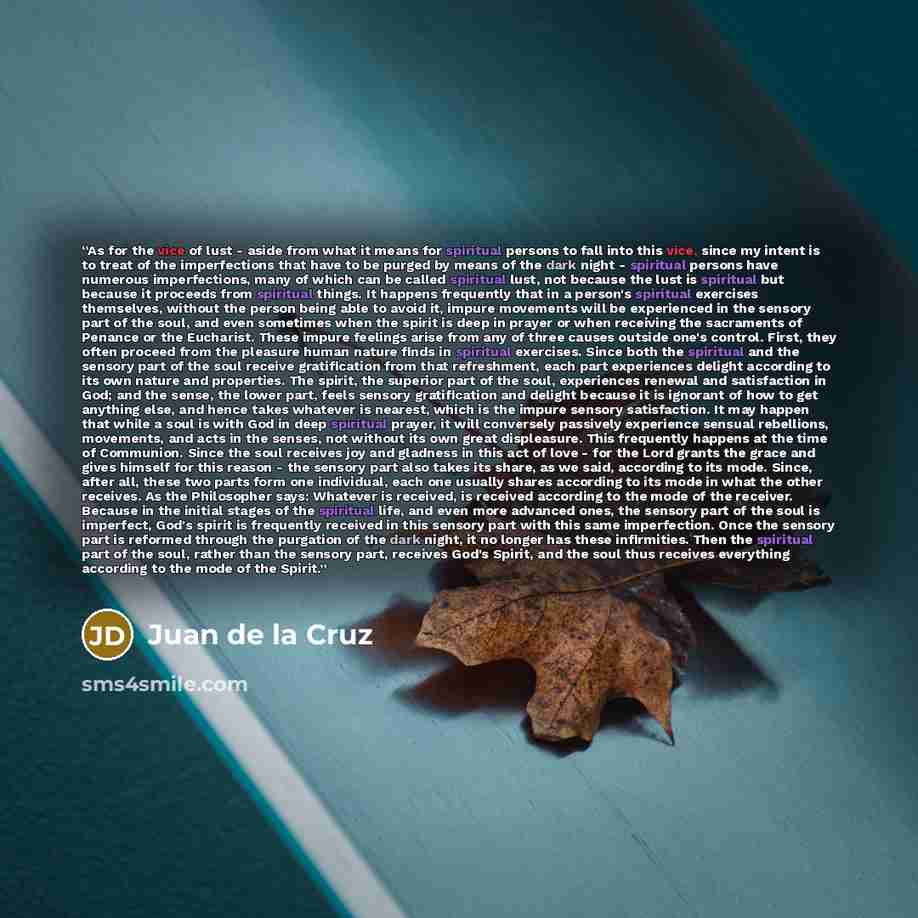
““As for the vice of lust - aside from what it means for spiritual persons to fall into this vice, since my intent is to treat of the imperfections that have to be purged by means of the dark night - spiritual persons have numerous imperfections, many of which can be called spiritual lust, not because the lust is spiritual but because it proceeds from spiritual things. It happens frequently that in a person's spiritual exercises themselves, without the person being able to avoid it, impure movements will be experienced in the sensory part of the soul, and even sometimes when the spirit is deep in prayer or when receiving the sacraments of Penance or the Eucharist. These impure feelings arise from any of three causes outside one's control. First, they often proceed from the pleasure human nature finds in spiritual exercises. Since both the spiritual and the sensory part of the soul receive gratification from that refreshment, each part experiences delight according to its own nature and properties. The spirit, the superior part of the soul, experiences renewal and satisfaction in God; and the sense, the lower part, feels sensory gratification and delight because it is ignorant of how to get anything else, and hence takes whatever is nearest, which is the impure sensory satisfaction. It may happen that while a soul is with God in deep spiritual prayer, it will conversely passively experience sensual rebellions, movements, and acts in the senses, not without its own great displeasure. This frequently happens at the time of Communion. Since the soul receives joy and gladness in this act of love - for the Lord grants the grace and gives himself for this reason - the sensory part also takes its share, as we said, according to its mode. Since, after all, these two parts form one individual, each one usually shares according to its mode in what the other receives. As the Philosopher says: Whatever is received, is received according to the mode of the receiver. Because in the initial stages of the spiritual life, and even more advanced ones, the sensory part of the soul is imperfect, God's spirit is frequently received in this sensory part with this same imperfection. Once the sensory part is reformed through the purgation of the dark night, it no longer has these infirmities. Then the spiritual part of the soul, rather than the sensory part, receives God's Spirit, and the soul thus receives everything according to the mode of the Spirit.””
About This Quote
Source Book: Dark Night of the Soul by Juan de la Cruz, 1578
Spiritual practitioners may experience impure sensory urges even during deep prayer, because the lower soul seeks sensory gratification while the higher soul seeks divine union.
In simple terms: Even devout people can feel unwanted sensual thoughts during prayer.
Key Takeaway
Recognize and gently redirect these impulses toward divine focus.
Themes
spirituality
temptation
inner conflict
Mood
reflective
solemn
Type
theological
instructional
When to use this quote
- personal prayer
- confession
- Eucharist
- spiritual direction
- retreats
Key Concepts
dualism
sensory vs spiritual desire
grace
purification
Questions to Reflect On
- How can one differentiate between genuine spiritual joy and sensory craving?
- What practices help integrate the sensory and spiritual parts harmoniously?
A Different Perspective
Such impulses may indicate deeper unresolved attachments, not merely lack of willpower.













![“[Islam] is the dynamic conviction that a person's spiritual and worldly responsibilities are one and the same, that an individuals duty to the community is indistinguishable from his or her duty to God.” quote by Reza Aslan](https://sms4smile.com/quotes/img-quotes/69f/reza-aslan-2665_community_islam-is-the-dynamic-conviction-that-a-p_1098071.jpg)