Quote by Joseph Pohle Download Open image ““sacramental rite or not. Hence the necessity of a proper intention.”” — Joseph Pohle ★ ★ ★ ★ ★ 3.4 out of 5 (7 ratings) Copy quoteShare
“all that is necessary for the valid administration of the Sacraments is the direct intention, i. e. the purpose of performing the rite as… — Joseph Pohle Copy Share Image
“There is, first, the actual intention, operating with the full advertence of the intellect. When a minister wishes here and now to confer, e.… — Joseph Pohle Copy Share Image
“A sacrament gives a dramatic sign that points beyond itself to some truth of redemption that is crucial to the life of the people… — R.C. Sproul Copy Share Image
A sacrament by virtue of which each imparts nothing but vexations to the other. — Honore de Balzac Copy Share Image
“—With the sole exception of Penance, which demands certain supernatural acts (faith, contrition, etc.) either as quasi-matter, or at least as a necessary condition,… — Joseph Pohle Copy Share Image
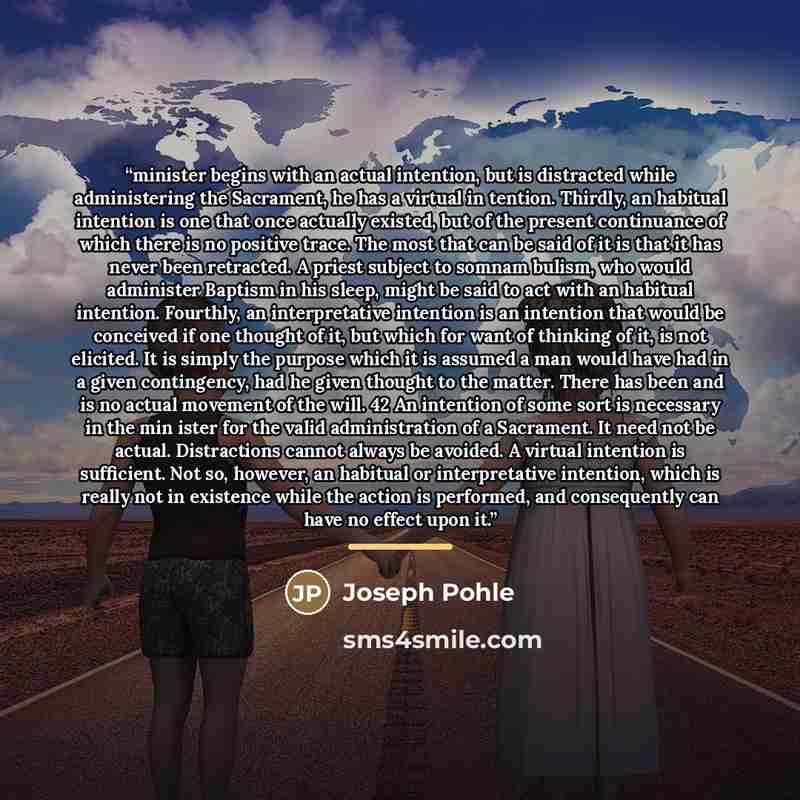
“minister begins with an actual intention, but is distracted while administering the Sacrament, he has a virtual in tention. Thirdly, an habitual intention is one that once actually existed, but of the present continuance of which there is no positive trace. The most that can be said of it is that it has never been retracted. A priest subject to… — Joseph Pohle Copy Share
We ought to regard the sacrament of baptism with reverence. An ordinance of which the Lord Jesus Himself partook, is not to be lightly… — J. C. Ryle Copy Share Image
“I am no longer fit to administer the sacraments because I express love in the way God intended for me—with another man.” — Charles Benedict Copy Share Image
“The confectio of a Sacrament, i. e. the combina tion of matter and form into the sacramental sign, is not necessarily of itself a sacramental act, but indifferent and ambiguous, inasmuch as the minister, being a free agent, may act with any one of a number of different purposes, e. g., to practice, to play a joke, to make a… — Joseph Pohle Copy Share
“St. Thomas, following his master Albert, proves the necessity of a right intention on the part of the minister from the proposition that every… — Joseph Pohle Copy Share Image
“But this could be interpreted primarily in terms of the ministry of word and sacrament, in accordance with the previous models of the Church,… — Avery Dulles Copy Share Image
RITE, n. A religious or semi-religious ceremony fixed by law, precept or custom, with the essential oil of sincerity carefully squeezed out of it. — Ambrose Bierce Copy Share Image
“We are compelled to concur in another view of Cardinal De Lugo, namely, that the value of the Mass is dependent on the greater… — Joseph Pohle Copy Share Image
“the scientific development of the doctrine of indulgences. 29 St. Thomas knows but one plenary indulgence, i. e. that granted for the liberation of… — Joseph Pohle Copy Share Image
“The Church has always regarded the admin istration of a Sacrament in the state of mortal sin as a sacrilege, and insists on the… — Joseph Pohle Copy Share Image
“Origen says: " The Church hath received it as a tradition from the Apostles that infants, too, ought to be baptized." 21” — Joseph Pohle Copy Share Image
“St. Bruno of Asti, who says: " The first tabernacle, therefore, is the Synagogue; the second, the Church; the third, Heaven. . . .… — Joseph Pohle Copy Share Image
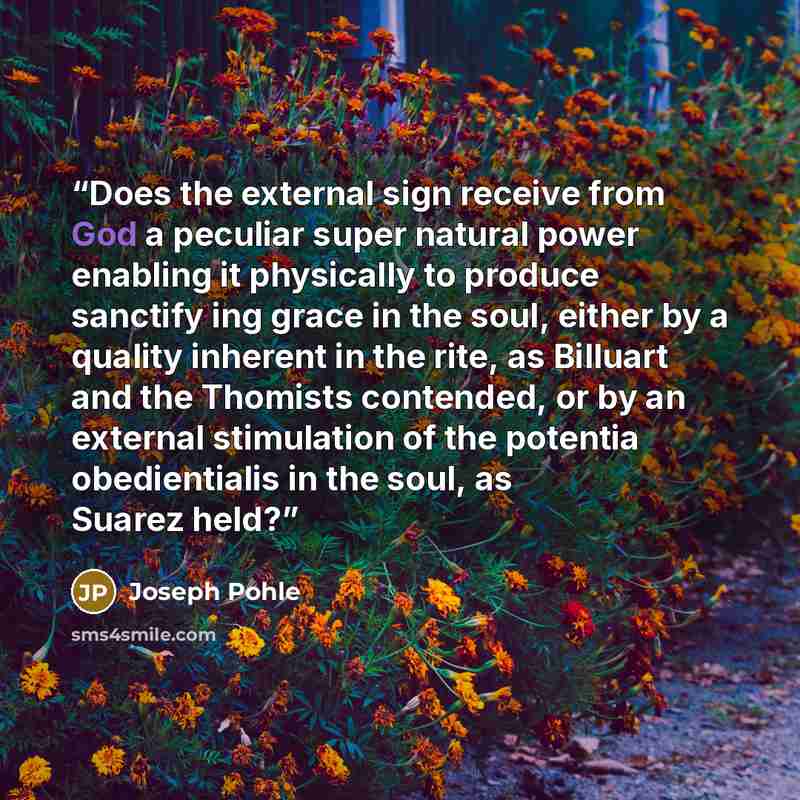
“Does the external sign receive from God a peculiar super natural power enabling it physically to produce sanctify ing grace in the soul, either… — Joseph Pohle Copy Share Image
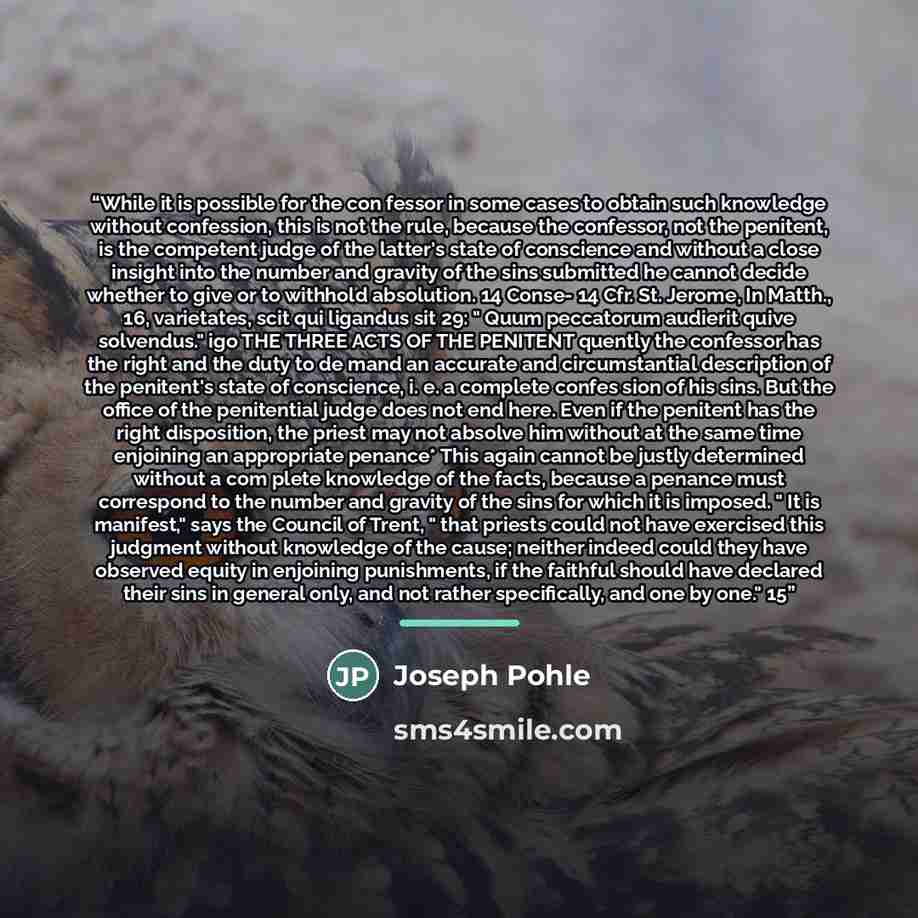
“While it is possible for the con fessor in some cases to obtain such knowledge without confession, this is not the rule, because the… — Joseph Pohle Copy Share Image
“minister begins with an actual intention, but is distracted while administering the Sacrament, he has a virtual in tention. Thirdly, an habitual intention is… — Joseph Pohle Copy Share Image
“The confectio of a Sacrament, i. e. the combina tion of matter and form into the sacramental sign, is not necessarily of itself a… — Joseph Pohle Copy Share Image
“The Second Council of Mileve (416) anath ematized all "who deny that new-born infants should be baptized immediately after birth." n The Tridentine Council… — Joseph Pohle Copy Share Image
“bread and wine." These species must, therefore, be acci dents, and, having by Transubstantiation lost their con natural subjects, which cannot be supplied by… — Joseph Pohle Copy Share Image
![“St. Bruno of Asti, who says: " The first tabernacle, therefore, is the Synagogue; the second, the Church; the third, Heaven. . . . The first was in a shadow and an image, the second is in an image and in truth, and the third [will be] in the truth alone. In the first, life is foreshadowed; in the…” quote by Joseph Pohle](https://sms4smile.com/quotes/img-quotes/7d8/joseph-pohle-3769_life_st-bruno-of-asti-who-says-the-first-tabe_36723.jpg)