Articles Quote by John Stuart Mill
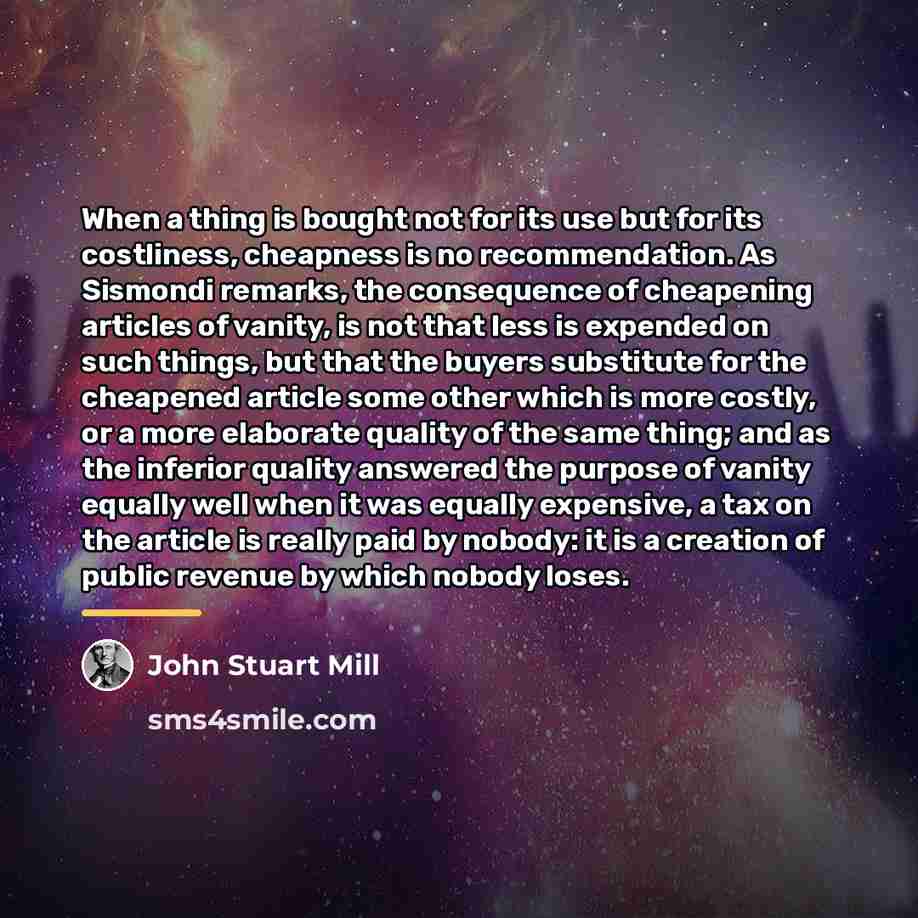
“When a thing is bought not for its use but for its costliness, cheapness is no recommendation. As Sismondi remarks, the consequence of cheapening articles of vanity, is not that less is expended on such things, but that the buyers substitute for the cheapened article some other which is more costly, or a more elaborate quality of the same thing; and as the inferior quality answered the purpose of vanity equally well when it was equally expensive, a tax on the article is really paid by nobody: it is a creation of public revenue by which nobody loses.”
About This Quote
Source Book: Principles of Political Economy, John Stuart Mill, 1848
Buying expensive items for status leads to higher overall spending, not saving.
In simple terms: Spending on status goods raises total cost.
Key Takeaway
Beware status‑driven purchases.
Themes
consumerism
economics
vanity
Mood
critical
analytical
Type
economic
philosophical
When to use this quote
- luxury market
- fashion industry
- tax policy
- personal budgeting
Key Concepts
externalities
public revenue
taxation
Questions to Reflect On
- How does status influence your buying choices?
- What alternatives reduce vanity spending?
A Different Perspective
May ignore true value and waste resources.
















![“[For people] to refuse a hearing to an opinion, because they are sure that it is false, is to assume that their certainty is the same thing as absolute certainty. All silencing of discussion is an assumption of infallibility.” quote by John Stuart Mill](https://sms4smile.com/quotes/img-quotes/c53/john-stuart-mill-477_doubt_for-people-to-refuse-a-hearing-to-an-opi_63929.jpg)


![“I wrote an article about the marine landing [in Haiti] right away, but barely mentioned the oil, because my article would come out two months later and I assumed by then, "of course, everybody knows." Nobody knew. There was a news report in the Wall Street Journal, in the petroleum journals, and…” quote by Noam Chomsky](https://sms4smile.com/quotes/img-quotes/dc5/noam-chomsky-42_articles_i-wrote-an-article-about-the-marine-land_13341.jpg)