Closed door Quote by John Steinbeck
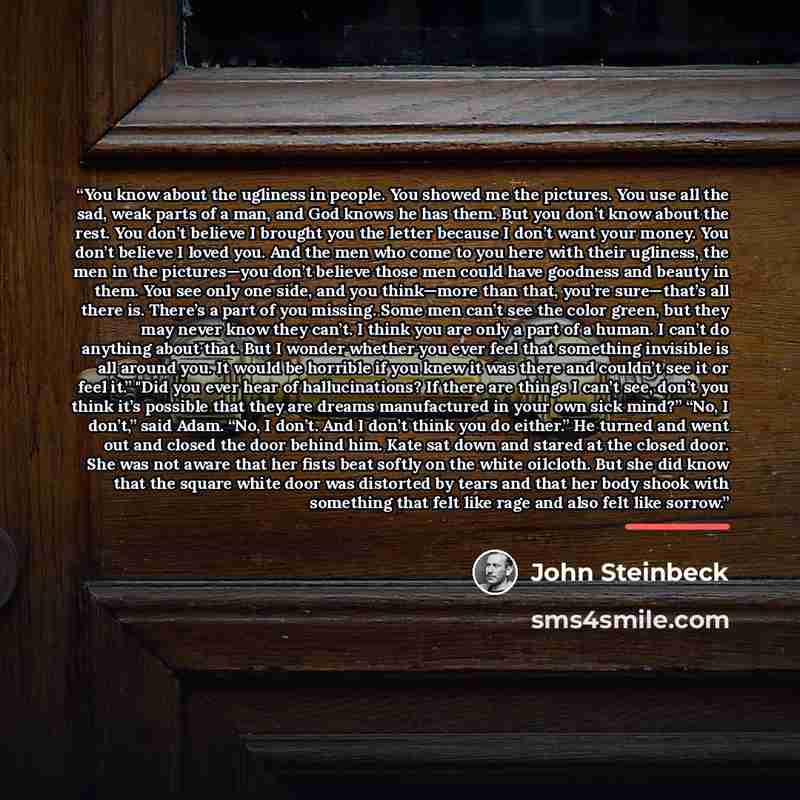
““You know about the ugliness in people. You showed me the pictures. You use all the sad, weak parts of a man, and God knows he has them. But you don’t know about the rest. You don’t believe I brought you the letter because I don’t want your money. You don’t believe I loved you. And the men who come to you here with their ugliness, the men in the pictures—you don’t believe those men could have goodness and beauty in them. You see only one side, and you think—more than that, you’re sure—that’s all there is. There’s a part of you missing. Some men can’t see the color green, but they may never know they can’t. I think you are only a part of a human. I can’t do anything about that. But I wonder whether you ever feel that something invisible is all around you. It would be horrible if you knew it was there and couldn’t see it or feel it.” "Did you ever hear of hallucinations? If there are things I can’t see, don’t you think it’s possible that they are dreams manufactured in your own sick mind?” “No, I don’t,” said Adam. “No, I don’t. And I don’t think you do either.” He turned and went out and closed the door behind him. Kate sat down and stared at the closed door. She was not aware that her fists beat softly on the white oilcloth. But she did know that the square white door was distorted by tears and that her body shook with something that felt like rage and also felt like sorrow.””
About This Quote
Source Novel: East of Eden, John Steinbeck, 1952
The speaker confronts a person who sees only the flaws in others, urging recognition of hidden goodness and unseen realities.
In simple terms: People often focus on negativity, missing deeper beauty and unseen forces.
Key Takeaway
Seek to notice hidden virtues and the unseen aspects of life.
Themes
empathy
perception
humanity
inner conflict
Mood
reflective
melancholic
introspective
Type
literary
philosophical
When to use this quote
- personal relationships
- mental health
- spiritual reflection
- conflict resolution
Key Concepts
psychology
existentialism
dualism
Questions to Reflect On
- How can you balance seeing flaws with recognizing hidden goodness?
- What unseen forces shape your perceptions?
A Different Perspective
The narrative may overemphasize metaphor, risking abstraction from practical action.





![“Teaching might even be the greatest of the arts since the medium is the human mind and spirit. My three [great teachers] did not tell - they catalyzed a burning desire to know. Under their influence, the horizons sprung wide and fear went away and the unknown became knowable. But most important of…” quote by John Steinbeck](https://sms4smile.com/quotes/img-quotes/84c/john-steinbeck-71_art_teaching-might-even-be-the-greatest-of-t_1738.jpg)