Children Quote by John Chrysostom
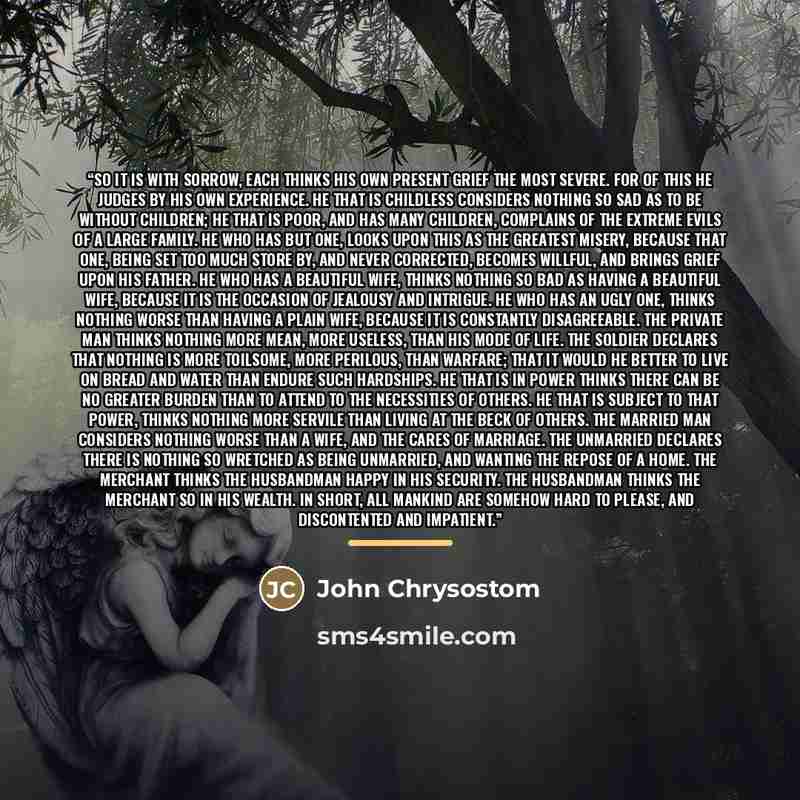
““So it is with sorrow, each thinks his own present grief the most severe. For of this he judges by his own experience. He that is childless considers nothing so sad as to be without children; he that is poor, and has many children, complains of the extreme evils of a large family. He who has but one, looks upon this as the greatest misery, because that one, being set too much store by, and never corrected, becomes willful, and brings grief upon his father. He who has a beautiful wife, thinks nothing so bad as having a beautiful wife, because it is the occasion of jealousy and intrigue. He who has an ugly one, thinks nothing worse than having a plain wife, because it is constantly disagreeable. The private man thinks nothing more mean, more useless, than his mode of life. The soldier declares that nothing is more toilsome, more perilous, than warfare; that it would he better to live on bread and water than endure such hardships. He that is in power thinks there can be no greater burden than to attend to the necessities of others. He that is subject to that power, thinks nothing more servile than living at the beck of others. The married man considers nothing worse than a wife, and the cares of marriage. The unmarried declares there is nothing so wretched as being unmarried, and wanting the repose of a home. The merchant thinks the husbandman happy in his security. The husbandman thinks the merchant so in his wealth. In short, all mankind are somehow hard to please, and discontented and impatient.””
About This Quote
Source Sermon: Homily on Human Discontent, 4th century CE
People judge their own situations as the worst because they compare only with their personal experience, leading to universal dissatisfaction.
In simple terms: Everyone thinks their own problem is the worst.
Key Takeaway
Recognize bias in personal judgments.
Themes
discontent
comparison
human nature
subjectivity
perception
Mood
reflective
thoughtful
Type
philosophical
observational
When to use this quote
- personal relationships
- career decisions
- family planning
- political leadership
- financial management
Key Concepts
philosophy
psychology
ethics
Questions to Reflect On
- How does personal bias shape your view of others' problems?
- Can you find gratitude despite perceived hardships?
A Different Perspective
It overlooks structural factors that cause genuine hardship beyond personal perception.















![“As a moth gnaws a garment, so doth envy consume a [person].” quote by John Chrysostom](https://sms4smile.com/quotes/img-quotes/8b9/john-chrysostom-18823_envy_as-a-moth-gnaws-a-garment-so-doth-envy-c_1095829.jpg)