Broken glass Quote by Jared Diamond
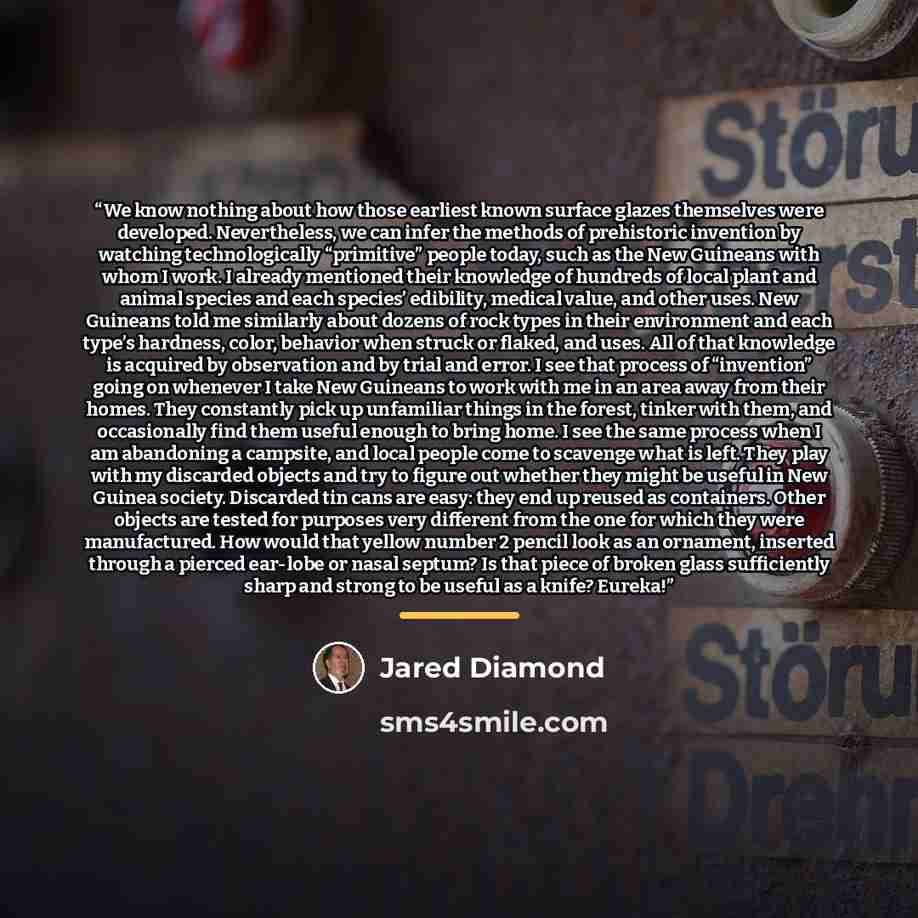
““We know nothing about how those earliest known surface glazes themselves were developed. Nevertheless, we can infer the methods of prehistoric invention by watching technologically “primitive” people today, such as the New Guineans with whom I work. I already mentioned their knowledge of hundreds of local plant and animal species and each species’ edibility, medical value, and other uses. New Guineans told me similarly about dozens of rock types in their environment and each type’s hardness, color, behavior when struck or flaked, and uses. All of that knowledge is acquired by observation and by trial and error. I see that process of “invention” going on whenever I take New Guineans to work with me in an area away from their homes. They constantly pick up unfamiliar things in the forest, tinker with them, and occasionally find them useful enough to bring home. I see the same process when I am abandoning a campsite, and local people come to scavenge what is left. They play with my discarded objects and try to figure out whether they might be useful in New Guinea society. Discarded tin cans are easy: they end up reused as containers. Other objects are tested for purposes very different from the one for which they were manufactured. How would that yellow number 2 pencil look as an ornament, inserted through a pierced ear-lobe or nasal septum? Is that piece of broken glass sufficiently sharp and strong to be useful as a knife? Eureka!””
About This Quote
Source Book: Guns, Germs, and Steel, Jared Diamond, 1997
The passage illustrates how observing modern “primitive” societies reveals invention through trial, error, and repurposing discarded items, highlighting human ingenuity.
In simple terms: People invent by experimenting with what they have.
Key Takeaway
Learn from everyday experimentation and reuse.
Themes
innovation
observation
adaptation
Mood
curious
analytical
Type
anthropological
educational
When to use this quote
- archaeology
- design thinking
- sustainability
- education
Key Concepts
trial‑and‑error
resourcefulness
anthropology
Questions to Reflect On
- How can we apply ancient ingenuity today?
- What limits repurposing everyday objects?
A Different Perspective
Modern contexts differ; not all ancient methods transfer directly.