Quote by James John Courtenay Download Open image ““Ethiopic must be traced ultimately to Arabic.”” — James John Courtenay ★ ★ ★ ★ ★ 3.3 out of 5 (7 ratings) Copy quoteShare
“The likeness of Ethiopic to Arabic suggests an original tribal affinity.” — James John Courtenay Copy Share Image
“All Semitic languages are perhaps ultimately traceable to Arabia.” — James John Courtenay Copy Share Image
“It is found that the Egyptian language has an appreciable admixture of Semitic, which was derived ultimately from Arabia.” — James John Courtenay Copy Share Image
“Ancient Arabic may naturally be regarded as the chief source of the Hebrew language.” — John Courtenay James Copy Share Image
“In any Semitic study, Arabic is a most useful adjunct, inasmuch as it often indicates the true significance of words where the Hebrew, Syriac… — James John Courtenay Copy Share Image
“By the affirmation of all scholars, Arabic is the most honourable language among all Semitic ones.” — Clemens Joseph David Copy Share Image
“The Arabic language has had a great history, and in many respects is more remarkable than any other Semitic speech.” — James John Courtenay Copy Share Image
“Nick commenced a monologue explaining the impossibility of such a phenomenon: the subordination of content to the aesthetics of language in Arabic literature, the… — Rabih Alameddine Copy Share Image
“For the understanding of primitive Semitic vowel-sounds a study of Arabic is almost indispensable.” — James John Courtenay Copy Share Image
“In its classical form Arabic is of later date than Hebrew, but in its ancient form akin to Hebrew and Aramaic, certainly as old,… — James John Courtenay Copy Share Image
“Laban spoke the language which came with that great Semitic migration from Arabia.” — James John Courtenay Copy Share Image
“They fully bloomed in the pages of the Bible and the Quran, where the Sumerian word ilu became transliterated as Elohim in Hebrew and… — Reza Aslan Copy Share Image
“The Arabic language has had a great history, and in many respects is more remarkable than any other Semitic speech.” — James John Courtenay Copy Share Image
“There was probably a larger admixture of Greek in Galilee than in any other Palestinian province.” — James John Courtenay Copy Share Image
“The Samaritans were conservative in the matter of script, preserving the Phoenician type after Judaea and Galilee had accepted the Aramaic character.” — James John Courtenay Copy Share Image
“There is some evidence that the Canaanites lived together with the Babylonians for a longer period than did the Aramaeans ... It is found… — James John Courtenay Copy Share Image
“In its classical form Arabic is of later date than Hebrew, but in its ancient form akin to Hebrew and Aramaic, certainly as old,… — James John Courtenay Copy Share Image
“It is doubtful whether the vernacular of Palestine admitted any Greek element prior to the Christian era. Even in the Greek form of the… — James John Courtenay Copy Share Image
“When Aramaeans became Christians, their name was often confounded with 'heathen', hence they called their land by the Greek name 'Syria', themselves by the… — James John Courtenay Copy Share Image
“The books of the Old Testament, as we know them, do not represent the language of Palestine as spoken at any one time or… — James John Courtenay Copy Share Image
“Mandaean ... letter-forms resemble the older Syriac ... Estrangelo character ... considerably coloured by Arabic ... likeness to Nabataean and the Babylonian Talmud.” — James John Courtenay Copy Share Image
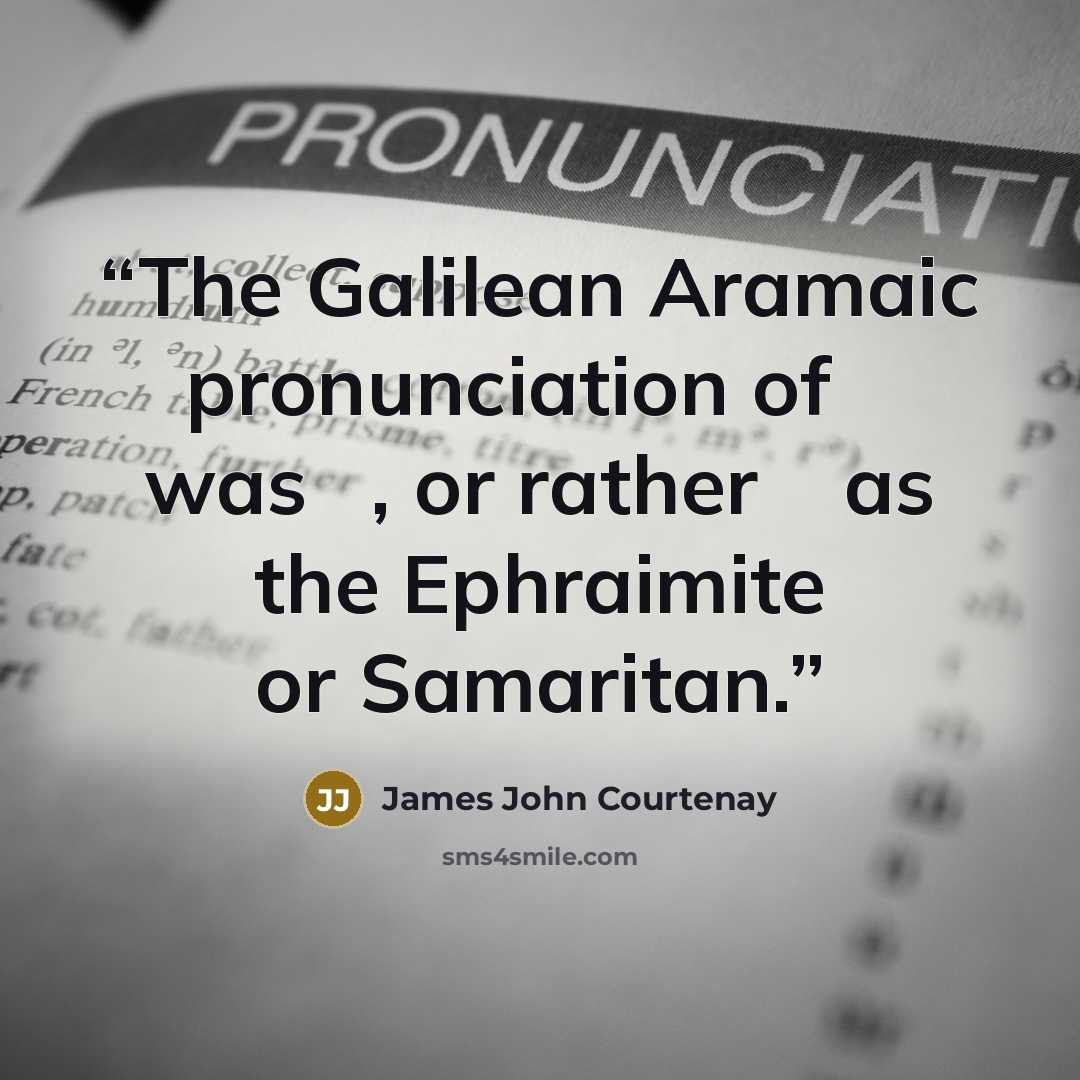
“The Galilean Aramaic pronunciation of שׁ was שׂ, or rather ס as the Ephraimite or Samaritan.” — James John Courtenay Copy Share Image
“With the progress of the Greek arms cam the decline of the Greek language.” — James John Courtenay Copy Share Image