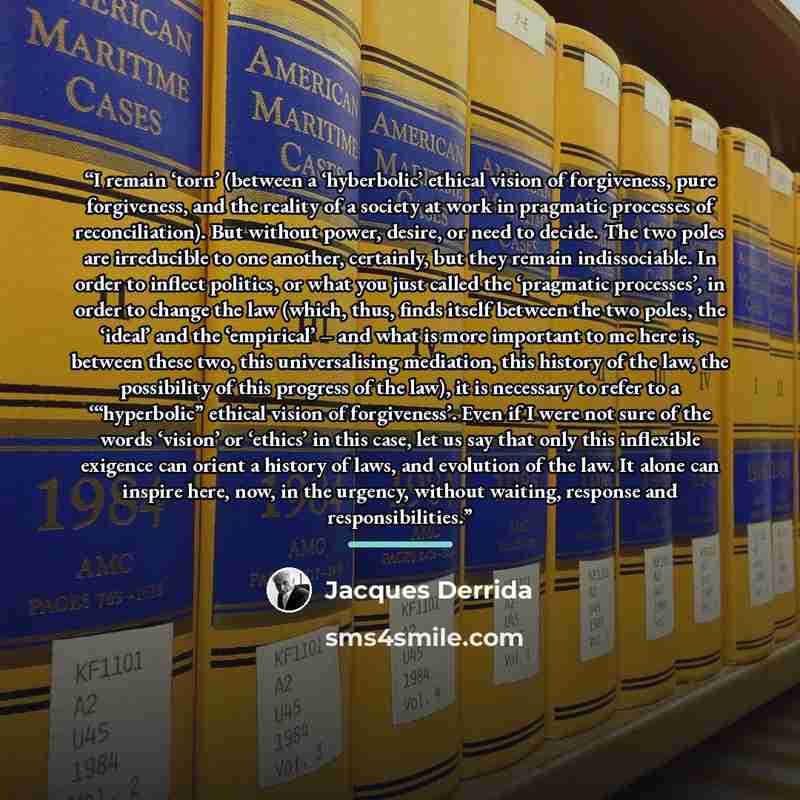
Forgiveness Quote by Jacques Derrida
““These two poles, the unconditional and the conditional, are absolutely heterogeneous, and must remain irreducible to one another. They are nonetheless indissociable: if one wants, and it is necessary, forgiveness to become effective, concrete, historic; if one wants it to arrive, to happen by changing things, it is necessary that this purity engage itself in a series of conditions of all kinds (psychosociological, political, etc.). It is between these two poles, irreconcilable but indissociable, that decisions and responsibilities are to be taken. Yet despite all the confusions which reduce forgiveness to amnesty or to amnesia, to acquittal or prescription, to the work of mourning or some political therapy of reconciliation, in short to some historical ecology, it must never be forgotten, nevertheless, that all of that refers to a certain idea of pure and unconditional forgiveness, without which this discourse would not have the least meaning. What complicates the question of ‘meaning’ is again what I suggested a moment ago: pure and unconditional forgiveness, in order to have its own meaning, must have no ‘meaning’, no finality, even no intelligibility. It is a madness of the impossible.””
About This Quote
Source Book: *The Gift of Death* by Jacques Derrida, 1995
Forgiveness involves a tension between unconditional purity and conditional reality; true forgiveness must engage with concrete conditions while remaining conceptually pure, creating a paradoxical, almost impossible, meaning.
In simple terms: Forgiveness is both pure and bound by real conditions, creating a paradox.
Key Takeaway
Recognize the paradox of forgiveness and act responsibly within conditions.
Themes
ethics
philosophy
politics
responsibility
Mood
reflective
complex
thoughtful
Type
philosophical
theoretical
critical
When to use this quote
- legal reconciliation
- personal healing
- political transition
- social justice
Key Concepts
conditionality
unconditionality
paradox
meaninglessness
Questions to Reflect On
- How can we apply unconditional forgiveness in real conflicts?
- What limits does conditionality impose on forgiveness?
A Different Perspective
Pure forgiveness may be unattainable in practice, leading to ambiguity.