Dreams Quote by Jacques Derrida
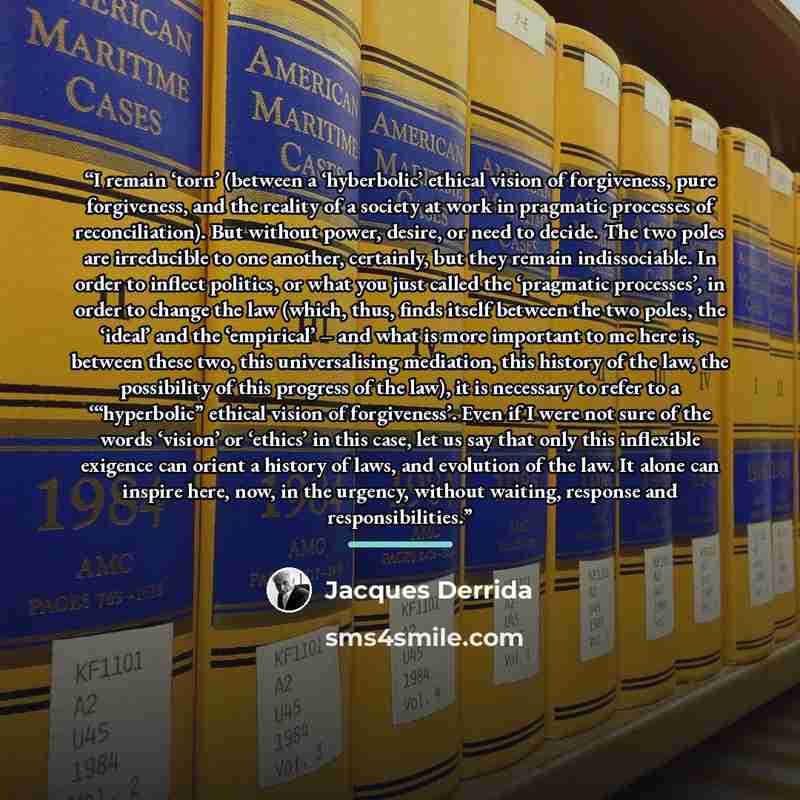
““I remain ‘torn’ (between a ‘hyberbolic’ ethical vision of forgiveness, pure forgiveness, and the reality of a society at work in pragmatic processes of reconciliation). But without power, desire, or need to decide. The two poles are irreducible to one another, certainly, but they remain indissociable. In order to inflect politics, or what you just called the ‘pragmatic processes’, in order to change the law (which, thus, finds itself between the two poles, the ‘ideal’ and the ‘empirical’ – and what is more important to me here is, between these two, this universalising mediation, this history of the law, the possibility of this progress of the law), it is necessary to refer to a ‘“hyperbolic” ethical vision of forgiveness’. Even if I were not sure of the words ‘vision’ or ‘ethics’ in this case, let us say that only this inflexible exigence can orient a history of laws, and evolution of the law. It alone can inspire here, now, in the urgency, without waiting, response and responsibilities.””
About This Quote
Source Speech: Lecture on Law and Forgiveness, 1995
The quote argues that an extreme, idealistic vision of forgiveness must guide legal and political processes, even though it seems at odds with pragmatic reconciliation.
In simple terms: Ideal forgiveness should steer law despite practical limits.
Key Takeaway
Embrace a bold ethical vision to shape law.
Themes
ethics
law
politics
forgiveness
idealism
Mood
reflective
serious
Type
philosophical
political
inspirational
When to use this quote
- court reforms
- peace negotiations
- truth and reconciliation commissions
- policy drafting
Key Concepts
hyperbolic vision
mediation
legal evolution
Questions to Reflect On
- How can an uncompromising ethical stance be applied in practical lawmaking?
- What risks arise when idealism dominates policy?
A Different Perspective
Ideal vision may clash with real‑world constraints, risking impracticality.