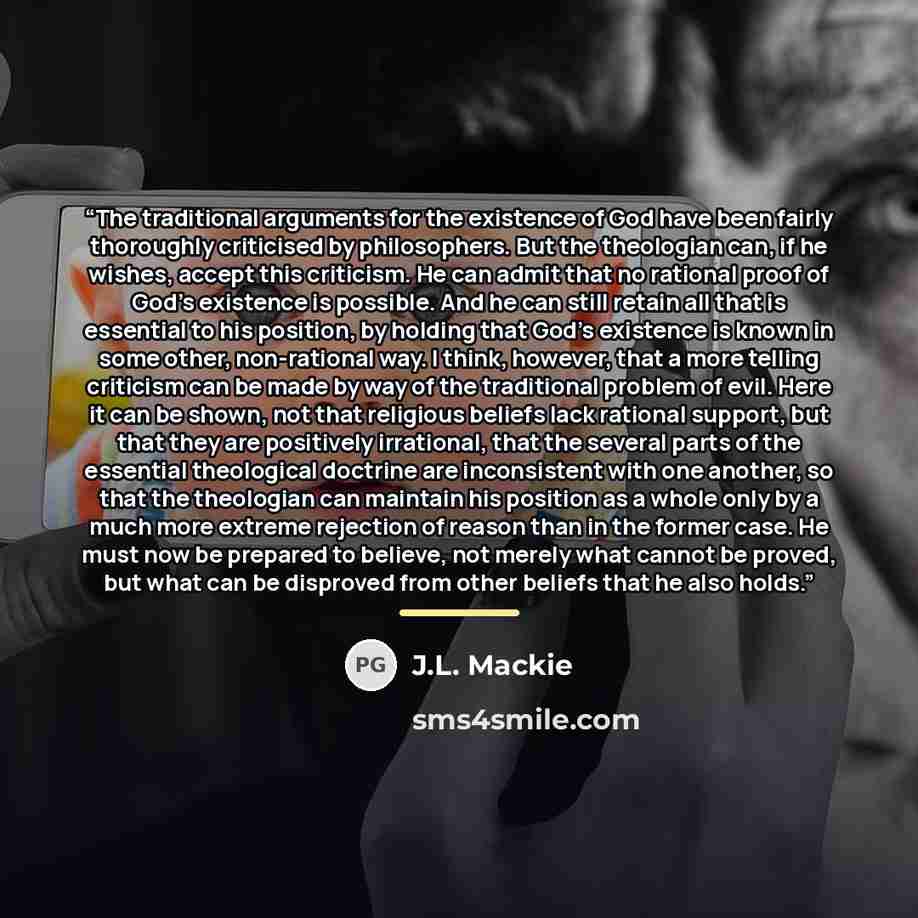
Cosmological Argument Quote by J.L. Mackie

““The argument from design, therefore, can be sustained only with the help of a supposedly a priori double-barrelled principle, that mental order (at least in a god) is self-explanatory, but that all material order not only is not self-explanatory, but is positively improbable and in need of further explanation...this double-barrelled principle is recognizable as the core of the cosmological argument...The argument will not take us even as far as Kant seems to allow without borrowing the a priori thesis that there is a vicious metaphysical contingency in all natural things, and, in contrast with this, the 'transcendental' concept of a god who is self-explanatory and necessarily existent. It is only with the help of these borrowings that the design argument can introduce the required asymmetry, that any natural explanation uses data which call for further explanation, but that the theistic explanation terminates the regress. Without this asymmetry, the design argument cannot show that there is any need to go beyond the sort of hypothesis that Hume foreshadowed and that Wallace and Darwin supplied... The dependence of the argument for design on the ideas that are the core of the cosmological one is greater than Kant realized.””
About This Quote
The design argument relies on an a priori principle that mental order is self-explanatory while material order is not, creating an asymmetry that the cosmological argument also depends on, thus requiring extra metaphysical assumptions.
In simple terms: Design argument needs extra metaphysical assumptions.
Key Takeaway
Design argument's reliance on hidden premises.
Themes
philosophy of religion
metaphysics
argument structure
cosmology
Kantian critique
design vs. chance
Mood
critical
analytical
skeptical
Type
analytical
critical
philosophical
When to use this quote
- debating the existence of God
- critiquing intelligent design
- teaching philosophy of religion
- analyzing Kant's influence
Key Concepts
a priori principles
asymmetry in explanations
metaphysical contingency
cosmological argument
Practical Applications
- philosophical critique
- academic coursework
Questions to Reflect On
- Does invoking self‑explanatory mental order unjustly bias the argument?
- Can the design argument stand without borrowing cosmological premises?