Bad people Quote by J.D. Vance
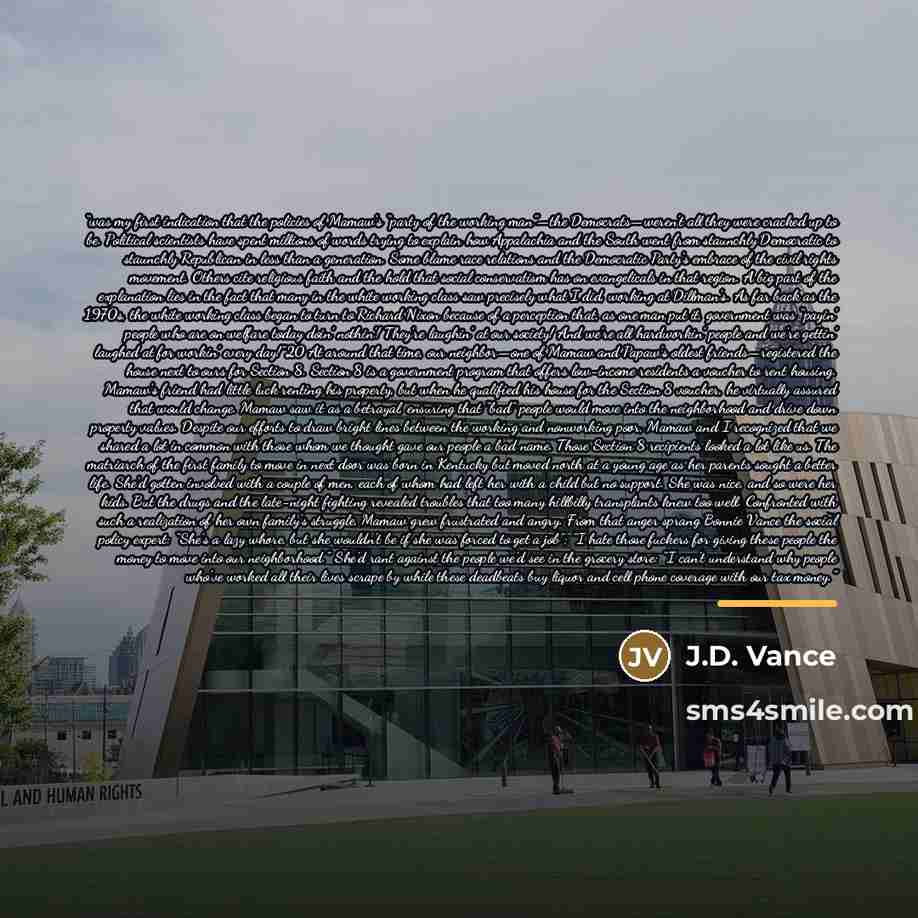
““was my first indication that the policies of Mamaw’s “party of the working man”—the Democrats—weren’t all they were cracked up to be. Political scientists have spent millions of words trying to explain how Appalachia and the South went from staunchly Democratic to staunchly Republican in less than a generation. Some blame race relations and the Democratic Party’s embrace of the civil rights movement. Others cite religious faith and the hold that social conservatism has on evangelicals in that region. A big part of the explanation lies in the fact that many in the white working class saw precisely what I did, working at Dillman’s. As far back as the 1970s, the white working class began to turn to Richard Nixon because of a perception that, as one man put it, government was “payin’ people who are on welfare today doin’ nothin’! They’re laughin’ at our society! And we’re all hardworkin’ people and we’re gettin’ laughed at for workin’ every day!”20 At around that time, our neighbor—one of Mamaw and Papaw’s oldest friends—registered the house next to ours for Section 8. Section 8 is a government program that offers low-income residents a voucher to rent housing. Mamaw’s friend had little luck renting his property, but when he qualified his house for the Section 8 voucher, he virtually assured that would change. Mamaw saw it as a betrayal, ensuring that “bad” people would move into the neighborhood and drive down property values. Despite our efforts to draw bright lines between the working and nonworking poor, Mamaw and I recognized that we shared a lot in common with those whom we thought gave our people a bad name. Those Section 8 recipients looked a lot like us. The matriarch of the first family to move in next door was born in Kentucky but moved north at a young age as her parents sought a better life. She’d gotten involved with a couple of men, each of whom had left her with a child but no support. She was nice, and so were her kids. But the drugs and the late-night fighting revealed troubles that too many hillbilly transplants knew too well. Confronted with such a realization of her own family’s struggle, Mamaw grew frustrated and angry. From that anger sprang Bonnie Vance the social policy expert: “She’s a lazy whore, but she wouldn’t be if she was forced to get a job”; “I hate those fuckers for giving these people the money to move into our neighborhood.” She’d rant against the people we’d see in the grocery store: “I can’t understand why people who’ve worked all their lives scrape by while these deadbeats buy liquor and cell phone coverage with our tax money.””
About This Quote
The narrator reflects on how personal experience with a low‑income neighbor shattered his belief that government assistance corrupts communities, revealing shared humanity across class lines.
In simple terms: Personal encounter challenges class stereotypes.
Key Takeaway
Empathy erodes political prejudice.
Themes
class identity
political realignment
government welfare
regional culture
racial politics
social empathy
Mood
reflective
empathetic
critical
Type
personal anecdote
political commentary
social observation
When to use this quote
- discussing political views with family
- encountering a new neighbor receiving vouchers
- observing changes in a rural community
- reflecting on personal bias
Key Concepts
working‑class politics
Section 8 housing
Southern political shift
intergenerational values
Practical Applications
- informing political analysis with lived experience
- using personal stories to bridge partisan divides
Questions to Reflect On
- How might personal relationships reshape political beliefs?
- What does this story suggest about the limits of class‑based assumptions?
A Different Perspective
Some argue that welfare programs strain local resources and alter neighborhood dynamics, a concern not fully addressed here.