Rationality Quote by Herbert Simon
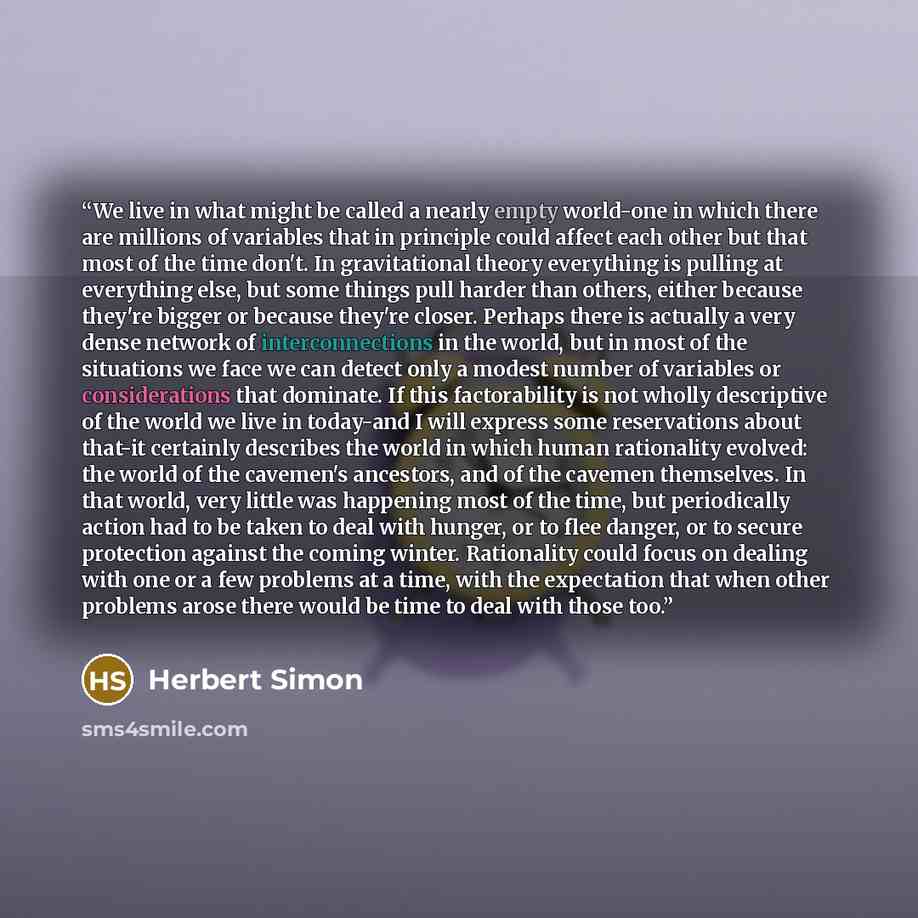
““We live in what might be called a nearly empty world-one in which there are millions of variables that in principle could affect each other but that most of the time don't. In gravitational theory everything is pulling at everything else, but some things pull harder than others, either because they're bigger or because they're closer. Perhaps there is actually a very dense network of interconnections in the world, but in most of the situations we face we can detect only a modest number of variables or considerations that dominate. If this factorability is not wholly descriptive of the world we live in today-and I will express some reservations about that-it certainly describes the world in which human rationality evolved: the world of the cavemen's ancestors, and of the cavemen themselves. In that world, very little was happening most of the time, but periodically action had to be taken to deal with hunger, or to flee danger, or to secure protection against the coming winter. Rationality could focus on dealing with one or a few problems at a time, with the expectation that when other problems arose there would be time to deal with those too.””
About This Quote
Source Book: The Sciences of the Artificial, Herbert Simon, 1969
Human rationality evolved in simple environments where few variables dominate, limiting our ability to handle complex interconnections.
In simple terms: Our minds are built for simple, few‑problem situations.
Key Takeaway
Simplify problems to match our cognitive limits.
Themes
cognitive limits
environmental simplicity
decision making
human evolution
complexity
Mood
reflective
analytical
Type
philosophical
practical
When to use this quote
- personal decision making
- risk assessment
- resource allocation
- strategic planning
Key Concepts
bounded rationality
environmental constraints
evolutionary psychology
Questions to Reflect On
- How do you simplify complex problems?
- When does simplification become a danger?
A Different Perspective
Assumes modern problems can be reduced to simple variables, which may overlook systemic risks.















![“[Stated in 1965:] Machines will be capable, within 20 years, of doing any work a man can do.” quote by Herbert Simon](https://sms4smile.com/quotes/img-quotes/462/herbert-simon-15495_ai_stated-in-1965-machines-will-be-capable_970980.jpg)