Death Quote by Herbert Marcuse
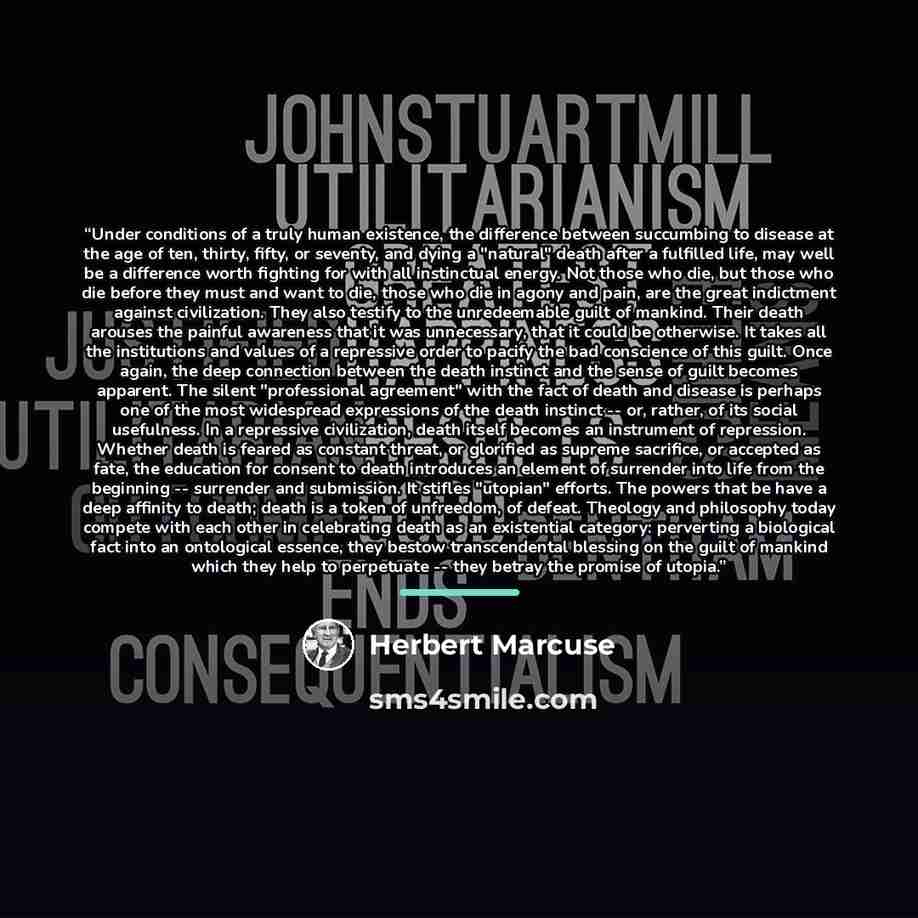
““Under conditions of a truly human existence, the difference between succumbing to disease at the age of ten, thirty, fifty, or seventy, and dying a "natural" death after a fulfilled life, may well be a difference worth fighting for with all instinctual energy. Not those who die, but those who die before they must and want to die, those who die in agony and pain, are the great indictment against civilization. They also testify to the unredeemable guilt of mankind. Their death arouses the painful awareness that it was unnecessary, that it could be otherwise. It takes all the institutions and values of a repressive order to pacify the bad conscience of this guilt. Once again, the deep connection between the death instinct and the sense of guilt becomes apparent. The silent "professional agreement" with the fact of death and disease is perhaps one of the most widespread expressions of the death instinct -- or, rather, of its social usefulness. In a repressive civilization, death itself becomes an instrument of repression. Whether death is feared as constant threat, or glorified as supreme sacrifice, or accepted as fate, the education for consent to death introduces an element of surrender into life from the beginning -- surrender and submission. It stifles "utopian" efforts. The powers that be have a deep affinity to death; death is a token of unfreedom, of defeat. Theology and philosophy today compete with each other in celebrating death as an existential category: perverting a biological fact into an ontological essence, they bestow transcendental blessing on the guilt of mankind which they help to perpetuate -- they betray the promise of utopia.””
About This Quote
Source Book: One-Dimensional Man, Herbert Marcuse, 1964
Civilization represses death, turning it into a tool of control; suffering deaths reveal guilt and the need for utopian resistance.
In simple terms: Society hides death, causing unnecessary suffering.
Key Takeaway
Challenge oppressive narratives about death.
Themes
politics
death
guilt
utopia
Mood
critical
provocative
Type
philosophical
political
When to use this quote
- healthcare policy
- elder care
- activism
- education reform
Key Concepts
critical theory
social control
Questions to Reflect On
- What societal structures perpetuate death as repression?
- How can we foster a culture that values life over death?
A Different Perspective
Changing deep‑seated beliefs is difficult and may meet resistance.
![“[Art] can speak its own language only as long as the images are alive which refuse and refute the established order.” quote by Herbert Marcuse](https://sms4smile.com/quotes/img-quotes/f06/herbert-marcuse-3589_alive_art-can-speak-its-own-language-only-as-l_17287.jpg)