Good enough Quote by George Saunders
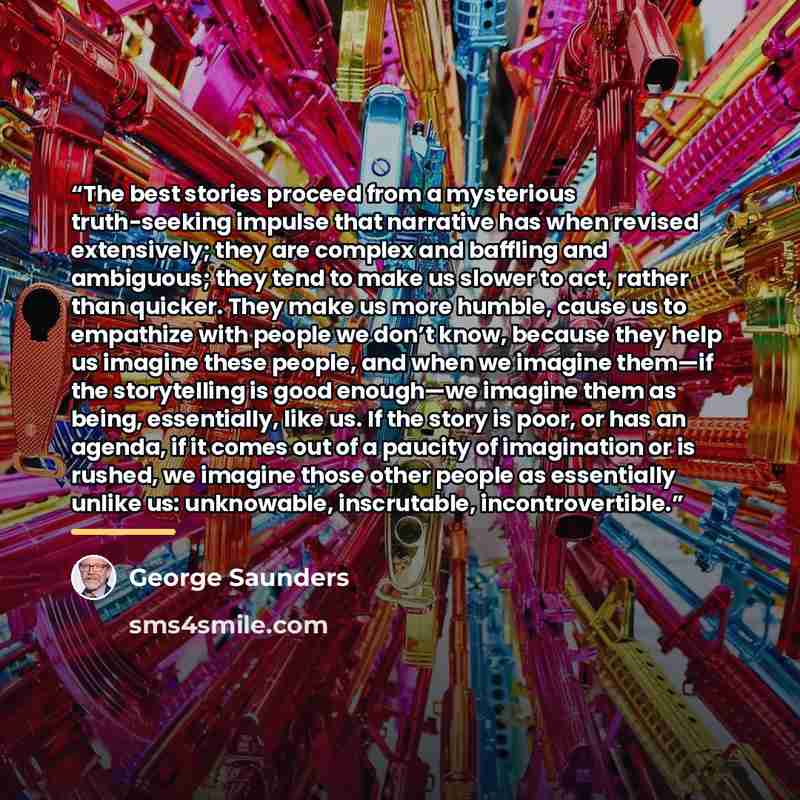
““The best stories proceed from a mysterious truth-seeking impulse that narrative has when revised extensively; they are complex and baffling and ambiguous; they tend to make us slower to act, rather than quicker. They make us more humble, cause us to empathize with people we don’t know, because they help us imagine these people, and when we imagine them—if the storytelling is good enough—we imagine them as being, essentially, like us. If the story is poor, or has an agenda, if it comes out of a paucity of imagination or is rushed, we imagine those other people as essentially unlike us: unknowable, inscrutable, incontrovertible.””
About This Quote
Source Essay: The Best Stories, The New Yorker, 2015
Stories that explore deep, ambiguous truths can slow our reactions, fostering humility and empathy by helping us see strangers as similar to ourselves.
In simple terms: Complex stories promote humility and empathy.
Key Takeaway
Seek nuanced narratives that challenge assumptions.
Themes
empathy
humility
storytelling
complexity
reflection
Mood
thoughtful
introspective
Type
literary
philosophical
When to use this quote
- reading literary fiction
- writing workshops
- diversity training
- cross‑cultural dialogue
Key Concepts
psychology
narrative theory
social cognition
Questions to Reflect On
- How does narrative complexity affect your willingness to act?
- What role does empathy play in interpreting ambiguous stories?
A Different Perspective
If a story is shallow or agenda‑driven, it can reinforce alienation instead of connection.