Blank mind Quote by George Saunders
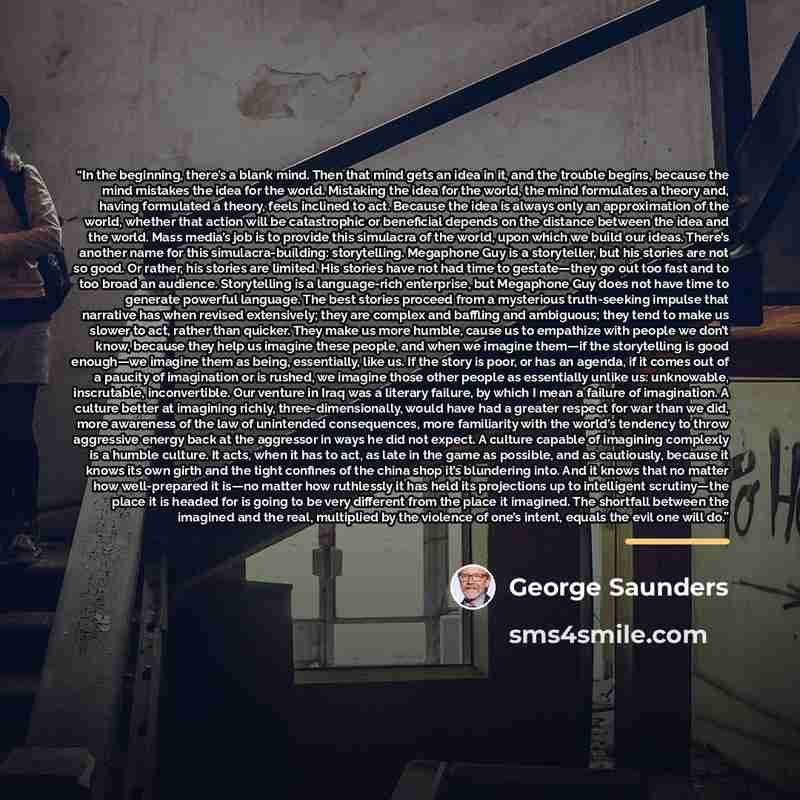
““In the beginning, there’s a blank mind. Then that mind gets an idea in it, and the trouble begins, because the mind mistakes the idea for the world. Mistaking the idea for the world, the mind formulates a theory and, having formulated a theory, feels inclined to act. Because the idea is always only an approximation of the world, whether that action will be catastrophic or beneficial depends on the distance between the idea and the world. Mass media’s job is to provide this simulacra of the world, upon which we build our ideas. There’s another name for this simulacra-building: storytelling. Megaphone Guy is a storyteller, but his stories are not so good. Or rather, his stories are limited. His stories have not had time to gestate—they go out too fast and to too broad an audience. Storytelling is a language-rich enterprise, but Megaphone Guy does not have time to generate powerful language. The best stories proceed from a mysterious truth-seeking impulse that narrative has when revised extensively; they are complex and baffling and ambiguous; they tend to make us slower to act, rather than quicker. They make us more humble, cause us to empathize with people we don’t know, because they help us imagine these people, and when we imagine them—if the storytelling is good enough—we imagine them as being, essentially, like us. If the story is poor, or has an agenda, if it comes out of a paucity of imagination or is rushed, we imagine those other people as essentially unlike us: unknowable, inscrutable, inconvertible. Our venture in Iraq was a literary failure, by which I mean a failure of imagination. A culture better at imagining richly, three-dimensionally, would have had a greater respect for war than we did, more awareness of the law of unintended consequences, more familiarity with the world’s tendency to throw aggressive energy back at the aggressor in ways he did not expect. A culture capable of imagining complexly is a humble culture. It acts, when it has to act, as late in the game as possible, and as cautiously, because it knows its own girth and the tight confines of the china shop it’s blundering into. And it knows that no matter how well-prepared it is—no matter how ruthlessly it has held its projections up to intelligent scrutiny—the place it is headed for is going to be very different from the place it imagined. The shortfall between the imagined and the real, multiplied by the violence of one’s intent, equals the evil one will do.””
About This Quote
Source Essay: The Unbearable Lightness of Media, 2015
Ideas are approximations of reality; acting on them without humility can cause harm, while rich storytelling fosters empathy and caution.
In simple terms: Ideas are imperfect; stories shape how we act.
Key Takeaway
Seek deeper imagination before acting.
Themes
imagination
media
storytelling
humility
consequences
Mood
thoughtful
critical
reflective
Type
philosophical
inspirational
When to use this quote
- political decision‑making
- media analysis
- war planning
- creative writing
- public discourse
Key Concepts
approximation
theory
simulation
empathy
humility
Questions to Reflect On
- How can we ensure stories foster empathy rather than division?
- What practices encourage humility in idea formation?
A Different Perspective
Rushed storytelling can mislead and dehumanize; not all narratives are equally reflective.