Parenting Quote by George Bernard Shaw
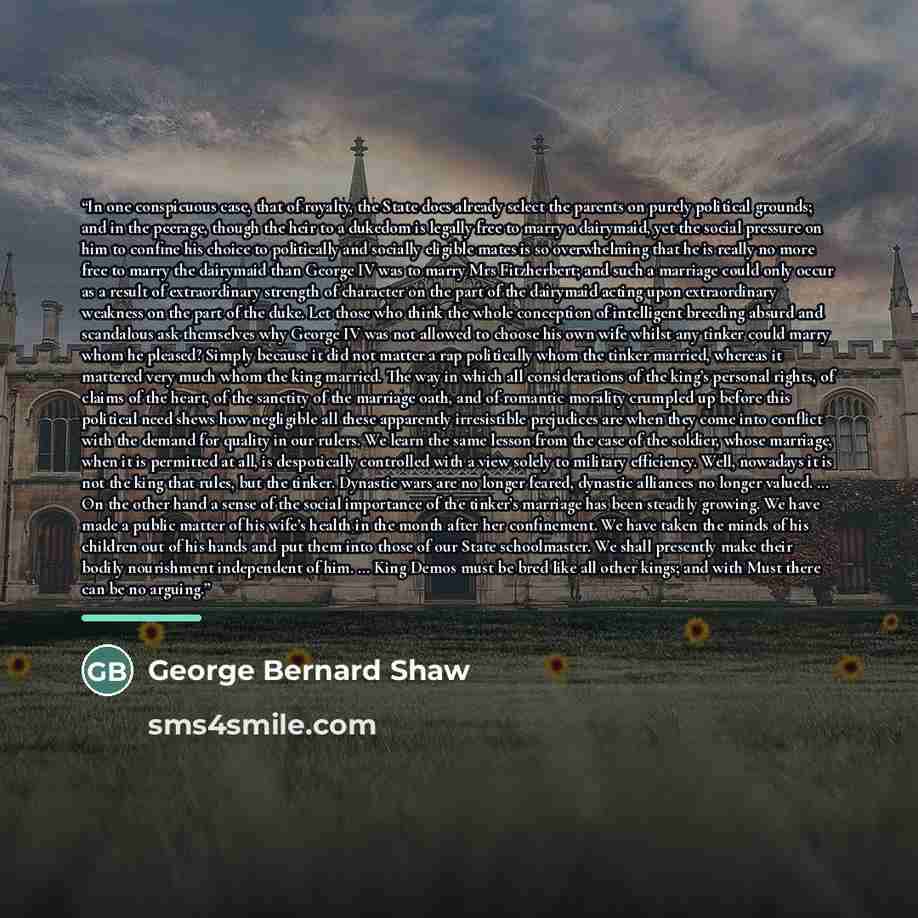
““In one conspicuous case, that of royalty, the State does already select the parents on purely political grounds; and in the peerage, though the heir to a dukedom is legally free to marry a dairymaid, yet the social pressure on him to confine his choice to politically and socially eligible mates is so overwhelming that he is really no more free to marry the dairymaid than George IV was to marry Mrs Fitzherbert; and such a marriage could only occur as a result of extraordinary strength of character on the part of the dairymaid acting upon extraordinary weakness on the part of the duke. Let those who think the whole conception of intelligent breeding absurd and scandalous ask themselves why George IV was not allowed to choose his own wife whilst any tinker could marry whom he pleased? Simply because it did not matter a rap politically whom the tinker married, whereas it mattered very much whom the king married. The way in which all considerations of the king’s personal rights, of claims of the heart, of the sanctity of the marriage oath, and of romantic morality crumpled up before this political need shews how negligible all these apparently irresistible prejudices are when they come into conflict with the demand for quality in our rulers. We learn the same lesson from the case of the soldier, whose marriage, when it is permitted at all, is despotically controlled with a view solely to military efficiency. Well, nowadays it is not the king that rules, but the tinker. Dynastic wars are no longer feared, dynastic alliances no longer valued. ... On the other hand a sense of the social importance of the tinker’s marriage has been steadily growing. We have made a public matter of his wife’s health in the month after her confinement. We have taken the minds of his children out of his hands and put them into those of our State schoolmaster. We shall presently make their bodily nourishment independent of him. ... King Demos must be bred like all other kings; and with Must there can be no arguing.””
About This Quote
Source Speech: Lecture on Social Reform, 1915
Political and social pressures dictate marriage choices for royalty, limiting personal freedom despite legal rights.
In simple terms: Royal marriages are controlled by politics, not love.
Key Takeaway
Recognize how power shapes personal decisions.
Themes
power
marriage
politics
social pressure
Mood
critical
thoughtful
Type
political
social
When to use this quote
- royal families
- political alliances
- social expectations
- legal rights
Key Concepts
class
authority
individual autonomy
Questions to Reflect On
- What would happen if personal love overrode political expectations?
- How can societies balance tradition with individual freedom?
A Different Perspective
Legal freedom may not translate into real choice without societal change.