Free thought Quote by G.K. Chesterton
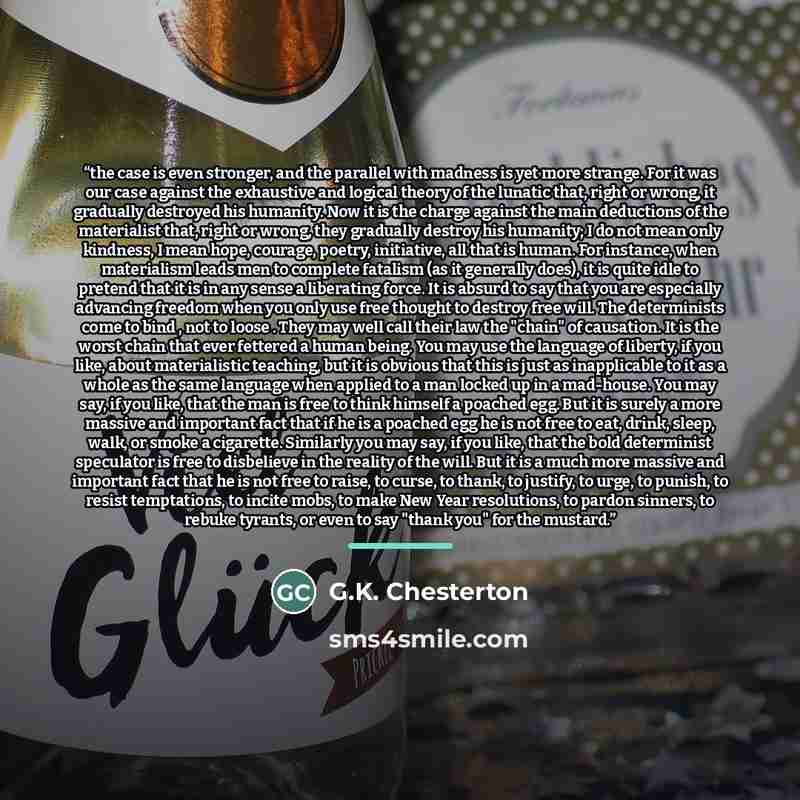
““the case is even stronger, and the parallel with madness is yet more strange. For it was our case against the exhaustive and logical theory of the lunatic that, right or wrong, it gradually destroyed his humanity. Now it is the charge against the main deductions of the materialist that, right or wrong, they gradually destroy his humanity; I do not mean only kindness, I mean hope, courage, poetry, initiative, all that is human. For instance, when materialism leads men to complete fatalism (as it generally does), it is quite idle to pretend that it is in any sense a liberating force. It is absurd to say that you are especially advancing freedom when you only use free thought to destroy free will. The determinists come to bind , not to loose . They may well call their law the "chain" of causation. It is the worst chain that ever fettered a human being. You may use the language of liberty, if you like, about materialistic teaching, but it is obvious that this is just as inapplicable to it as a whole as the same language when applied to a man locked up in a mad-house. You may say, if you like, that the man is free to think himself a poached egg. But it is surely a more massive and important fact that if he is a poached egg he is not free to eat, drink, sleep, walk, or smoke a cigarette. Similarly you may say, if you like, that the bold determinist speculator is free to disbelieve in the reality of the will. But it is a much more massive and important fact that he is not free to raise, to curse, to thank, to justify, to urge, to punish, to resist temptations, to incite mobs, to make New Year resolutions, to pardon sinners, to rebuke tyrants, or even to say "thank you" for the mustard.””
About This Quote
Source Essay: "The Man Who Was Thursday", 1908
Chesterton argues that materialist determinism erodes essential human qualities like hope and courage, turning freedom into a paradoxical chain.
In simple terms: Determinism can strip away what makes us human.
Key Takeaway
Guard humanity against purely logical doctrines.
Themes
philosophy
humanism
freedom
determinism
materialism
Mood
critical
thoughtful
serious
Type
philosophical
critical
When to use this quote
- academic debate
- political discourse
- personal reflection
- social policy
- education
Key Concepts
Existentialism
ethical critique
human dignity
Questions to Reflect On
- How does belief in free will shape ethical behavior?
- Can deterministic views coexist with humanistic values?
A Different Perspective
Determinism may also inspire creative resistance and moral responsibility.