Believe in god Quote by Frank Turek
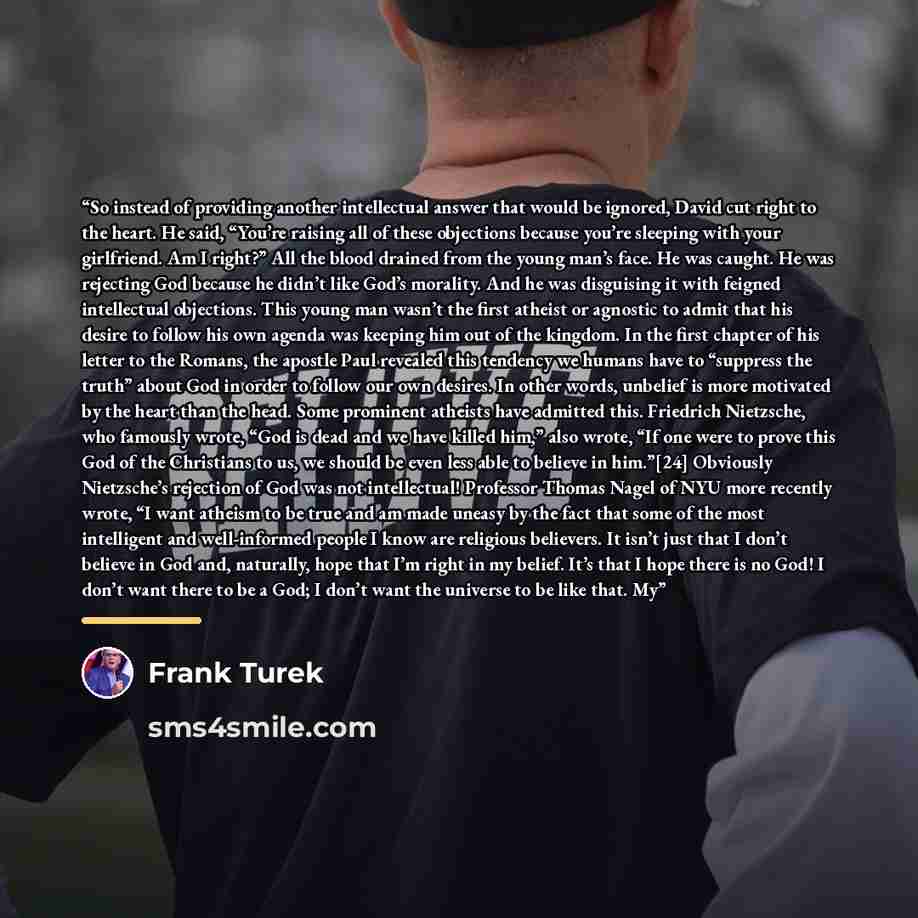
““So instead of providing another intellectual answer that would be ignored, David cut right to the heart. He said, “You’re raising all of these objections because you’re sleeping with your girlfriend. Am I right?” All the blood drained from the young man’s face. He was caught. He was rejecting God because he didn’t like God’s morality. And he was disguising it with feigned intellectual objections. This young man wasn’t the first atheist or agnostic to admit that his desire to follow his own agenda was keeping him out of the kingdom. In the first chapter of his letter to the Romans, the apostle Paul revealed this tendency we humans have to “suppress the truth” about God in order to follow our own desires. In other words, unbelief is more motivated by the heart than the head. Some prominent atheists have admitted this. Friedrich Nietzsche, who famously wrote, “God is dead and we have killed him,” also wrote, “If one were to prove this God of the Christians to us, we should be even less able to believe in him.”[24] Obviously Nietzsche’s rejection of God was not intellectual! Professor Thomas Nagel of NYU more recently wrote, “I want atheism to be true and am made uneasy by the fact that some of the most intelligent and well-informed people I know are religious believers. It isn’t just that I don’t believe in God and, naturally, hope that I’m right in my belief. It’s that I hope there is no God! I don’t want there to be a God; I don’t want the universe to be like that. My””
About This Quote
The passage contends that many atheists' objections to God stem from personal desires rather than pure intellect, citing historical thinkers to illustrate the heart‑driven nature of belief.
In simple terms: Unbelief often hides personal motives, not just logical arguments.
Key Takeaway
Desire can masquerade as intellectual dissent.
Themes
theology
philosophy
psychology
Mood
analytical
critical
Type
argumentative
philosophical
When to use this quote
- debates on faith
- academic discussions of belief
Key Concepts
motivational bias
cognitive dissonance
Practical Applications
- examine personal motives in belief dialogues
- use reflective questioning in apologetics
Questions to Reflect On
- What role do personal desires play in shaping one's worldview?
- How can we differentiate sincere intellectual doubt from self‑interest?
A Different Perspective
The argument may overgeneralize and dismiss genuine intellectual critiques of religion.


![“. . . [Nietzsche] had the good manners to despise Christianity, in large part, for what it actually was--above all, for its devotion to an ethics of compassion--rather than allow himself the soothing, self-righteous fantasy that Christianity’s history had been nothing but an interminable pageant…” quote by David Bentley Hart](https://sms4smile.com/quotes/img-quotes/c74/david-bentley-hart-4691_christian-faith_nietzsche-had-the-good-manners-to-despis_745509.jpg)